
Global Waterless Textile Dyeing Services Market Outlook 2026-2036: DyeCoo, Alchemie Technology & Kornit Digital Drive Sustainable Textile Transformation Across Asia and Europe
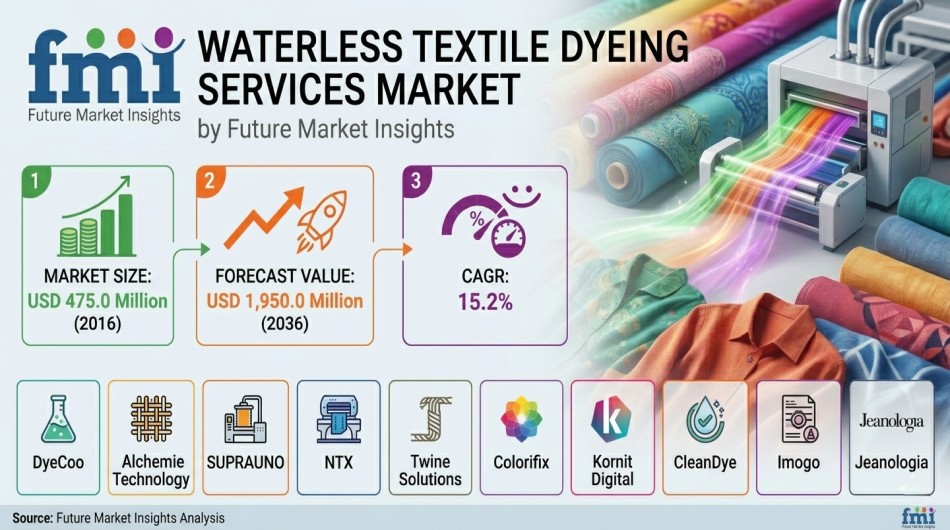 Waterless textile dyeing services gain momentum as brands seek sustainable, low-water production with scalable, audit-ready color solutions.
NEWARK, DE / ACCESS Newswire / May 12, 2026 / According to the latest analysis by Future Market Insights, the global Waterless Textile Dyeing Services Market is projected to grow from USD 475.0 million in 2026 to USD 1,950.0 million by 2036, expanding at a CAGR of 15.2% during the forecast period. The market is entering a new growth phase as apparel brands, textile mills, and dyehouses shift from pilot sustainability initiatives toward commercially scalable, low-water textile coloration services.
The market is being driven by rising scrutiny around textile wastewater, increasing demand for sustainable apparel sourcing, and growing adoption of waterless or near-waterless dyeing technologies such as supercritical CO2 dyeing, digital low-liquor dyeing, and bio-based coloration systems.
Unlike conventional dyeing operations, waterless textile dyeing services are emerging as performance-focused, audit-ready production solutions capable of reducing water consumption, lowering wastewater exposure, and supporting brand sustainability targets without requiring brands to own new dyeing infrastructure.
An FMI analyst notes:
Waterless dyeing services will not replace every dye bath in this decade. The strongest commercial route is more selective. Service providers that can qualify repeat colours, document water savings, and fit into existing brand approval systems will convert high-value programs first.
Get detailed market forecasts, competitive benchmarking, and pricing trends: https://www.futuremarketinsights.com/reports/sample/rep-gb-33061
Market Drivers and Strategic Shifts
The growing focus on environmental compliance and sustainable sourcing is transforming dyeing operations across global textile supply chains. Apparel brands are increasingly prioritizing supplier qualification programs that demonstrate measurable reductions in water usage and wastewater generation.
At the same time, export-oriented dyehouses and textile converters are adopting service-based partnerships to test waterless technologies before committing to large-scale capital investments.
Key growth drivers include:
Expansion of supercritical CO2 dyeing and digital low-liquor dyeing technologies
Rising demand for wastewater-free or low-water textile processing
Strong adoption in sportswear, athleisure, technical textiles, and performance apparel
Increasing preference for brand-approved production programs with repeatable colour performance
Growing buyer pressure on dyehouses to meet sustainability audit requirements
Rising textile water stress concerns across Asia's manufacturing hubs
However, the market also faces challenges such as fabric compatibility limitations, shade repeatability concerns, high technology qualification requirements, and slower conversion from pilot trials to recurring production programs.
Segment and Regional Insights
Supercritical CO2 dyeing services are projected to account for 31.0% share of technology demand in 2026 due to their ability to eliminate process water from selected synthetic dyeing applications.
Polyester and synthetic blends are expected to hold 46.0% share of fabric type demand in 2026, supported by stronger compatibility between synthetic fibres and CO2-based dyeing systems.
Brand-approved production programs are forecast to capture 41.0% share of service model demand as apparel brands increasingly prioritize audit-ready production with stable colour quality and repeatability.
Sportswear and performance apparel are expected to account for 34.0% share of end-use demand in 2026 because synthetic materials dominate these categories and sustainability reporting requirements are becoming stricter.
Regionally:
Bangladesh is projected to grow at 17.1% CAGR through 2036 due to stronger buyer audits and export sustainability pressures
Vietnam is forecast to expand at 16.8% CAGR as sportswear and synthetic apparel programs accelerate low-water dyeing trials
India is expected to register 16.4% CAGR as textile clusters explore lower-water finishing routes
China remains a major conversion market supported by deep textile processing capacity and technology access
Turkey is emerging as a strategic nearshore sourcing hub for European brands seeking cleaner dyeing solutions
Germany is seeing selective adoption across technical textiles and premium apparel categories
Countries such as Bangladesh, Vietnam, India, China, Turkey, and the United States are expected to lead both service adoption and innovation throughout the forecast period.
Competitive Landscape
The market remains fragmented across supercritical CO2 dyeing providers, digital dyeing technology firms, thread dyeing specialists, and bio-based coloration companies.
Key players include DyeCoo, Alchemie Technology, Twine Solutions, Colorifix, Kornit Digital, NTX, and SUPRAUNO.
Competitive strategies are increasingly centered on:
Fabric qualification and repeat colour consistency
Expansion of brand-approved production programs
Development of audit-ready water-saving documentation
Partnerships with textile mills, converters, and apparel brands
Scaling installed dyeing capacity across export manufacturing hubs
Commercialization of low-water and bio-based coloration technologies
Customize insights for your business strategy@ https://www.futuremarketinsights.com/customization-available/rep-gb-33061
Why FMI's Waterless Textile Dyeing Services Market Report Is Different
Traditional market research typically provides:
Market size, CAGR, and forecast
Basic segment and regional analysis
Company listings and high-level competition reviews
FMI delivers deeper operational and sourcing intelligence through:
Dyehouse qualification and supplier approval insights
Technology readiness and adoption benchmarking
Water reduction and wastewater exposure analysis
Fabric compatibility and colour repeatability assessment
Service pricing and production economics benchmarking
Buyer audit and compliance mapping
Regional textile processing and conversion analysis
Brand sourcing and sustainability program intelligence
Commercial adoption tracking across sportswear, technical textiles, and fashion apparel
Competitive positioning across CO2, digital, and bio-based coloration technologies
Why This Matters for Buyers
Supports sustainable sourcing and supplier qualification decisions
Helps apparel brands evaluate commercially viable low-water dyeing partners
Enables textile mills to test technologies before capital investment
Reduces compliance and wastewater-related operational risks
Improves transparency around colour consistency and process performance
Who Should Use This Report
Apparel brands and sourcing teams
Textile mills and dyehouses
Technology providers and textile innovators
Garment manufacturers and converters
Sustainability and compliance professionals
Investors and private equity firms
Technical textile and sportswear suppliers
Where It Supports Action
Source: Identify qualified low-water dyeing service providers
Manufacture: Evaluate scalable waterless production programs
Audit: Improve wastewater and sustainability compliance
Develop: Align textile innovation with brand sourcing needs
Partner: Build strategic mill and technology collaborations
Invest: Identify high-growth regional textile processing markets
Expand: Scale approved production capacity in export hubs
Compete: Benchmark service capabilities and technology positioning
Waterless Textile Dyeing Services Market Size & Industry Trends 2036
Market name: Waterless Textile Dyeing Services Market
Market size: USD 475.0 Million (2026)
Forecast value: USD 1,950.0 Million (2036)
CAGR: 15.2%
Forecast period: 2026 to 2036
Leading technology segment: Supercritical CO2 Dyeing Services (31.0% share)
Leading fabric segment: Polyester and Synthetic Blends (46.0% share)
Leading service model: Brand-Approved Production Programs (41.0% share)
Fastest-growing countries: Bangladesh, Vietnam, India
Key companies: DyeCoo, Alchemie Technology, SUPRAUNO, NTX, Twine Solutions, Colorifix, Kornit Digital, CleanDye, Imogo, Jeanologia
Unlock 360° insights for strategic decision making and investment planning@ https://www.futuremarketinsights.com/checkout/33061
Explore More Related Studies Published by FMI Research:
Textile Staples Market: https://www.futuremarketinsights.com/reports/textile-staples-market
Textile Colors Market: https://www.futuremarketinsights.com/reports/textile-colors-market
Textile Machine Lubricants Market: https://www.futuremarketinsights.com/reports/textile-machine-lubricants-market
Textile Coatings Market: https://www.futuremarketinsights.com/reports/textile-coatings-market
Textile Based pH Controllers Market: https://www.futuremarketinsights.com/reports/textile-based-ph-controllers-market
About Future Market Insights (FMI)
Future Market Insights (FMI) delivers actionable, decision-focused market intelligence that goes beyond traditional research reports. The company provides:
In-depth pricing and cost benchmarking analysis
Demand forecasting based on real industry inputs
Procurement and buyer behavior insights
Supply chain and trade flow intelligence
Technology adoption trends across industries
FMI follows a robust bottom-up research methodology, combining insights from industry experts, procurement leaders, textile manufacturers, and technical professionals to ensure accurate and practical market intelligence.
For Press & Corporate Inquiries
Rahul Singh
AVP - Marketing and Growth Strategy
Future Market Insights, Inc.
+91 8600020075
For Sales - [email protected]
For Media - [email protected]
For web - https://www.futuremarketinsights.com/
For Web : https://www.factmr.com/
SOURCE: Future Market Insights, Inc.