
Global Airborne Warning and Control System Market to Reach USD 12.89 Billion by 2036 as Defense Modernization Accelerates Worldwide
 AI-Driven Sensor Fusion, Defense Modernization Programs, and Rising Multi-Domain Threats Accelerate Global Airborne Warning and Control System (AWACS) Market Growth Through 2036
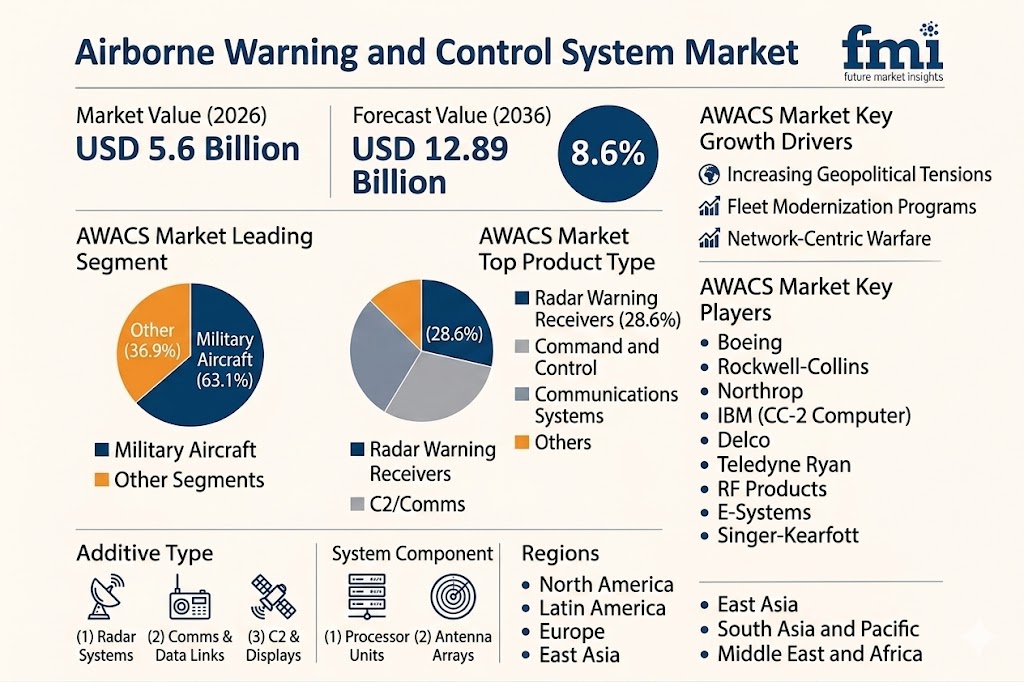
NEWARK, DE / ACCESS Newswire / April 28, 2026 / According to the latest analysis by Future Market Insights, the global airborne warning and control system market is entering a new phase of strategic expansion, driven by rising geopolitical tensions, multi-domain warfare demands, and accelerated defense modernization programs. Valued at USD 5.6 billion in 2026, the market is projected to surge to USD 12.89 billion by 2036, registering a robust CAGR of 8.6% over the forecast period.
According to the latest analysis by Future Market Insights (FMI), the growth trajectory is being shaped not just by new aircraft procurement, but by large-scale upgrades of legacy AWACS fleets with next-generation radar, communication, and AI-enabled systems.
Get detailed market forecasts, competitive benchmarking, and pricing trends:
https://www.futuremarketinsights.com/reports/sample/rep-gb-750
Quick Facts & Market Snapshot
Market Value (2026): USD 5.6 Billion
Forecast Value (2036): USD 12.89 Billion
CAGR (2026-2036): 8.6%
Incremental Opportunity: USD 7.24 Billion
Leading Segment: Military Aircraft (63.1% Share)
Top Product Type: Radar Warning Receivers (28.6% Share)
Fastest Growing Markets: South Korea (8.9%), UK (8.7%)
The Strategic Shift: From Surveillance to Multi-Domain Command
Modern AWACS platforms are no longer limited to airborne surveillance. They are evolving into integrated command-and-control hubs capable of real-time battlefield management.
"Defense forces are prioritizing AI-enabled sensor fusion and multi-domain coordination capabilities," notes an FMI analyst. "The ability to process vast streams of radar and electronic intelligence data in real time is becoming a decisive operational advantage."
This transformation is fueling demand for:
Advanced radar systems with extended detection range
AI-powered threat identification and response
Integrated communication systems for joint-force coordination
Technology Evolution: AI and Sensor Fusion Take Center Stage
The next generation of AWACS systems is defined by rapid advancements in core technologies:
Radar Technology: Remains dominant, with AESA radar systems enabling faster tracking and improved stealth detection
Sensor Fusion: Integrates data from multiple sources for a unified operational picture
Artificial Intelligence: Enables automated threat classification and decision support
Communication Systems: Enhances interoperability across allied defense networks
These innovations are transforming AWACS into intelligent airborne command centers capable of supporting complex military operations.
Segment Insights: Military Aircraft and Radar Systems Lead
Military Aircraft Dominate Platform Demand
Accounting for 63.1% of the market, military aircraft remain the primary deployment platform. Fixed-wing systems such as AWACS and electronic warfare aircraft continue to drive procurement and upgrades.
Radar Warning Receivers Anchor Product Demand
With a 28.6% market share, radar warning receivers serve as the backbone of electronic threat detection, offering:
Real-time radar signal identification
Threat classification and geolocation
Enhanced situational awareness for pilots and operators
Access the Complete Report in PDF Format: https://www.futuremarketinsights.com/reports/brochure/rep-gb-750
Regional Outlook: Asia-Pacific Emerges as Growth Engine
South Korea Leads Global Growth (8.9% CAGR)
Rapid defense modernization and indigenous platform development are propelling South Korea to the forefront of market expansion.
United Kingdom and Europe Maintain Strong Momentum
The UK (8.7% CAGR) and the European Union (8.5%) are investing heavily in AWACS fleet upgrades and NATO interoperability programs.
North America Remains the Largest Market
Driven by significant U.S. defense spending, particularly in fleet replacement programs such as the E-7A Wedgetail, North America continues to dominate global revenues.
Market Drivers: Defense Spending and Evolving Threat Landscapes
The AWACS market is gaining momentum due to:
Defense Modernization Programs: Across NATO and Indo-Pacific nations
Rising Geopolitical Tensions: Increasing need for real-time surveillance and control
Fleet Upgrade Initiatives: Extending lifecycle of existing AWACS platforms
Multi-Domain Warfare: Demand for integrated air, land, and sea operations
Challenges: Budget Constraints and Long Procurement Cycles
Despite strong growth potential, the market faces structural challenges:
Lengthy defense procurement timelines
Budget allocation constraints across nations
High development and integration costs
Complex regulatory and interoperability requirements
These factors often delay new platform acquisitions, shifting near-term demand toward upgrades.
Competitive Landscape: Innovation and Integration Define Leadership
The market is highly competitive, with key players focusing on advanced systems integration and long-term defense contracts. Leading companies include:
Boeing - Leading AWACS platforms (E-7A Wedgetail, E-3 Sentry)
Northrop Grumman - Advanced radar and electronic warfare systems
Collins Aerospace - Avionics and communication systems
Emerging players such as Saab AB, Thales Group, and Israel Aerospace Industries are strengthening competition with innovative surveillance and electronic warfare solutions.
The Outlook: A Core Pillar of Modern Warfare
By 2036, airborne warning and control systems will become indispensable to modern military strategy. As warfare evolves toward faster, data-driven decision-making, AWACS platforms will play a central role in enabling:
Real-time situational awareness
Integrated command and control
Enhanced threat detection and response
With continuous advancements in AI, radar, and sensor fusion technologies, the AWACS market is set to remain a cornerstone of global defense infrastructure.
Buy Report: Unlock 360° insights for strategic decision making and investment planning:
https://www.futuremarketinsights.com/checkout/750
Related Reports:
Noise Control System Market- https://www.futuremarketinsights.com/reports/noise-control-system-market
Vibration Control Systems Market- https://www.futuremarketinsights.com/reports/vibration-control-systems-market
Machine Control System Market- https://www.futuremarketinsights.com/reports/machine-control-system-market
About Future Market Insights (FMI)
Future Market Insights (FMI) is a leading provider of market intelligence and consulting services, serving clients in over 150 countries. Headquartered in Delaware, USA, with a global delivery center in India and offices in the UK and UAE, FMI delivers actionable insights to businesses across industries including automotive, technology, consumer products, manufacturing, energy, and chemicals.
An ESOMAR-certified research organization, FMI provides custom and syndicated market reports and consulting services, supporting both Fortune 1,000 companies and SMEs. Its team of 300+ experienced analysts ensures credible, data-driven insights to help clients navigate global markets and identify growth opportunities.
For Press & Corporate Inquiries
Rahul Singh
AVP - Marketing and Growth Strategy
Future Market Insights, Inc.
+91 8600020075
For Sales - [email protected]
For Media - [email protected]
For web - https://www.futuremarketinsights.com/
SOURCE: Future Market Insights, Inc.