
Smart Industrial Illumination Market to Surpass USD 20.5 Billion by 2036 as Factories Shift from Basic LED Retrofits to Intelligent Lighting Ecosystems
 Smart Industrial Illumination Market Gains Momentum as Connected Lighting, Energy Optimization, and Industrial Automation Transform Global Warehouses and Smart Factories
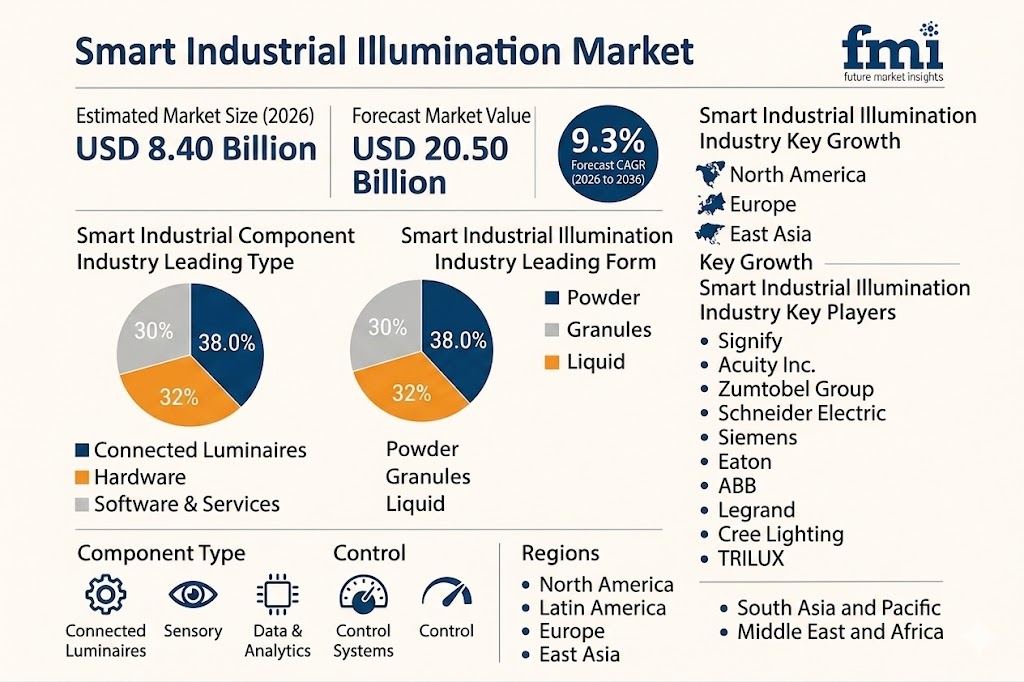
NEWARK, DE / ACCESS Newswire / May 11, 2026 / According to the latest analysis by Future Market Insights, the global smart industrial illumination market is entering a new phase of accelerated transformation as industrial facilities increasingly adopt connected lighting systems to improve energy efficiency, operational intelligence, and workplace safety. According to the latest analysis by Future Market Insights (FMI), the market is projected to grow from USD 8.40 billion in 2026 to USD 20.50 billion by 2036, registering a robust CAGR of 9.3% during the forecast period.
What was once considered a simple lighting upgrade has evolved into a strategic digital infrastructure investment. Today's industrial lighting systems are becoming intelligent data networks capable of measuring occupancy, tracking assets, supporting predictive maintenance, and integrating seamlessly with broader building automation systems.
Get detailed market forecasts, competitive benchmarking, and pricing trends:
https://www.futuremarketinsights.com/reports/sample/rep-gb-33057
Quick Stats: Smart Industrial Illumination Market
Market Value (2025): USD 7.69 Billion
Estimated Market Size (2026): USD 8.40 Billion
Forecast Market Value (2036): USD 20.50 Billion
Forecast CAGR (2026 to 2036): 9.3%
Incremental Opportunity Created: USD 12.10 Billion
Leading Component Segment: Connected Luminaires
Connected Luminaires Share (2026): 38.0%
The Rise of "Lighting-as-Intelligence"
Industrial operators are no longer evaluating lighting solely on brightness or fixture lifespan. The focus has shifted toward measurable operational outcomes.
This transformation is being fueled by multiple converging trends:
Rising global energy-efficiency mandates
Corporate decarbonization commitments
Rapid expansion of warehouses and smart factories
Increasing adoption of industrial automation
Demand for audit-ready operational data
Industrial facilities are now integrating lighting systems with occupancy sensors, automation software, and centralized controls to optimize power usage by zone and time-of-day. In many modern facilities, luminaires are becoming ceiling-mounted data nodes that feed real-time operational insights into broader factory management systems.
Connected Luminaires Dominate the Technology Shift
Among all product categories, connected luminaires are expected to account for 38.0% of component demand in 2026, reflecting growing preference for fixtures that combine illumination with sensing and control capabilities.
Smart nodes are projected to represent 31.0% share as sensing functionality increasingly moves closer to the fixture level.
Hybrid connectivity solutions are emerging as the dominant architecture, projected to hold 44.0% of connectivity demand in 2026. Industrial operators are combining the reliability of wired systems such as DALI with the flexibility of wireless BLE sensors in retrofit-heavy environments where rewiring can disrupt operations.
The market's transition is also being accelerated by advancements in industrial-grade controls and lighting software platforms that allow:
Zone-level occupancy management
Automated daylight harvesting
Remote monitoring and diagnostics
Predictive maintenance alerts
Energy reporting and compliance verification
Asset tracking across warehouses and plants
Warehouses and Smart Factories Become Core Growth Engines
Warehouses are projected to account for 36.0% of end-use demand in 2026 as logistics operators modernize facilities to support e-commerce fulfillment and automated material handling systems.
Modern warehouse environments increasingly require dynamic lighting systems capable of adjusting to:
Real-time occupancy patterns
Shift schedules
Robotic movement pathways
Dock activity fluctuations
Safety-critical operational zones
At the same time, manufacturing plants are rapidly integrating smart industrial illumination into broader Industry 4.0 strategies. Lighting infrastructure is becoming a critical layer within industrial automation ecosystems, enabling facilities to combine energy optimization with operational intelligence.
Factories are particularly prioritizing sensor-enabled luminaires that improve:
Worker visibility
Safety compliance
Inspection accuracy
Equipment monitoring
Predictive maintenance workflows
Cold storage facilities are also emerging as an important adoption segment due to the low-heat output and energy efficiency advantages of connected LED systems.
Access the Complete Report in PDF Format: https://www.futuremarketinsights.com/reports/brochure/rep-gb-33057
Regional Outlook: Asia-Pacific Leads the Next Growth Wave
While North America and Europe continue to maintain strong industrial retrofit activity, Asia-Pacific is emerging as the fastest-growing regional opportunity for smart industrial illumination.
South Korea Leads Global Growth
South Korea is projected to register the fastest CAGR globally at 11.5% through 2036 as factory automation initiatives and government-backed smart manufacturing programs accelerate connected lighting adoption.
Manufacturers in South Korea are increasingly deploying sensor-linked lighting systems that support autonomous factory operations and industrial robotics integration.
Japan Accelerates Industrial Decarbonization
Japan is forecast to expand at 10.9% CAGR as manufacturers intensify efforts to reduce industrial carbon emissions and improve facility-level energy management.
Japanese industrial operators are especially focused on lighting systems that combine energy savings with predictive maintenance and inspection-quality improvements.
United Kingdom and Germany Focus on Energy Efficiency
The UK market is projected to grow at 10.2% CAGR, supported by rising retrofit activity across non-domestic buildings and tightening energy management standards.
Germany, forecast to expand at 9.6% CAGR, continues to prioritize connected lighting investments as industrial operators seek tighter control over electricity usage and operational efficiency.
India Emerges as a High-Potential Greenfield Market
India is expected to record 8.7% CAGR through 2036 as the expansion of industrial parks and manufacturing corridors drives large-scale greenfield lighting opportunities.
The development of plug-and-play industrial parks and smart industrial zones is creating strong demand for integrated luminaires, gateways, and control platforms.
China Strengthens Smart Factory Deployment
China is projected to grow at 8.4% CAGR as large-scale smart factory initiatives continue expanding across manufacturing sectors.
The country's rapid industrial digitalization is significantly increasing demand for networked luminaires, smart nodes, and centralized lighting software platforms.
Technology Evolution Drives Higher Project Value
One of the defining characteristics of the market is the shift from commodity lighting products to controls-led intelligent infrastructure projects.
This evolution is increasing average project value as software platforms, sensors, and recurring service contracts become central to industrial lighting deployments.
Modern smart industrial illumination systems increasingly include:
Embedded occupancy sensing
Real-time energy analytics
Fixture health monitoring
Integration with building automation systems
AI-driven optimization tools
Cloud-based reporting dashboards
As industrial operators prioritize measurable operational performance, suppliers capable of delivering integrated hardware-software ecosystems are gaining competitive advantage.
Market Challenges: Integration Complexity and Retrofit Risk
Despite strong long-term growth potential, the industry faces several operational and technical challenges.
One of the primary barriers remains integration complexity between modern connected luminaires and legacy industrial control infrastructure. Many facilities continue to operate mixed environments that combine older switchgear with advanced digital control systems.
This creates challenges related to:
Commissioning timelines
Protocol compatibility
Retrofit downtime
Handover reliability
System interoperability
Industrial buyers are increasingly favoring vendors that support open protocols and demonstrate strong integration capabilities across complex multi-site environments.
Competitive Landscape: Platform Strength Defines Market Leadership
Competition within the smart industrial illumination market is increasingly centered on platform depth, integration capability, and project delivery expertise.
Leading global players include:
Signify
Acuity Inc.
Zumtobel Group
TRILUX
Cree Lighting
Schneider Electric
Siemens
ABB
Eaton
Legrand
Signify remains one of the market leaders due to its large-scale connected lighting ecosystem and Interact platform, which supports centralized real-time control across industrial and professional indoor spaces worldwide.
Meanwhile, automation-focused companies such as Schneider Electric, Siemens, and ABB are differentiating themselves by integrating lighting controls into broader smart-building and industrial automation ecosystems.
Buy Report: Unlock 360° insights for strategic decision making and investment planning:
https://www.futuremarketinsights.com/checkout/33057
The Outlook: Industrial Lighting Becomes a Strategic Digital Asset
By 2036, smart industrial illumination is expected to become a foundational layer of industrial digital infrastructure rather than a standalone building utility.
As factories, warehouses, and logistics centers evolve into intelligent environments, lighting networks will increasingly function as real-time sensing and data platforms that support energy optimization, worker safety, automation, and predictive operations.
The future of industrial lighting is no longer about illumination alone-it is about creating measurable intelligence across every square meter of industrial space.
Related Reports:
Industrial Nailers Market- https://www.futuremarketinsights.com/reports/industrial-nailers-market
Industrial Furnace Market- https://www.futuremarketinsights.com/reports/industrial-furnaces-market
Industrial Robotic Motors Market- https://www.futuremarketinsights.com/reports/industrial-robotic-motors-market
Industrial Coupling Market- https://www.futuremarketinsights.com/reports/industrial-coupling-market
About Future Market Insights (FMI)
Future Market Insights (FMI) is a leading provider of market intelligence and consulting services, serving clients in over 150 countries. Headquartered in Delaware, USA, with a global delivery center in India and offices in the UK and UAE, FMI delivers actionable insights to businesses across industries including automotive, technology, consumer products, manufacturing, energy, and chemicals.
An ESOMAR-certified research organization, FMI provides custom and syndicated market reports and consulting services, supporting both Fortune 1,000 companies and SMEs. Its team of 300+ experienced analysts ensures credible, data-driven insights to help clients navigate global markets and identify growth opportunities.
For Press & Corporate Inquiries
Rahul Singh
AVP - Marketing and Growth Strategy
Future Market Insights, Inc.
+91 8600020075
For Sales - [email protected]
For Media - [email protected]
For web - https://www.futuremarketinsights.com/
For Web - https://www.factmr.com/
SOURCE: Future Market Insights, Inc.