
Microbial Seed Treatment Market to Reach USD 5.0 Billion by 2036 as Biological Crop Protection and Seed-Applied Technologies Gain Commercial Momentum
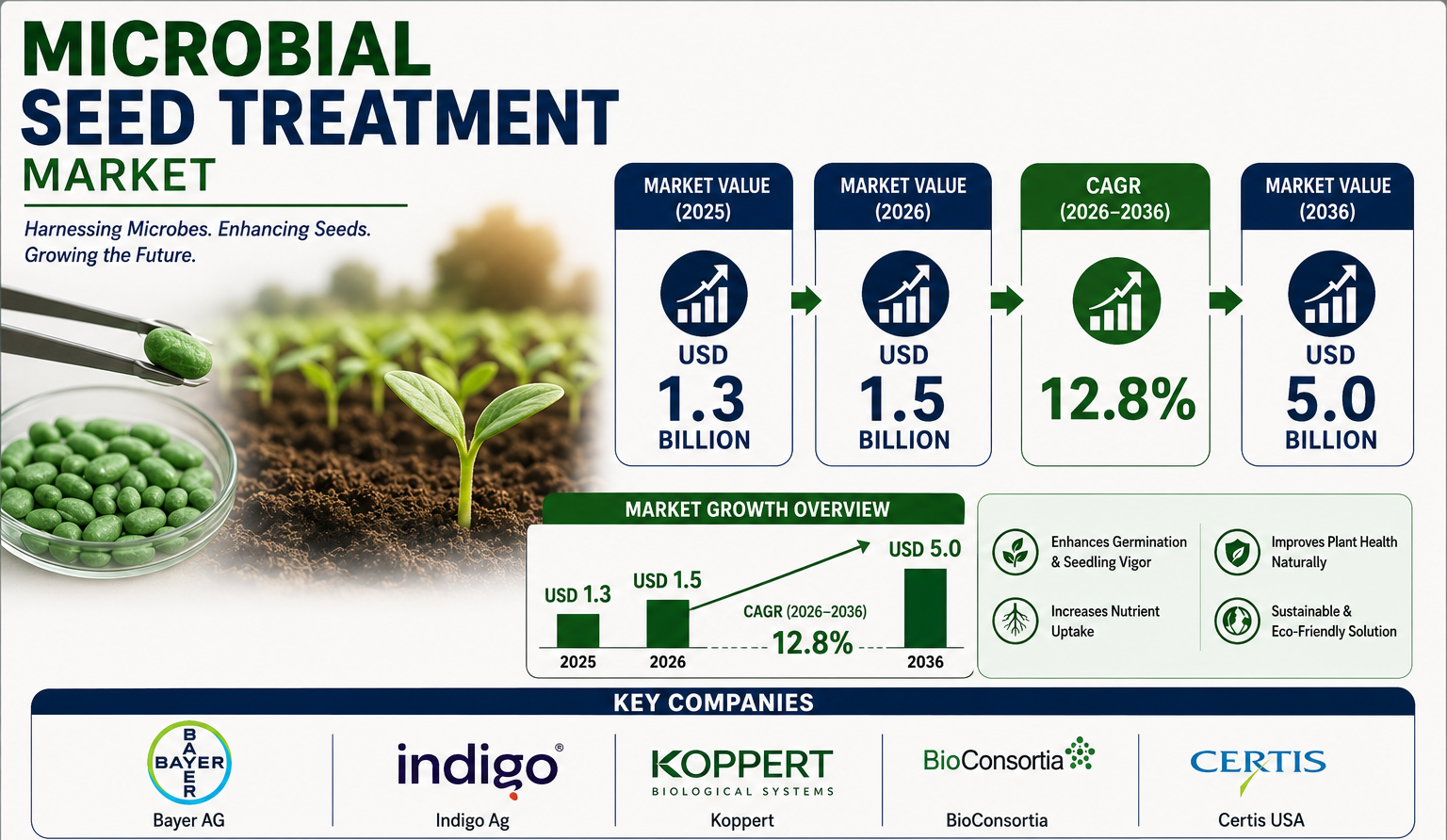 The global microbial seed treatment market is entering a high-growth phase driven by rising demand for biological crop protection, expanding use of seed-applied microbial technologies, and increasing pressure to reduce chemical pesticide dependence across commercial farming systems.
NEWARK, DE / ACCESS Newswire / May 14, 2026 / According to the latest insights by Future Market Insights (FMI), the global Microbial Seed Treatment Market is transitioning from a niche biological input category into a scalable agricultural crop protection segment as seed companies, distributors, and commercial farms increasingly prioritize microbial products that improve early crop establishment, fungal resistance, and nutrient availability. Long-term market expansion is being supported by regulatory pressure on pesticide usage, rising cereal and oilseed acreage, and increasing adoption of sustainable farming solutions.
Quick Stats: Microbial Seed Treatment Market
Market Size (2025): USD 1.3 billion
Market Size (2026): USD 1.5 billion
Projected Market Value (2036): USD 5.0 billion
Forecast CAGR (2026-2036): 12.8%
Leading Treatment Segment: Fungicides (37.0%)
Leading Application Method: Foliar Spray (41.5%)
Leading Formulation Type: Liquid Formulation (44.2%)
Leading Mode of Action: Systemic Action (46.8%)
Leading End-Use Segment: Commercial Farming (52.6%)
Fastest Growing Markets: China, India, Germany
Get detailed market forecasts, competitive benchmarking, and pricing trends: https://www.futuremarketinsights.com/reports/sample/rep-gb-776
A Market Increasingly Defined by Biological Seed Protection and Sustainable Farming
Microbial seed treatment technologies are becoming increasingly important within modern crop production systems as growers seek alternatives to chemical-intensive farming programs. Seed-stage microbial protection is gaining commercial momentum because microbial treatments can improve crop establishment, root development, nutrient access, and early-stage disease resistance while reducing pesticide load.
Manufacturers are increasingly prioritizing:
Shelf-stable microbial formulations
Seed coating compatibility
Systemic biological protection
Nutrient-access biofertility solutions
Commercial seed-treatment integration
Crop-specific microbial strain development
The market is also benefiting from rising grower demand for sustainable agricultural inputs that improve stand quality without adding operational complexity during planting and seed handling.
Market Forecast: Biological Crop Protection Supports Long-Term Growth
The microbial seed treatment market is expected to maintain strong long-term expansion as biological crop protection adoption accelerates across cereals, oilseeds, and commercial farming systems.
Fungicide-based microbial treatments are projected to account for 37.0% of market demand in 2026 due to increasing concern around seedborne fungal diseases and early-stage crop loss.
Liquid formulations are expected to dominate with 44.2% market share because commercial seed-treatment facilities increasingly require:
Uniform seed coating
Stable microbial delivery
Efficient blending systems
Compatibility with seed-treatment machinery
Reduced handling complexity
Systemic-action microbial products are projected to secure 46.8% share as growers increasingly prioritize treatments capable of entering young plants and protecting seedlings during vulnerable emergence stages.
Why Early Crop Protection and Biofertility Continue Driving Demand
Seed-applied biological protection remains the strongest commercial foundation for the microbial seed treatment market.
Demand is increasingly linked to:
Early-stage fungal disease control
Improved seedling vigor
Nitrogen and phosphate availability
Reduced pesticide dependency
Enhanced crop establishment
Better root development
Unlike conventional crop protection programs that rely heavily on post-emergence spraying, microbial seed treatments provide targeted biological activity directly at the seed stage, improving early crop performance and reducing stand loss risk.
Large commercial farms are increasingly prioritizing microbial products that fit existing seed treatment infrastructure without disrupting operational workflows.
Regulatory Pressure Is Accelerating Biological Seed Treatment Adoption
Regulatory pressure on pesticide use is strengthening demand for seed-focused biological crop protection technologies.
Governments and agricultural agencies are increasingly supporting:
Reduced chemical pesticide load
Sustainable agriculture initiatives
Biological crop protection programs
Low-residue farming systems
Environmentally compliant seed technologies
Seed companies are also favoring microbial products that integrate into existing coating systems while maintaining viable microbial activity during storage and transportation.
Customize insights for your business strategy: https://www.futuremarketinsights.com/customization-available/rep-gb-776
Regional Analysis: China and India Lead Global Growth
China Leads Global Growth (16.5% CAGR)
China is projected to remain the fastest-growing microbial seed treatment market through 2036 due to:
Large cereal acreage
Expanding biological input adoption
Commercial seed-treatment infrastructure growth
Increasing microbial product trials
Rising demand for early-stage crop protection
Large-scale wheat, maize, and rice programs are creating substantial demand for microbial coatings capable of improving crop establishment and reducing fungal pressure.
India Strengthens Biological Farming Expansion
India is expected to grow at 15.2% CAGR due to:
Government-backed biological farming initiatives
Expanding dealer-led seed distribution
Growing adoption of sustainable farming inputs
Increasing demand for affordable crop protection solutions
Commercial farms and cooperative seed networks are increasingly introducing microbial inoculants and seed-applied biofertility products across rice and wheat cultivation systems.
Germany Focuses on Biological Compliance and Crop Protection
Germany continues expanding microbial seed treatment adoption through:
Strict crop-input regulations
Biological cereal treatment programs
Residue-reduction farming initiatives
Technical validation requirements
Sustainable agricultural policies
European crop-input buyers increasingly prioritize microbial products supported by regulatory documentation and field-performance evidence.
Brazil Supports Commercial Seed Treatment Expansion
Brazil's soybean and maize systems are creating strong opportunities for microbial seed technologies due to:
Commercial-scale treated seed use
Broad-acre farming economics
Large seasonal planting windows
Demand for improved crop vigor
Rising biological agriculture adoption
Competitive Landscape: Biological Innovation and Seed Compatibility Matter Most
The microbial seed treatment market remains highly innovation-driven, with suppliers competing through microbial strain performance, seed-coating compatibility, and biological efficacy.
Key companies include:
Bayer AG
Syngenta Group
Indigo Ag, Inc.
Koppert
BioConsortia
Valent BioSciences
Corteva
Certis USA L.L.C.
Heliae Development LLC
VensoGrow
Competition is increasingly centered around:
Microbial strain development
Shelf-life stability
Seed treatment compatibility
Crop-specific field validation
Biological nutrient enhancement
Commercial seed-treatment integration
Distributor partnerships
Strategic Implications for Industry Stakeholders
For Seed Companies: Microbial products that integrate with existing seed-coating systems while maintaining storage stability are becoming increasingly attractive.
For Biological Input Suppliers: Field-validation data, microbial viability, and coating compatibility are emerging as critical competitive differentiators.
For Commercial Farms: Biological seed treatments offer opportunities to improve crop establishment while reducing reliance on field-applied chemical pesticides.
For Investors: Biological agriculture and sustainable crop protection technologies continue presenting strong long-term growth opportunities globally.
Unlock 360° insights for strategic decision making and investment planning: https://www.futuremarketinsights.com/checkout/776
Future Outlook: Biological Seed Treatments Will Become a Mainstream Crop Protection Category
The microbial seed treatment market is expected to evolve from trial-stage biological adoption into a commercially standardized agricultural input category.
Over the next decade:
Biological seed fungicides will gain larger commercial share
Biofertility seed treatments will expand rapidly
Commercial seed-treatment integration will improve adoption
Regulatory support for biological crop protection will strengthen
Large cereal and oilseed programs will drive scalable market growth
Sustainable agriculture initiatives will accelerate microbial adoption
Executive Takeaways
Microbial seed treatment demand is increasingly driven by biological crop protection and sustainable farming trends
Commercial farming remains the largest end-use segment
Liquid microbial formulations dominate due to seed-coating compatibility
China and India represent the fastest-growing adoption markets
Competitive advantage increasingly depends on strain stability and field-performance validation
Regulatory pressure on pesticide reduction continues supporting biological seed treatment adoption
Related Reports:
Protease Market: https://www.futuremarketinsights.com/reports/protease-market
Grape Seed Extracts Market: https://www.futuremarketinsights.com/reports/grape-seed-extracts-market
Stigmasterol-Rich Plant Sterols Market: https://www.futuremarketinsights.com/reports/stigmasterol-rich-plant-sterols-market
Botanical CO2 Extracts Market: https://www.futuremarketinsights.com/reports/botanical-co2-extracts-market
Mediterranean Pre-Diabetes Ingredient Concepts Market: https://www.futuremarketinsights.com/reports/mediterranean-pre-diabetes-ingredient-concepts-market
About Future Market Insights (FMI)
Future Market Insights (FMI) delivers actionable, decision-focused market intelligence that goes beyond traditional research reports. The company provides:
In-depth pricing and cost benchmarking analysis
Demand forecasting based on real industry inputs
Procurement and buyer behavior insights
Supply chain and trade flow intelligence
Technology adoption trends across industries
FMI follows a robust bottom-up research methodology, combining insights from industry experts, procurement leaders, and technical professionals to ensure accurate and practical market intelligence.
For Press & Corporate Inquiries
Rahul Singh
AVP - Marketing and Growth Strategy
Future Market Insights, Inc.
+91 8600020075
For Sales - [email protected]
For Media - [email protected]
For web - https://www.futuremarketinsights.com/
For Web - https://www.factmr.com/
SOURCE: Future Market Insights, Inc.