
Global PCR Thermoforms Market Forecast 2026-2036: India Leads Circular Push, Amcor, Faerch Gain Edge
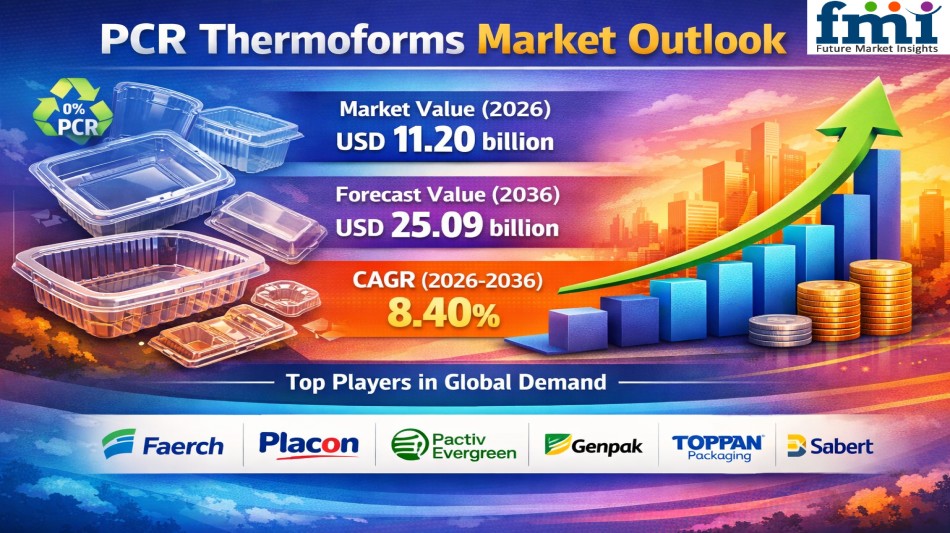 Packaging shifts from cost focus to compliance-led circular strategies, driving PCR thermoforms growth through regulation, sustainability mandates, and supply chain transformation.
NEWARK, DE / ACCESS Newswire / April 8, 2026 / The global PCR (Post-Consumer Recycled) Thermoforms Market is entering a decisive transformation phase, driven by regulatory enforcement, retailer mandates, and corporate sustainability commitments. According to the latest analysis, the market is valued at USD 11.20 billion in 2026, up from USD 10.33 billion in 2025, and is projected to reach USD 25.09 billion by 2036, expanding at a CAGR of 8.40%.
This growth trajectory reflects a structural shift in packaging procurement-from cost-driven sourcing to compliance-driven, circular material strategies.
Market Snapshot & Key Metrics
2026 Market Size: USD 11.20 Billion
2036 Forecast Value: USD 25.09 Billion
CAGR (2026-2036): 8.40%
Cumulative Revenue Opportunity: Significant multi-billion expansion driven by regulatory acceleration
High-Growth Region: India (10.2% CAGR)
Discover Growth Opportunities in the Market - Get Your Sample Report Now
https://www.futuremarketinsights.com/reports/sample/rep-gb-32550
Market Definition & Scope
PCR thermoforms refer to rigid plastic packaging formats-including trays, clamshells, and blisters-manufactured using post-consumer recycled resins derived from formal waste recovery streams. These materials are reprocessed into sheets and thermoformed into packaging solutions compliant with food-contact and retail standards.
Demand Drivers: Regulation Meets Procurement Reality
Three structural forces are accelerating adoption:
Regulatory Pressure
Plastic taxes and Extended Producer Responsibility (EPR) laws are transforming packaging into a compliance-driven cost center
Non-compliance leads to financial penalties and product delisting risks
Corporate Sustainability Mandates
Global FMCG companies are enforcing minimum PCR content targets across product portfolios
Procurement teams are prioritizing suppliers with verified recycled feedstock
Retailer Enforcement
Major retailers are eliminating non-circular packaging formats
Shelf access increasingly depends on recyclability and PCR integration
Supply Chain Dynamics: Who Supplies Whom?
The PCR thermoforms ecosystem is highly interdependent:
Municipal & Commercial Recovery Facilities → supply bottle bales and plastic waste streams
Recyclers & Material Processors → convert waste into food-grade PCR flakes/pellets
Thermoform Converters (e.g., Faerch, Placon) → produce trays, clamshells using PCR sheets
FMCG & Food Processors → integrate packaging into retail supply chains
Retailers → enforce compliance through procurement standards
Critical Insight: Access to clean, high-clarity bottle bales determines competitive advantage. Companies with secured feedstock contracts outperform those relying on volatile spot markets.
Pricing Trends: Volatility Over Parity
Recycled PET often trades at a premium to virgin resin due to supply shortages
High demand for clear bottle bales drives price inflation
Long-term contracts are replacing spot purchasing to mitigate risk
Hidden Cost Factor:
Operational inefficiencies-such as slower extrusion speeds and increased material thickness-can silently erode sustainability gains and profitability.
Segment Analysis: Where Growth Concentrates
By Material
rPET: 63.0% market share (dominant due to bottle recycling infrastructure)
By Product
Trays: 34.0% share (driven by fresh food and protein packaging demand)
By End Use
Food Sector: 56.0% share (high-volume FMCG applications)
By Process
Inline Thermoforming: 58.0% share
Enables energy efficiency and scrap reuse
By PCR Content
30-50% PCR: 37.0% share
Optimal balance between compliance and mechanical performance
Regional Insights: Uneven but Accelerating Adoption
High-Growth Markets
India (10.2% CAGR): Rapid formalization of recycling systems under EPR laws
Germany (9.1%): Strong circular economy infrastructure
China (8.8%): Vertically integrated manufacturing scale
United Kingdom (8.7%): Tax-driven adoption
Mature Markets
United States (7.9%): State-level regulations driving complexity
Brazil (7.6%): Infrastructure development unlocking supply
Japan (7.1%): Quality-driven, gradual adoption
Key Trend: Global adoption is fragmented, with regulatory enforcement timelines dictating market maturity.
Competitive Landscape: Integration Defines Leadership
The market is moderately consolidated, with key players including:
Faerch
Placon
Pactiv Evergreen
Genpak
TOPPAN Packaging
Sabert
Amcor
Strategic Differentiators:
Secured feedstock supply agreements
Advanced filtration and decontamination systems
High-speed processing of recycled materials
Food-contact certification capabilities
Barrier to Entry:
High capital investment in recycling-compatible infrastructure limits new entrants.
Key Risks & Operational Challenges
Feedstock volatility: Inconsistent supply of high-quality recycled material
Processing inefficiencies: Variability in intrinsic viscosity impacts production speed
Contamination risks: PVC presence can destroy PET batches
Regulatory complexity: Region-specific compliance increases operational burden
Recyclability gaps: Multi-layer designs may hinder actual recycling outcomes
Strategic Opportunities & Investment Areas
Closed-Loop Systems: Tray-to-tray recycling reduces dependence on bottle bales
AI-Driven Sorting Technologies: Improves yield and food-grade material recovery
Mono-Material Design Innovation: Eliminates incompatible layers, enhancing recyclability
Vertical Integration: Combining recycling + thermoforming ensures supply security
Future Outlook: From Material Shift to System Transformation
The PCR thermoforms market is no longer just a material substitution story-it is evolving into a full-scale supply chain transformation.
As recycling infrastructure matures and food-grade certifications scale:
Virgin resin parity will lose relevance
Circular packaging will become the default standard
Procurement strategies will shift toward long-term resilience over short-term cost savings
Companies that invest early in feedstock security, processing technology, and regulatory compliance will define the next decade of packaging leadership.
Analyst Perspective
Industry experts highlight a critical blind spot:
While sourcing PCR materials appears straightforward, processing them at scale without efficiency losses remains the real challenge. This operational complexity is creating a divide between tier-one integrated players and vulnerable converters.
Conclusion for Decision-Makers
Short-term: Secure feedstock contracts and ensure compliance readiness
Mid-term: Invest in advanced processing and recycling integration
Long-term: Transition toward closed-loop, circular packaging ecosystems
The winners in this market will not be those who simply adopt recycled materials-but those who master the economics and engineering of circularity.
For an in-depth analysis of evolving formulation trends and to access the complete strategic outlook for the PCR Thermoforms Market through 2036, visit the official report page at: https://www.futuremarketinsights.com/reports/pcr-thermoforms-market
Explore More Research Reports by FMI
PCR Packaging for Pharma and OTC Market: https://www.futuremarketinsights.com/reports/pcr-packaging-for-pharma-and-otc-market
PCR Lidding Films Market: https://www.futuremarketinsights.com/reports/pcr-lidding-films-market
PCR Laminates Market: https://www.futuremarketinsights.com/reports/pcr-laminates-market
PCR Bubble Films Market: https://www.futuremarketinsights.com/reports/pcr-bubble-films-market
PCR Cosmetic Packaging Market: https://www.futuremarketinsights.com/reports/pcr-cosmetic-packaging-market
About Future Market Insights (FMI)
Future Market Insights (FMI) is a leading provider of market intelligence and consulting services, serving clients in over 150 countries. Headquartered in Delaware, USA, with a global delivery center in India and offices in the UK and UAE, FMI delivers actionable insights to businesses across industries including automotive, technology, consumer products, manufacturing, energy, and chemicals.
An ESOMAR-certified research organization, FMI provides custom and syndicated market reports and consulting services, supporting both Fortune 1,000 companies and SMEs. Its team of 300+ experienced analysts ensures credible, data-driven insights to help clients navigate global markets and identify growth opportunities.
For Press & Corporate Inquiries
Rahul Singh
AVP - Marketing and Growth Strategy
Future Market Insights, Inc.
+91 8600020075
For Sales - [email protected]
For Media - [email protected]
For web - https://www.futuremarketinsights.com/
SOURCE: Future Market Insights, Inc.