
American Women Are Being Let Down: Only 1-In-3 Voters Say the U.S. Health Care System Is Meeting Women’s Needs
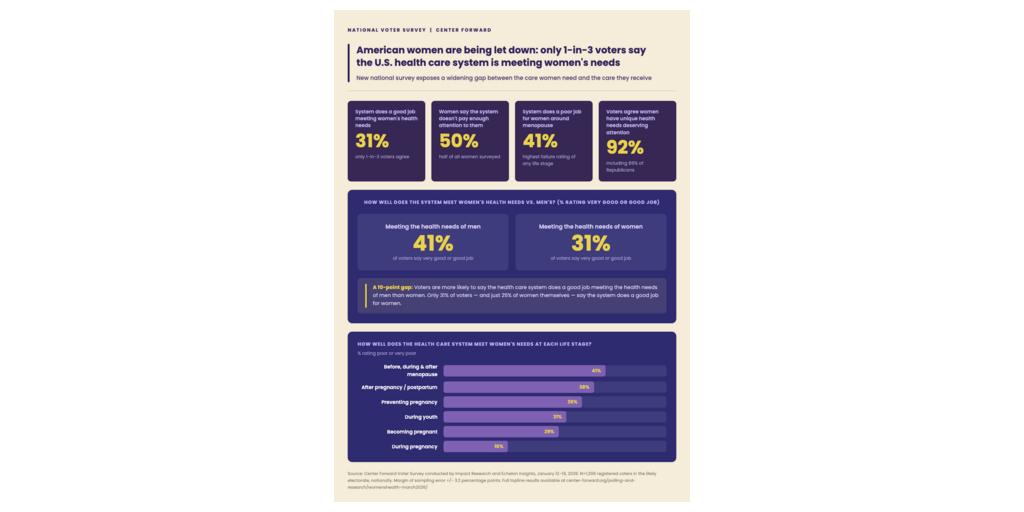 WASHINGTON--( BUSINESS WIRE)--A sweeping new national voter survey paints a troubling picture of women’s health care in America today. Despite near-universal agreement that women have unique health needs deserving specific attention, only 31% of voters believe the U.S. health care system is doing a good or very good job of meeting those needs. The survey, conducted by Impact Research and Echelon Insights for Center Forward among 1,206 registered voters in the likely electorate nationwide, reveals a health care system that voters across party lines believe is falling short for women at nearly every stage of life.
“These findings should serve as a wake-up call for the health care industry and for policymakers,” said Tara Evans, Marketing Director for Plan B One-Step. “Women are telling us loudly and clearly that the system is not working for them. From reproductive health to menopause care to postpartum support, the gaps are real, they are significant, and voters want action.”
KEY FINDINGS ON THE STATE OF WOMEN’S HEALTH CARE:
The findings reveal that the health care gap is not evenly distributed. Women with fair or poor health are 15 points more likely than those in excellent or very good health to say the system does not pay enough attention to their needs. Those earning under $50,000 annually are among the most likely to feel overlooked, with 61% of voters earning $30,000 to $49,000 per year agreeing the system does not pay enough attention to their health issues.
“The picture this data paints is one of a system that works better for some Americans than others, and women, particularly those with lower incomes or in rural communities, are bearing the greatest burden of that failure,” adds Evans. “Plan B is committed to being part of the solution by ensuring that at the very minimum, women have access to emergency contraception when they need it.”
Plan B is the most widely distributed over-the-counter emergency contraception. It’s available in all 50 U.S. states, at all major retailers, local grocers, and other pharmacies, with no ID or prescription needed to purchase regardless of what state someone lives in.
In addition to ensuring accessibility right off the shelf, Plan B donates up to 500,000 units of their product each year to clinics, nonprofit organizations, advocacy groups, and other qualifying organizations that focus on supporting medically underserved communities.
The survey was conducted January 12–16, 2026, with a margin of sampling error of plus or minus 3.2 percentage points. Full topline results are available at center-forward.org.
About Plan B One-Step
Plan B One-Step is a backup method of birth control used to help prevent unintended pregnancy after unprotected sex or if the usual method of birth control fails. It is not an abortion pill and will not impact implantation or harm an existing pregnancy. Emergency contraception, like Plan B, is used within 72 hours after unprotected sex. The sooner it is taken, the better it works. Available without a prescription or ID at retailers nationwide, Plan B is safe, legal, and accessible in all 50 states. These findings are part of The 2026 Women’s Health Mandate, a five-part bipartisan data series on women’s health care in America, conducted by Impact Research and Echelon Insights for Center Forward.