
Canva Study: Marketers Lean into AI for Creative Work – But Consumer Trust Is the New Battleground
 SAN FRANCISCO--( BUSINESS WIRE)--Canva, the world’s leading visual communication platform, today released its third iteration of “The State of Marketing and AI” report, revealing a defining tension in modern marketing: AI is unlocking unprecedented speed and scale, but both marketers and consumers are grappling with how to balance that velocity with authenticity.
The study, conducted in partnership with The Harris Poll, surveyed 1,415 marketing leaders and 3,547 consumers across the United States, United Kingdom, Australia, France, Germany, Japan, and India.
Marketing teams are under pressure to produce more with less, and AI has quickly become the solution. Today, 97% of marketing leaders use AI in their everyday creative work, and nearly all say they plan to increase their investments in AI to keep up with demand.
Seven in ten consumers (70%) say AI-generated ads are “missing their soul,” and 65% say they are “so obvious it’s laughable,” showing that consumers react more to how authentic an ad feels than to how it was produced.
AI Becomes Core to Marketing Operations
Many marketing leaders describe AI as their strategic partner, with 41% saying it functions as their “director” and 39% as their “collaborator.” This closer collaboration between marketers and AI not only leads to significant time savings, but also organizational impact:
However, as the marketing world shifts from experimentation to everyday execution, the unintended outcome is volume without vision. The State of Marketing report shows consumers are pushing back against “AI slop” – content that feels generic, lacking emotional depth, or obviously machine-generated:
The Consumer Paradox
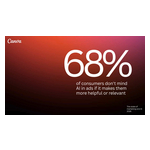
Consumer attitudes toward AI in marketing are often contradictory. While 68% say they don’t mind AI in ads if they’re helpful or relevant, 78% say they would rather see ads made by people, even if AI could make them better. Eighty-seven percent say the best advertising still requires a human touch, and 74% are more likely to purchase from an ad created entirely by humans.
Consumers also express concern about overuse and sameness:
Personalization remains another point of tension. While many consumers welcome relevant ads, they object when targeting feels invasive:
Among Gen Z and Millennials, attitudes are more nuanced. Seventy percent say they pay more attention to the “vibe” of an ad versus how it was made, and 69% say they do not mind AI polish as long as real people are featured.
Agreement on What AI Cannot Replace
As AI handles execution, distinctly human skills become more critical. Creative instinct, clarity of voice, and centering the customer aren't things you can create with a prompt. When asked what AI can never replicate, marketing leaders point to capabilities that require emotional intelligence and cultural fluency:
As AI takes on more executional work, leaders say their focus is shifting toward strategy and decision-making. Three-quarters (75%) expect creative roles to grow in the next five years, with greater emphasis on imagination, judgment, and direction.
“AI has changed how marketing gets made, but not what makes it effective,” said Emma Robinson, Head of B2B Growth Marketing at Canva. “Speed and scale matter, but they don’t build trust on their own. The opportunity isn’t only producing more content. It’s building smarter systems where AI drives efficiency while brand governance and creative judgment protect what makes a brand distinctive.”
Consumers Push for Clear Guardrails
As AI-generated content becomes harder to detect, consumers are calling for transparency and governance:
Consumers are clear about what builds brand trust: data protection (53%), disclosure of AI use (52%), guarantees that AI isn't replacing jobs (39%), and the ability to opt out of AI ads (37%).
The Path Forward
For marketing leaders, the future is twofold.
AI investment and deployment must continue. With most teams already embedding AI into daily workflows, the next step is intentional integration: building systems that connect tools, improving AI literacy across teams, and ensuring automation drives measurable efficiency rather than generic output.
At the same time, leaders must actively protect what makes their brands distinctive. As AI makes content production easier, differentiation depends on clarity of voice, creative judgment, and a close understanding of the customer — whether that is a CTO at a Fortune 500 company or an individual consumer. The brands that succeed will be those that use AI to scale their operations while staying grounded in what connects, resonates, and inspires.
For recommendations on how to navigate the tension between creative velocity and consumer trust, read the full report here.
Methodology
The research was conducted in partnership with The Harris Poll:
About Canva
Launched in 2013, Canva is the world's leading all-in-one platform for visual communication and collaboration. Built to empower everyone to design, Canva serves the creative and design needs of enterprises, small businesses, consumers, and students in more than 190 countries worldwide. Whether you're a novice taking your first steps in design, or a creative professional seeking powerful tools, Canva ensures users have what they need to transform an idea into something beautiful. Underpinned by the world's most comprehensive library of designer-made content, Canva is powered by a suite of products and proprietary AI tools that elevate how individuals and teams create, collaborate, and communicate with ease.