
Emergency Exit Hatch Lightweight Composite Structures Market to Reach USD 490.0 Million by 2036
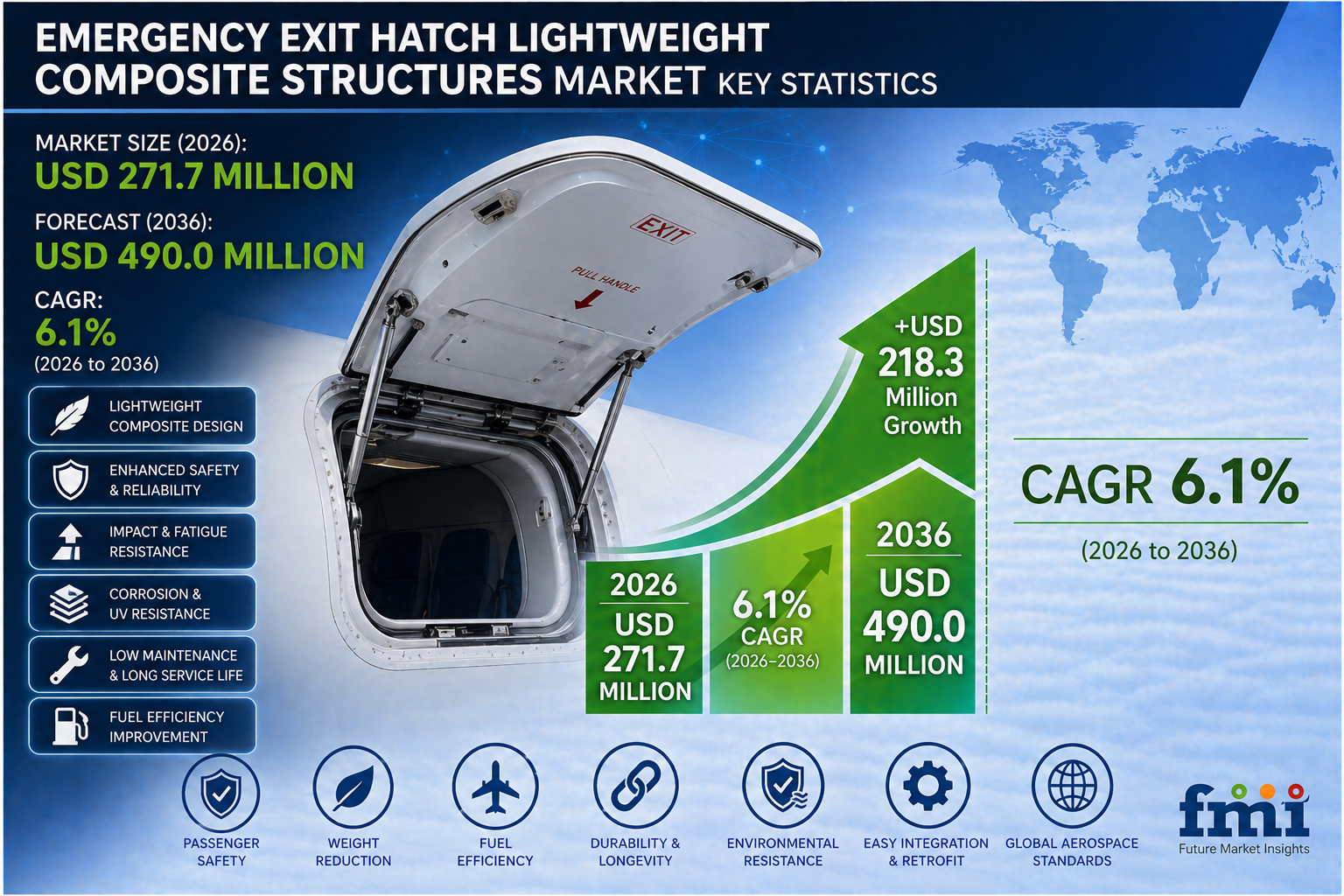 Rising Single-Aisle Aircraft Production and Growing Adoption of Lightweight Composite Hatch Systems Drive Market Expansion at 6.1% CAGR
NEWARK, DE / ACCESS Newswire / April 29, 2026 / According to the latest analysis by Future Market Insights, the global emergency exit hatch lightweight composite structures market is entering a steady growth phase as aircraft manufacturers and airlines increasingly prioritize lightweight certified aerostructures that improve operational efficiency, durability, and lifecycle performance. Valued at USD 256.1 million in 2025, the market is projected to reach USD 271.7 million in 2026 and expand significantly to USD 490.0 million by 2036, registering a CAGR of 6.1% during the forecast period.
This growth reflects the aviation industry's broader transition toward advanced composite structures that reduce aircraft weight while maintaining stringent safety and certification standards. As airlines continue modernizing fleets and OEMs accelerate production of next-generation narrowbody aircraft, lightweight emergency hatch systems are becoming increasingly important across commercial aviation platforms.
Market Value Analysis: Aircraft Production and Composite Adoption Drive Demand
Between 2026 and 2030, demand for lightweight emergency exit hatch structures is expected to accelerate as aircraft OEMs expand production capacity and increase the use of composite exterior structures across commercial aircraft programs.
Get detailed market forecasts, competitive benchmarking, and pricing trends:
https://www.futuremarketinsights.com/reports/sample/rep-gb-32897
Organizations are increasingly focusing on:
Integration of lightweight composite hatch systems into narrowbody aircraft platforms
Adoption of carbon epoxy and honeycomb sandwich structures for weight reduction
Enhancing structural durability while maintaining evacuation safety compliance
Expanding OEM line-fit programs for certified hatch assemblies
Improving stiffness-to-mass balance in external aircraft structures
Failure to adopt advanced composite hatch systems may result in higher aircraft weight, reduced fuel efficiency, and increased lifecycle maintenance costs in an increasingly performance-focused aviation environment.
From 2030 to 2036, growth will be driven by expanding single-aisle aircraft fleets, rising replacement demand during heavy maintenance cycles, and continued investment in certified composite aerostructures.
Technology Evolution: Composite Materials and Aerospace Manufacturing Drive Innovation
The evolution of emergency exit hatch structures is being shaped by advancements in aerospace composites, manufacturing precision, and certified lightweight structural systems.
Key innovations include:
Carbon epoxy composite structures for improved strength-to-weight performance
Honeycomb sandwich core architectures for enhanced stiffness and reduced mass
Advanced autoclave prepreg manufacturing for consistent laminate quality
Hybrid composite laminates for improved fatigue and corrosion resistance
Lightweight removable plug systems supporting simplified hatch architecture
A key challenge remains balancing lightweight design objectives with strict aerospace certification requirements and long qualification timelines.
An industry analyst notes:
"Lightweight composite emergency hatch systems are becoming increasingly important as aircraft manufacturers seek to improve efficiency while maintaining stringent structural and evacuation safety standards."
Composite Emergency Hatches Become Central to Aircraft Weight Optimization
As aircraft manufacturers compete on fuel efficiency and operational economics, composite hatch systems are becoming a core element of next-generation aerostructure strategies.
Core capabilities include:
Reduced aircraft weight for improved fuel efficiency
Enhanced structural stiffness and fatigue performance
Lower corrosion exposure compared to legacy metallic systems
Improved lifecycle durability across high-utilization aircraft fleets
Scalable integration across narrowbody and regional aircraft platforms
This transition is positioning lightweight emergency hatch systems as a strategic component within modern aerospace manufacturing programs.
Speak to Analyst: Customize insights for your business strategy:
https://www.futuremarketinsights.com/customization-available/rep-gb-32897
Segment Spotlight
Single-Aisle Aircraft Lead Aircraft Platform Segment (41.0%)
Driven by large production volumes across narrowbody commercial aircraft programs.
Overwing Exits Lead Exit Type Segment (44.0%)
Supported by extensive use across single-aisle and regional aircraft fleets.
Carbon Epoxy Leads Material System Segment (48.0%)
Favored for its established aerospace certification history and structural performance.
Honeycomb Sandwich Leads Core Structure Segment (46.0%)
Driven by superior stiffness-to-weight characteristics in hatch applications.
OEM Line-Fit Leads End Use Segment (68.0%)
Reflects strong demand from factory-integrated aircraft hatch programs.
Regional Insights: Aerospace Manufacturing Expansion Supports Market Growth
The emergency exit hatch lightweight composite structures market is expanding globally, supported by aircraft production growth, supplier localization, and rising use of composite aerostructures.
Country
CAGR (2026-2036)
Key Growth Drivers
India
8.3%
Aerospace manufacturing expansion and export-linked aerostructure work
China
7.7%
Fleet growth and broader composite manufacturing ambition
Brazil
7.1%
Embraer-linked production and regional aircraft specialization
Canada
6.4%
A220 assembly activity and aerospace supplier depth
United States
6.0%
Large OEM base and replacement demand across active fleets
France
5.9%
Airbus-linked industrial ecosystem and certified aerostructure expertise
Germany
5.6%
Strong aerospace manufacturing capability and European program participation
Regional growth patterns reflect differences in aerospace manufacturing maturity, OEM concentration, and certified composite production capability.
Opportunities: Lightweight Structures and Replacement Demand Unlock Growth
Key opportunities shaping the market include:
Expansion of lightweight composite structures across aircraft exterior systems
Growing replacement demand during deep aircraft maintenance cycles
Development of hybrid laminate and thermoplastic composite hatch systems
Increased supplier localization across emerging aerospace hubs
Adoption of advanced manufacturing methods for aerospace composites
These opportunities are enabling suppliers to strengthen long-term program participation while supporting broader aerospace lightweighting initiatives.
Competitive Landscape: Certification Capability and Program Access Define Leadership
The market remains highly specialized, with competition driven by aerospace certification depth, composite manufacturing expertise, and OEM program access.
Leading companies include:
Collins Aerospace
Saab
Latécoère
Spirit AeroSystems
GKN Aerospace
Ducommun
Dynamatic Technologies
Competitive differentiation is driven by:
Certified aerospace composite manufacturing capability
Long-term OEM program relationships
Advanced autoclave and prepreg processing expertise
Platform-specific aerostructure integration capabilities
Strong aerospace quality and compliance systems
Future Outlook: Composite Hatch Systems Become Integral to Next-Generation Aircraft
Looking ahead to 2036, lightweight composite emergency hatch systems will play an increasingly important role in aircraft efficiency, safety, and lifecycle optimization strategies.
Key trends include:
Wider adoption of composite hatch systems across narrowbody aircraft
Increased use of honeycomb sandwich and hybrid laminate structures
Growth in OEM line-fit demand for certified lightweight aerostructures
Expansion of replacement demand across aging commercial fleets
Greater integration of advanced aerospace composite manufacturing technologies
As aircraft manufacturers continue prioritizing lightweight structures and operational efficiency, composite emergency hatch systems will become an increasingly critical component of future aerospace platforms.
Unlock 360° insights for strategic decision making and investment planning:
https://www.futuremarketinsights.com/checkout/32897
Browse More Automotive Industry Reports:
Gear Shift Sleeves Market - https://www.futuremarketinsights.com/reports/gear-shift-sleeves-market
E-Motor Assisted Braking Systems Market - https://www.futuremarketinsights.com/reports/e-motor-assisted-braking-systems-market
Blended Brake Systems Market - https://www.futuremarketinsights.com/reports/blended-brake-systems-market
EV Powertrain Market - https://www.futuremarketinsights.com/reports/ev-powertrain-market
ISO 24089 Software Update Compliance Management Platforms Market - https://www.futuremarketinsights.com/reports/iso-24089-software-update-compliance-management-platforms-market
About Future Market Insights (FMI)
Future Market Insights (FMI) is a leading provider of market intelligence and consulting services, serving clients in over 150 countries. Headquartered in Delaware, USA, with a global delivery center in India and offices in the UK and UAE, FMI delivers actionable insights to businesses across industries including automotive, technology, consumer products, manufacturing, energy, and chemicals.
An ESOMAR-certified research organization, FMI provides custom and syndicated market reports and consulting services, supporting both Fortune 1,000 companies and SMEs. Its team of 300+ experienced analysts ensures credible, data-driven insights to help clients navigate global markets and identify growth opportunities.
For Press & Corporate Inquiries
Rahul Singh
AVP - Marketing and Growth Strategy
Future Market Insights, Inc.
+91 8600020075
For Sales - [email protected]
For Media - [email protected]
For web - https://www.futuremarketinsights.com/
SOURCE: Future Market Insights, Inc.