
Citrus-Based Sugar-Reduction Flavor Modulators Market to Reach USD 448.1 Million by 2036, Driven by Clean-Label Reformulation and Beverage Innovation
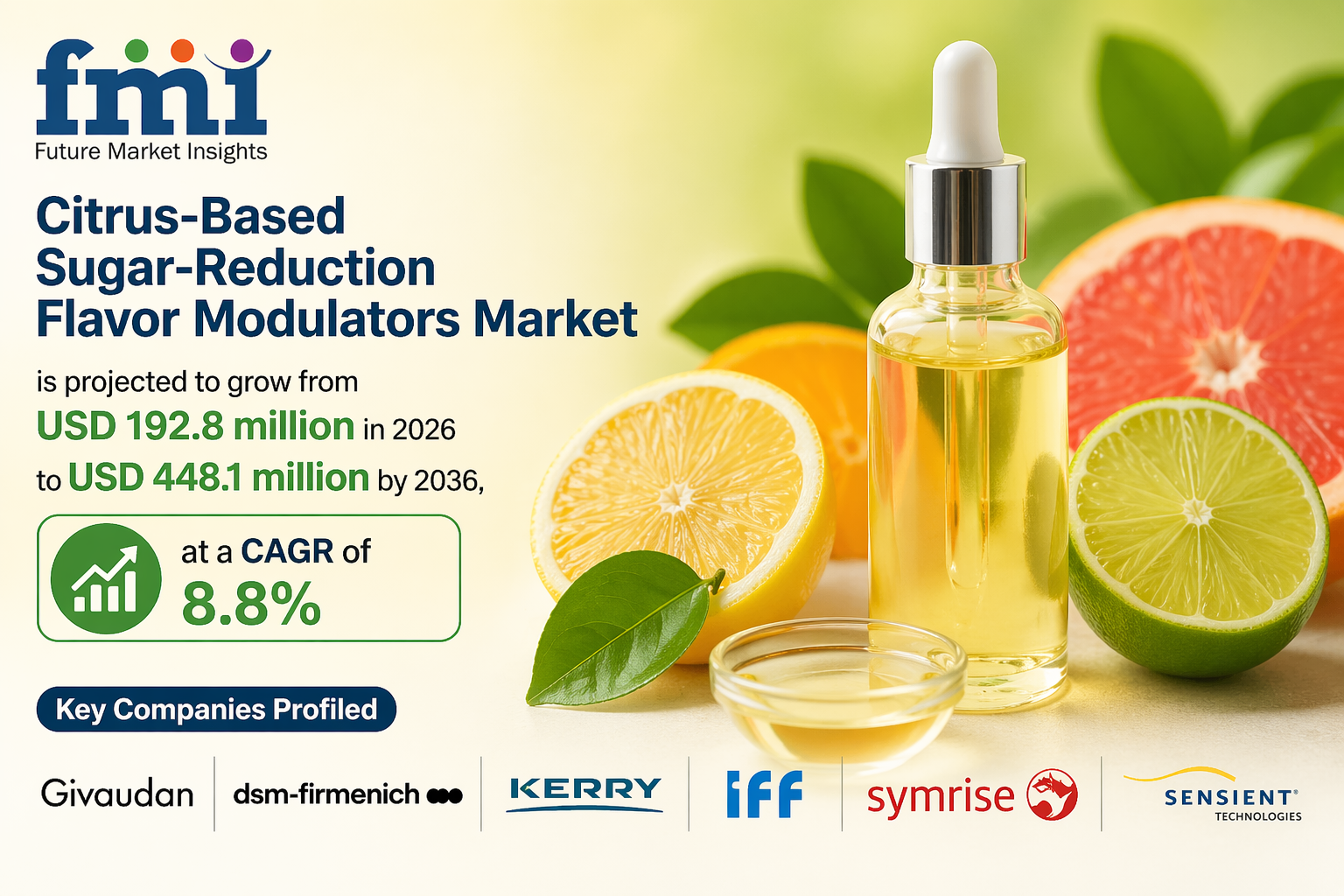 Citrus-based sugar-reduction flavor modulators market grows as brands cut sugar while preserving taste, driven by clean-label demand and beverage reformulation trends
NEWARK, DE / ACCESS Newswire / April 24, 2026 / The global citrus-based sugar-reduction flavor modulators market is entering a steady growth phase as food and beverage manufacturers intensify efforts to reduce added sugar while maintaining taste integrity. Increasing regulatory pressure, evolving consumer preferences for low-sugar products, and the need for clean-label formulations are accelerating adoption of citrus-derived modulation systems across multiple product categories.
According to the latest analysis by Future Market Insights, the market was valued at USD 177.2 million in 2025 and is projected to grow from USD 192.8 million in 2026 to USD 448.1 million by 2036, expanding at a CAGR of 8.8% during the forecast period. The market is expected to create an incremental opportunity of USD 255.3 million over the next decade, driven by rising reformulation activity in beverages, dairy, and confectionery segments.
Quick Stats: Citrus-Based Sugar-Reduction Flavor Modulators Market
Market Outlook: Niche but rapidly expanding segment within natural taste modulation ingredients
Key Growth Drivers: Sugar reduction mandates, clean-label demand, beverage reformulation
Top Demand Regions: Asia Pacific, Europe, North America
Leading Application Segment: Beverages
Core Ingredient Focus: Citrus-derived sweetness enhancers and masking systems
Get detailed market forecasts, competitive benchmarking, and pricing trends: https://www.futuremarketinsights.com/reports/sample/rep-gb-32839
Supply Chain Dynamics and Raw Material Considerations
The market relies heavily on citrus crop availability, making it sensitive to seasonal fluctuations, weather patterns, and agricultural risks such as disease outbreaks. Orange-based inputs dominate due to their scale and relatively stable supply chains compared to niche citrus varieties.
Processing consistency is critical, as citrus-derived modulation systems require careful extraction and formulation to preserve volatile aroma compounds responsible for sweetness perception. Variability in raw material quality can directly impact performance, especially in large-scale beverage applications.
Sustainability and waste-stream valorization are gaining traction, with manufacturers increasingly utilizing citrus peels and by-products as feedstock for flavor modulation ingredients. This not only improves cost efficiency but also aligns with circular economy goals.
Demand Drivers and Consumer Trends
Market growth is being shaped by multiple structural drivers:
Rising pressure to reduce added sugar in packaged foods and beverages
Increasing consumer preference for natural and clean-label ingredients
Growing use of stevia, monk fruit, and alternative sweeteners requiring taste correction
Expansion of low-sugar beverages, functional drinks, and wellness products
Regulatory actions such as sugar taxes and front-of-pack labeling
Citrus-based modulators are gaining preference because they enhance perceived sweetness through aroma interactions rather than direct sugar replacement, allowing formulators to maintain flavor balance without compromising label claims.
Product Trends and Segment Insights
The market includes citrus-derived systems designed for sweetness enhancement, off-note masking, mouthfeel restoration, and acidity balancing.
Orange-based modulators lead the source segment with a 43.0% share due to familiarity, scalability, and strong sensory performance
Sweetness enhancers dominate the function segment with 41.0% share, reflecting their central role in reformulation
Beverages account for the largest application share at 47.0%, driven by aggressive sugar reduction targets
Liquid formats lead with 62.0% share, supported by ease of integration into beverage systems
Natural label types dominate with 68.0% share, aligning with consumer demand for recognizable ingredients
Manufacturers are focusing on improving aroma-sweetness synergy, ensuring stability across processing conditions, and enhancing compatibility with different food matrices.
Processing Constraints and Operational Challenges
Despite strong demand, several challenges persist:
Citrus crop volatility impacting raw material availability and pricing
Matrix-dependent performance requiring product-specific formulation adjustments
Stability issues under heat, pH variation, and storage conditions
Complexity in balancing sweetness, acidity, and mouthfeel simultaneously
Higher formulation time and testing costs for multi-category applications
Performance inconsistency across different product types-such as beverages versus dairy or bakery-remains a key barrier to broader adoption.
Access the Complete Report in PDF Format: https://www.futuremarketinsights.com/reports/brochure/rep-gb-32839
Regional Growth Dynamics and Key Markets
Growth patterns vary significantly by region:
Asia Pacific leads due to rapid growth in packaged beverages and changing consumption habits
Europe is driven by regulatory pressure, sugar taxes, and strong clean-label demand
North America benefits from high reformulation activity and label transparency trends
Latin America shows strong potential due to warning-label systems and citrus processing capacity
Country Highlights:
India (10.4% CAGR): Fastest-growing market driven by packaged beverage expansion
United Kingdom (9.8% CAGR): Sugar levy accelerating reformulation
United States (9.1% CAGR): Strong demand for low-sugar beverages and functional drinks
Mexico (8.9% CAGR): Warning labels pushing rapid product reformulation
Brazil (8.6% CAGR): Strong citrus supply base supporting ingredient production
Germany (8.0% CAGR): High preference for natural ingredients
Japan (7.4% CAGR): Focus on refined, balanced low-sugar formulations
Opportunities in Innovation and Product Development
The evolving market landscape is opening new innovation pathways:
Aroma-sweetness optimization: Isolating compounds that enhance sweetness perception
Cross-matrix formulation tools: Improving performance across beverages, dairy, and bakery
Encapsulation technologies: Enhancing stability and controlled release
Waste-stream utilization: Converting citrus by-products into high-value ingredients
Advanced sensory modeling: Predicting flavor interactions in reduced-sugar systems
Companies investing in these areas are likely to gain a competitive advantage in formulation efficiency and product performance.
Competitive Landscape
The market is moderately fragmented, with leading players focusing on integrated flavor solutions rather than standalone ingredients.
Key competitive factors include:
Advanced formulation capabilities combining sweetness enhancement and masking
Strong regulatory and compliance frameworks for multi-region product launches
Robust citrus sourcing and supply chain management
Application-specific expertise across beverage and food categories
Major companies active in this space include Givaudan, dsm-firmenich, Kerry Group, IFF, Symrise, and Sensient Technologies.
Strategic collaborations between flavor houses and food & beverage brands are shaping innovation and accelerating commercialization.
Future Outlook
The citrus-based sugar-reduction flavor modulators market is transitioning from a niche innovation space into a critical component of modern product reformulation strategies. As sugar reduction becomes a long-term industry priority, demand for solutions that preserve taste without compromising label appeal will continue to grow.
Manufacturers that can deliver consistent performance across applications, secure stable citrus supply chains, and align with clean-label expectations will be best positioned to capture emerging opportunities in this evolving market.
Unlock 360° insights for strategic decision making and investment planning - https://www.futuremarketinsights.com/checkout/32839
Related Reports:
Flavor Modulators Market: https://www.futuremarketinsights.com/reports/flavour-modulators-market
Savory Flavor Modulators Market: https://www.futuremarketinsights.com/reports/savory-flavor-modulators-market
Natural Flavor Modulators Market: https://www.futuremarketinsights.com/reports/natural-flavor-modulators-market
Flavors Market: https://www.futuremarketinsights.com/reports/flavors-market
Flavor and Flavor Enhancers Market: https://www.futuremarketinsights.com/reports/flavour-and-flavour-enhancers-market
About Future Market Insights (FMI)
Future Market Insights (FMI) delivers actionable, decision-maker-focused research, offering deeper insights beyond traditional market data. Its reports include:
Pricing and cost benchmarking
Consumer behavior and procurement analysis
Supply chain intelligence
Technology and trend forecasting
FMI combines industry expertise with real-world data inputs to provide practical, validated, and business-ready insights, helping organizations make informed strategic decisions in evolving global markets.
FMI does what others don't-it connects data with real business decisions, helping companies plan investments, optimize costs, and stay ahead in competitive markets.
For Press & Corporate Inquiries
Rahul Singh
AVP - Marketing and Growth Strategy
Future Market Insights, Inc.
+91 8600020075
For Sales - [email protected]
For Media - [email protected]
For web - https://www.futuremarketinsights.com/
SOURCE: Future Market Insights, Inc.