
Global Mono-Material Recyclable Stretch Yarn Systems Market Set to Hit USD 2.6 Billion by 2036, Led by China, India & Toray Industries
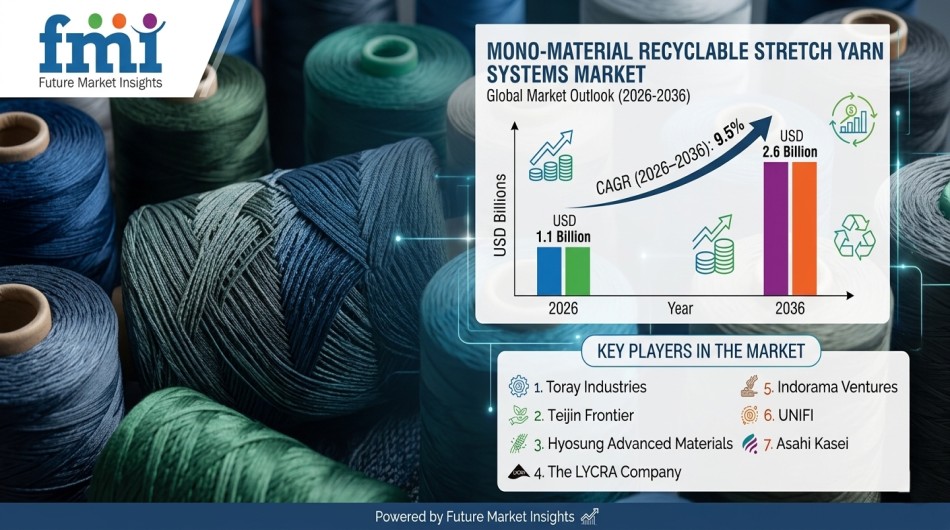 Mono-material stretch yarn market grows steadily, driven by sustainability, recyclability demand, and shift away from elastane in apparel production.
NEWARK, DE / ACCESS Newswire / April 10, 2026 / According to the latest analysis by Future Market Insights, the global mono-material recyclable stretch yarn systems market is entering a high-growth phase, fueled by increasing demand for circular textile solutions, regulatory pressure on mixed-material fabrics, and innovation in polymer-based stretch technologies. The market is valued at USD 1.1 billion in 2026 and is projected to reach USD 2.6 billion by 2036, expanding at a CAGR of 9.5% over the forecast period. This growth represents an absolute dollar opportunity of USD 1.54 billion, underscoring a structural shift in textile manufacturing toward recyclable, single-polymer architectures.
Market Snapshot: Mono-Material Recyclable Stretch Yarn Systems Market
Key Market Metrics
Market Size (2026): USD 1.1 Billion
Forecast Value (2036): USD 2.6 Billion
CAGR (2026-2036): 9.5%
Absolute Dollar Opportunity: USD 1.54 Billion
Leading Stretch Mechanism: Mechanical Crimp (42.0% share)
Dominant Polymer Type: Polyester (38.0%)
Leading Application Segment: Knitted Fabrics (36.0%)
Primary End Use: Activewear (31.0%)
Key Players: Toray Industries, Teijin Frontier, Hyosung Advanced Materials, The LYCRA Company, Indorama Ventures, UNIFI, Asahi Kasei
Get detailed market forecasts, competitive benchmarking, and pricing trends: https://www.futuremarketinsights.com/reports/sample/rep-gb-32588
Growth Dynamics and Demand Drivers
The market is gaining momentum as apparel brands transition away from elastane-based blends toward recyclable mono-material alternatives. This shift is largely driven by the need to improve end-of-life processing and comply with tightening environmental regulations.
A major catalyst is the introduction of stricter textile waste policies, particularly in Europe, where separate textile collection mandates are increasing pressure on manufacturers to adopt recyclable fabric systems. At the same time, corporate ESG commitments and extended producer responsibility frameworks are accelerating adoption across global supply chains.
Performance requirements remain central to adoption. Buyers demand stretch recovery, color consistency, and durability comparable to traditional elastane-based fabrics. As a result, innovation in polymer chemistry and yarn engineering is becoming a critical competitive factor.
Segment Insights
By Stretch Mechanism
Mechanical crimp dominates (42.0%), offering scalable production using modified existing machinery
Conjugate filament technologies gaining traction in premium applications
By Polymer Type
Polyester leads (38.0%), supported by:
Established PET recycling infrastructure
Strong thermal stability
Compatibility with current sorting systems
Polyamide and alternative polymers emerging in niche segments
By Application
Knitted fabrics (36.0%) lead due to inherent flexibility and ease of stretch integration
Woven fabrics face slower adoption due to structural limitations
By End Use
Activewear (31.0%) dominates, driven by:
High performance requirements
Sustainability scrutiny
Rapid adoption by global athletic brands
Growth also observed in innerwear, uniforms, and athleisure
By Recycling Route
Mechanical recycling leads (46.0%), leveraging existing PET recovery systems
Chemical recycling gaining long-term interest but limited by scale requirements
Speak to Analyst: Customize insights for your business strategy: https://www.futuremarketinsights.com/customization-available/rep-gb-32588
Supply Chain and Industry Structure
The industry is characterized by a complex, decentralized supply chain spanning polymer recovery, yarn spinning, fabric production, and garment manufacturing. Asia Pacific serves as the primary production hub, with integrated ecosystems that combine recycling, spinning, and textile processing.
Manufacturers are increasingly investing in bi-component spinning technologies and securing feedstock through recycling partnerships. Control over raw material sourcing is emerging as a key differentiator, particularly as demand for high-quality recycled inputs intensifies.
Pricing and Value Trends
Pricing in the market reflects a transition toward lifecycle-based value assessment. While mono-material yarn systems may carry higher upfront costs due to advanced processing requirements, they offer long-term economic advantages through:
Reduced end-of-life disposal costs
Compliance with regulatory frameworks
Lower environmental impact
Brands are increasingly factoring recyclability and compliance into sourcing decisions, shifting focus from cost per unit to total product lifecycle value.
Competitive Landscape
The market remains moderately fragmented, with competition centered on technical capability, feedstock access, and scalability. Leading players such as Toray Industries, Teijin Frontier, and Hyosung Advanced Materials are investing heavily in advanced spinning technologies and circular material systems.
At the same time, integrated players with control over recycling streams are gaining an advantage by ensuring consistent raw material supply. New entrants face challenges related to feedstock availability and maintaining polymer performance across multiple recycling cycles.
Strategic partnerships, recycling infrastructure investments, and innovation in yarn engineering are key competitive strategies shaping the market.
Regional Analysis
Asia Pacific (Production Powerhouse)
China (10.7% CAGR): Driven by large-scale textile manufacturing and recycling integration
India (9.9% CAGR): Growth supported by textile upgrades and export demand
Strong ecosystem for scalable production and cost efficiency
Latin America
Brazil (10.3% CAGR): Expansion driven by local activewear manufacturing and reduced import reliance
North America
United States (9.2% CAGR): Demand shaped by compliance, traceability, and brand-driven specifications
Europe
Germany (9.1% CAGR): Policy-driven adoption with strong regulatory push
High emphasis on recyclability, documentation, and material traceability
Other Markets
South Korea (8.7%), Italy (8.5%) showing steady growth in technical and premium segments
Future Outlook and Opportunities
The mono-material recyclable stretch yarn systems market is poised to become a cornerstone of sustainable textile manufacturing. Growth will be driven by advancements in:
Polymer engineering and yarn design
Dyeing and finishing technologies
Recycling infrastructure and feedstock management
Key opportunities include:
Expansion into high-performance apparel categories
Integration with digital textile printing platforms
Adoption in corporate uniform and workwear programs
Companies that can balance performance, scalability, and recyclability will be best positioned to capitalize on long-term market potential.
Buy Full Report: Unlock 360° insights for strategic decision making and investment planning: https://www.futuremarketinsights.com/checkout/32588
Explore More Related Studies Published by FMI Research:
Potassium Sulfate Market: https://www.futuremarketinsights.com/reports/potassium-sulfate-market
Joint Compound Market: https://www.futuremarketinsights.com/reports/joint-compound-market
Oxalic Acid Market: https://www.futuremarketinsights.com/reports/oxalic-acid-market
Sodium Lactate Market: https://www.futuremarketinsights.com/reports/sodium-lactate-market
Fiberglass Market: https://www.futuremarketinsights.com/reports/fiberglass-market
About Future Market Insights (FMI)
Future Market Insights (FMI) is a leading provider of market intelligence and consulting services, serving clients in over 150 countries. Headquartered in Delaware, USA, with a global delivery center in India and offices in the UK and UAE, FMI delivers actionable insights to businesses across industries including automotive, technology, consumer products, manufacturing, energy, and chemicals.
An ESOMAR-certified research organization, FMI provides custom and syndicated market reports and consulting services, supporting both Fortune 1,000 companies and SMEs. Its team of 300+ experienced analysts ensures credible, data-driven insights to help clients navigate global markets and identify growth opportunities.
For Press & Corporate Inquiries
Rahul Singh
AVP - Marketing and Growth Strategy
Future Market Insights, Inc.
+91 8600020075
For Sales - [email protected]
For Media - [email protected]
For web - https://www.futuremarketinsights.com/
SOURCE: Future Market Insights, Inc.