
Global Electric Boat Market to Reach USD 20.9 Billion by 2035 Driven by Marine Electrification and Sustainable Boating Demand
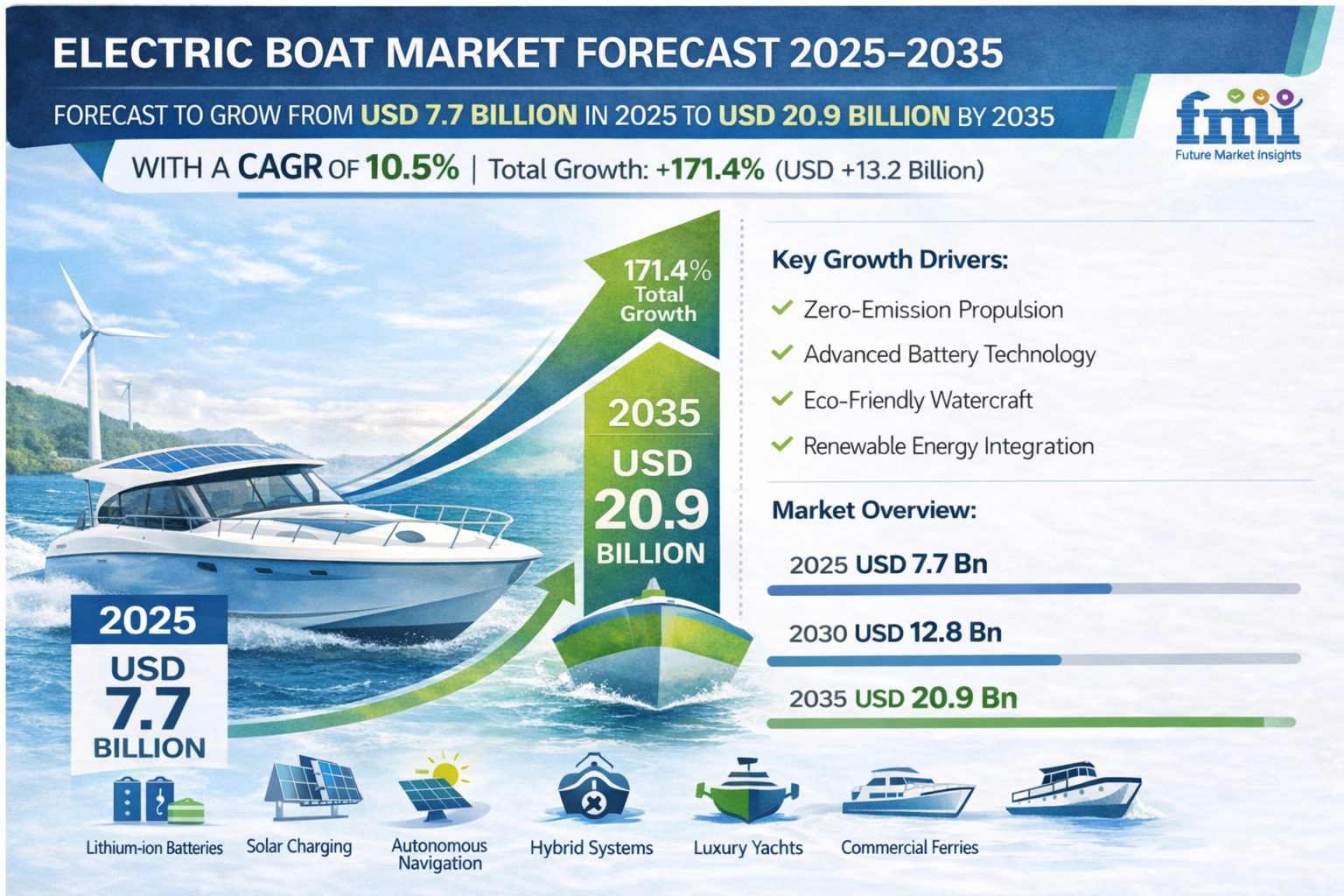 Advancements in Battery Technology, Zero-Emission Regulations, and Eco-Tourism Trends Propel Electric Boat Adoption at a 10.5% CAGR
NEWARK, DELAWARE / ACCESS Newswire / March 5, 2026 / The global electric boat market is entering a transformative growth phase as marine transportation and recreational boating industries accelerate the transition toward zero-emission propulsion systems. Valued at USD 7.7 billion in 2025, the market is projected to reach USD 20.9 billion by 2035, expanding at a CAGR of 10.5% during the forecast period.
This rapid expansion reflects the rising global commitment to marine decarbonization, advancements in battery technology, and increasing demand for sustainable tourism and eco-friendly watercraft. Electric propulsion systems are evolving from niche alternatives into mainstream solutions for commercial ferries, recreational vessels, and coastal transportation networks.
Industry analysts note that the electric boat sector is entering a decade of innovation where battery-electric propulsion, integrated digital monitoring, and renewable charging infrastructure will redefine marine mobility worldwide.
Get Access of Report Sample:
https://www.futuremarketinsights.com/reports/sample/rep-gb-5121
Marine Electrification Reshapes the Boating Industry
The electric boat market gained strong momentum in 2024 and 2025, driven by stricter environmental regulations and rising awareness of sustainable marine operations. Governments, port authorities, and tourism operators are increasingly adopting electric propulsion solutions to reduce noise pollution, eliminate emissions, and meet decarbonization targets.
By 2030, the market is expected to grow from USD 7.7 billion to approximately USD 12.8 billion, representing an incremental opportunity of USD 5.12 billion. This early phase of the forecast period will be characterized by the widespread transition from traditional lead-acid batteries to lithium-ion systems, offering higher energy density, faster charging, and extended operating ranges.
Modern electric boats equipped with advanced battery management systems, integrated electric drive trains, and smart energy monitoring platforms are increasingly replacing conventional diesel-powered vessels across recreational boating, water taxi services, and ferry operations.
An industry expert comments:
"Electric propulsion is transforming the boating experience. It delivers quiet operation, lower maintenance, and zero emissions-making it the future of sustainable marine mobility."
Technology Evolution: From Electric Propulsion to Smart Marine Ecosystems
Electric boat platforms are rapidly integrating advanced technologies that enhance efficiency, safety, and operational reliability. These innovations are turning electric boats into intelligent marine mobility systems.
Key technological developments include:
Lithium-ion marine battery systems enabling longer travel ranges and faster charging
Advanced electric propulsion systems with integrated power electronics
Smart battery management and predictive monitoring platforms
Renewable energy charging solutions such as solar-powered marina docks
Hybrid-electric propulsion systems for extended operational range
Autonomous navigation compatibility for next-generation vessels
By 2030-2035, the industry is expected to shift toward comprehensive electric marine ecosystems, combining electric vessels, renewable energy infrastructure, and smart port technologies.
Regulatory Momentum Accelerates Electric Boat Adoption
Environmental policies and maritime regulations worldwide are accelerating the shift toward zero-emission marine propulsion.
Key policy initiatives include:
European Clean Port programs restricting diesel vessel emissions
The International Maritime Organization's 2050 decarbonization targets
California's Commercial Harbor Craft Regulation, pushing zero-emission vessels
National marine electrification programs in China and Nordic countries
These initiatives are creating strong incentives for ferry operators, tour companies, and marina operators to transition toward electric boat fleets.
Segment Spotlight
Pure Electric Boats Lead Product Segment
Pure electric boats account for the dominant market share, capturing approximately 87.8% of the market. Their popularity stems from:
Zero-emission operation
Quiet propulsion ideal for tourism and recreational boating
Reduced maintenance compared to internal combustion engines
Lower operational costs due to electricity-based energy consumption
These vessels are widely used across water taxis, passenger ferries, eco-tourism boats, and recreational craft.
Lead-Acid Batteries Currently Dominate
Lead-acid batteries hold approximately 87.9% of the market share, primarily due to their lower upfront cost and established supply chains.
However, lithium-ion batteries are rapidly gaining adoption, offering:
3-4× higher energy density
Faster charging capability
Longer lifecycle (3,000+ charge cycles)
Reduced vessel weight
This transition is expected to accelerate as battery prices decline and performance improves.
Industry-Specific Adoption Trends
Electric boats are gaining traction across multiple marine sectors:
Tourism & Recreation:
Resort operators and charter companies are deploying silent electric boats for eco-tourism and wildlife tours.
Commercial Transport:
Urban water taxi services and ferry operators are adopting electric propulsion to reduce fuel costs and emissions.
Luxury Yachting:
High-end yacht manufacturers are integrating electric propulsion to meet sustainability preferences among affluent buyers.
Public Sector & Law Enforcement:
Government agencies are deploying electric patrol boats for quiet surveillance and environmentally responsible operations.
Risk Landscape
Despite strong growth potential, the electric boat market faces several challenges:
Limited charging infrastructure at marina facilities
High upfront investment for battery systems
Range limitations compared to diesel-powered vessels
Infrastructure upgrade costs for high-power charging systems
Battery replacement and lifecycle management considerations
Manufacturers investing in fast-charging systems, modular battery architectures, and hybrid propulsion technologies are expected to overcome these barriers effectively.
Regional Growth Insights (2025-2035 CAGR)
Country
CAGR
Key Growth Driver
China
12.1%
Inland waterway electrification and domestic battery production
United States
10.7%
Sustainable tourism and marina electrification initiatives
Norway
11.4%
Government-led ferry electrification programs
Germany
9.8%
Environmental regulations and electric leisure boating demand
United Kingdom
9.4%
Expansion of eco-tourism and coastal water transport
Asia Pacific, Europe, and North America are expected to remain leading regional markets, supported by marine electrification programs and strong boating cultures.
Competitive Landscape: Innovation Drives Market Leadership
The electric boat industry is highly competitive, with manufacturers investing heavily in battery technology, electric propulsion systems, and smart vessel platforms.
Key market players include:
FRAUSCHER BOOTSWERFT
Duffy Electric Boat Company
RAND Boats
Vision Marine Technologies
Quadrofoil
Companies are focusing on electric propulsion innovation, battery performance improvements, and smart marine connectivity platforms to gain competitive advantage.
Strategic partnerships with battery manufacturers and marina infrastructure providers are also shaping market competition.
Future Outlook: Autonomous and Renewable-Powered Marine Mobility
Looking toward 2035, several transformative trends are expected to redefine the electric boat ecosystem:
Autonomous electric vessels for ferry and cargo transport
Solar-powered marina charging networks
AI-powered fleet monitoring and predictive maintenance systems
Smart port integration and digital vessel traffic management
High-capacity marine battery technologies enabling longer-range vessels
As marine industries worldwide accelerate decarbonization efforts, electric boats will play a critical role in shaping the future of sustainable maritime transportation.
With strong policy support, advancing battery technologies, and rising demand for eco-friendly mobility solutions, the global electric boat market is positioned for robust expansion through the next decade, transforming how vessels are designed, powered, and operated across recreational and commercial marine sectors.
For an in-depth analysis of evolving formulation trends and to access the complete strategic outlook for the Electric Boat Market through 2035, visit the official report page at: https://www.futuremarketinsights.com/reports/electric-boats-market
Brows More Technology Industry Reports:
City Bus Door Actuators and Door Control Units Market - https://www.futuremarketinsights.com/reports/city-bus-door-actuators-and-door-control-units-market
Fuel System Diagnostics & Health Monitoring Market - https://www.futuremarketinsights.com/reports/fuel-system-diagnostics-health-monitoring-market
Bus HVAC Components Market - https://www.futuremarketinsights.com/reports/bus-hvac-components-market
Aluminum Body Panel Fasteners Market - https://www.futuremarketinsights.com/reports/aluminum-body-panel-fasteners-market
Transmission Filter Market - https://www.futuremarketinsights.com/reports/transmission-filter-market
About Future Market Insights (FMI)
Future Market Insights (FMI) is a leading provider of market intelligence and consulting services, serving clients in over 150 countries. Headquartered in Delaware, USA, with a global delivery center in India and offices in the UK and UAE, FMI delivers actionable insights to businesses across industries including automotive, technology, consumer products, manufacturing, energy, and chemicals.
An ESOMAR-certified research organization, FMI provides custom and syndicated market reports and consulting services, supporting both Fortune 1,000 companies and SMEs. Its team of 300+ experienced analysts ensures credible, data-driven insights to help clients navigate global markets and identify growth opportunities.
For Press & Corporate Inquiries
Rahul Singh
AVP - Marketing and Growth Strategy
Future Market Insights, Inc.
+91 8600020075
For Sales - [email protected]
For Media - [email protected]
For web - https://www.futuremarketinsights.com/
SOURCE: Future Market Insights, Inc.