
Vadzo Imaging's AR2020 20MP Mono and Color Camera: The Advanced Embedded Vision Choice Over Sony IMX183 Solutions
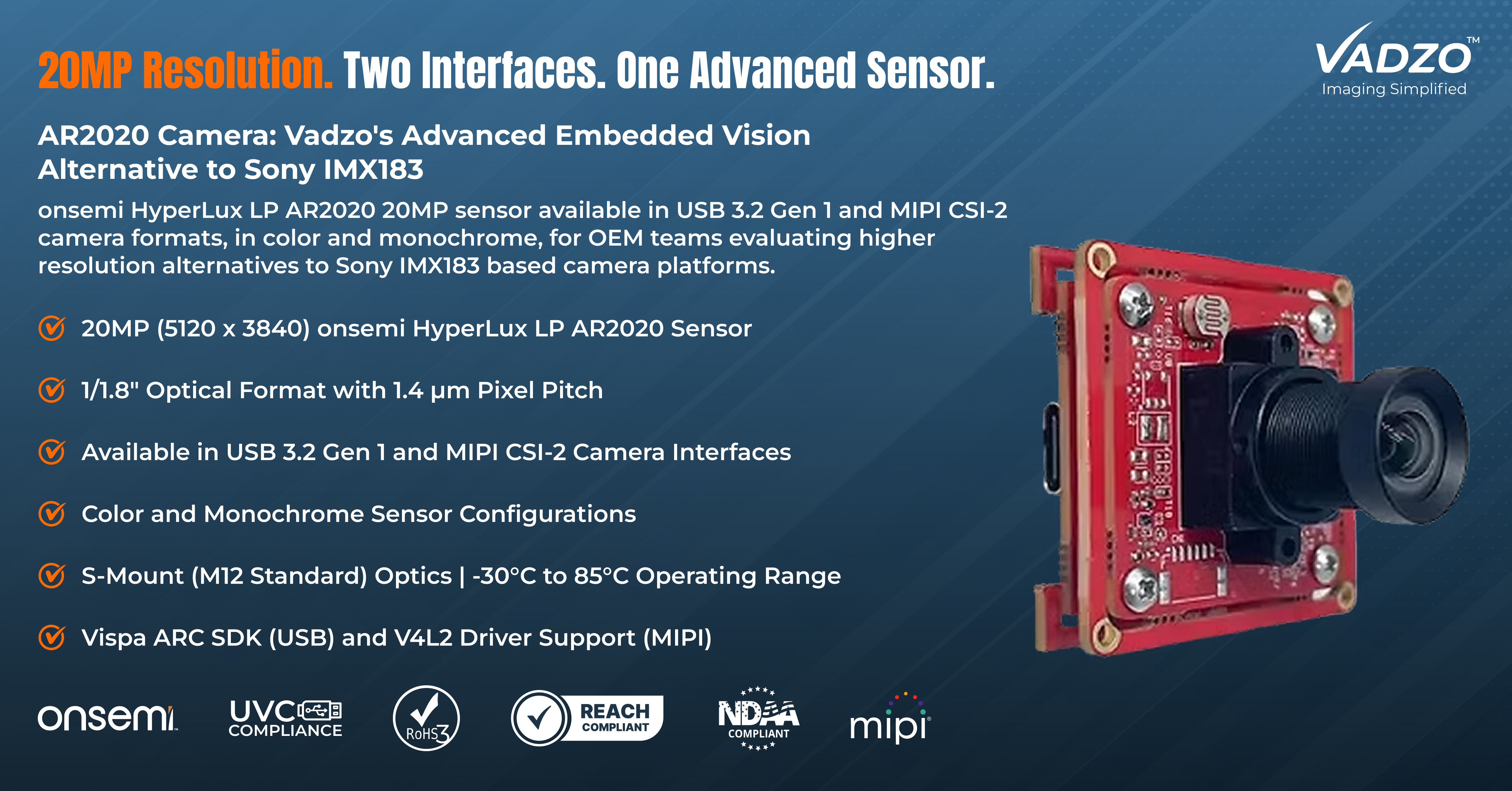 Vadzo Imaging explains why its onsemi HyperLux LP AR2020 based camera portfolio, available across USB and MIPI CSI-2 interfaces in color and monochrome configurations, gives OEM developers and embedded vision engineers a more integration ready alternative to camera designs built around the Sony IMX183 sensor.
FORT WORTH, TX / ACCESS Newswire / July 16, 2026 / Vadzo Imaging, a provider of embedded vision camera products, today explains why its AR2020 camera portfolio, built on the onsemi HyperLux LP AR2020 image sensor, gives OEM developers and system integrators a more embedded-ready alternative to camera designs built around the Sony IMX183 sensor. Offered across the Falcon-2020CRS and Falcon-2020MRS USB camera products and the Bolt-2020CRS and Bolt-2020MRS MIPI CSI-2 camera products, the AR2020 platform delivers 20MP resolution in both color and monochrome sensor configurations, addressing semiconductor inspection, microscopy, aerial mapping, surveillance, metrology, and life sciences imaging applications where engineering teams have often defaulted to IMX183-based camera designs without evaluating the full integration cost of that choice.
Why Type 1 Format Sensor Designs Create Integration Overhead in Embedded Systems
The Sony IMX183 is a 20 megapixel CMOS image sensor built with a 2.4 µm pixel pitch, and it has earned a lasting place in scientific imaging, astrophotography, and general purpose machine vision camera products. Its resolution and its back-illuminated pixel architecture remain genuinely competitive more than a decade after its introduction. The limitation embedded vision engineers run into is not image quality. It is an integration path.
Camera products built around the IMX183 are supplied almost exclusively as benchtop USB3 or Gigabit Ethernet modules using C-Mount optics, a lens standard with a long back focal distance that was never designed for board-level or MIPI CSI-2 embedded integration. A C-Mount lens assembly on a Type 1 format sensor typically adds significant length and weight to the optical stack compared to a compact S-Mount (M12 Standard) design, a difference that matters directly when the target enclosure is a UAV payload bay, a handheld terminal, or a kiosk housing rather than a benchtop instrument chassis. There is also no widely available native MIPI CSI-2 variant of an IMX183-based camera, which means OEM teams standardizing on a Raspberry Pi or NVIDIA Jetson class SoC cannot source an equivalent 20MP camera on that sensor without commissioning a custom board design and a custom driver development effort for each target platform.
AR2020 vs IMX183 Camera: Sensor Architecture and Embedded Integration Comparison
The onsemi HyperLux LP AR2020 is a 20 megapixel CMOS image sensor resolving 5120 x 3840 pixels on a 1/1.8 inch optical format with a 1.4 µm pixel pitch and rolling shutter readout, qualified across a -30°C to 85°C operating range. Vadzo Imaging offers the AR2020 sensor across four board-level camera products spanning both USB and MIPI CSI-2, part of the broader Onsemi Hyperlux AR2020 Camera family that Vadzo continues to expand. Where the AR2020 vs IMX183 camera comparison matters most for embedded vision engineers is not the datasheet resolution figure, which is comparable between the two sensors, but the physical integration path each one supports.
The IMX183's larger Type 1 optical format and 2.4 µm pixel pitch give it a real photon collection advantage per pixel over the AR2020's smaller 1.4 µm pixel, and that difference matters in low-light or short exposure scientific imaging work. Engineers evaluating this decision should weigh the tradeoff honestly rather than treat resolution as the only variable. For semiconductor inspection, PCB inspection, aerial mapping, and metrology work performed under controlled or well-lit illumination, that tradeoff generally favors the AR2020's integration profile without a meaningful loss in usable detail.
What changes with the AR2020 platform is everything around the sensor. The same 20MP resolution class ships today as a compact S-Mount board-level module over USB 3.x for the Falcon-2020CRS and Falcon-2020MRS camera products, and over 2-lane MIPI CSI-2 for the Bolt-2020CRS and Bolt-2020MRS camera products, without requiring a custom board spin, a C-Mount lens assembly, or a bespoke driver development effort for each target platform.
The Vadzo AR2020 Camera Portfolio: Four Configurations, One Sensor Platform
Vadzo Imaging offers the onsemi HyperLux LP AR2020 sensor across four board-level camera products spanning both major embedded interfaces. The Falcon-2020CRS is an AR2020 Color Camera delivering 20MP color output over USB 3.2 Gen 1, while the Falcon-2020MRS is an AR2020 Monochrome Camera delivering the same resolution in monochrome over USB 3.0. For OEM teams standardizing on MIPI CSI-2 rather than USB, the Bolt-2020CRS provides 20MP Color MIPI Camera output, and the Bolt-2020MRS is an AR2020 MIPI Camera configuration with monochrome NIR sensitivity for applications operating under infrared illumination. All four camera products share the same S-Mount (M12 Standard) lens interface and the same -30°C to 85°C operating range, which means OEM teams can standardize optics and thermal qualification across a USB deployment and an MIPI deployment of the same product line without requalifying the lens assembly for each interface variant.
Key Capabilities of the AR2020 Camera Portfolio
20MP Resolution for Feature Level Detail at Long Working Distances: At 5120 x 3840 pixels, the AR2020 delivers roughly four times the linear resolution of a 5MP sensor across the same field of view, which lets OEM teams hold a wider field of view while retaining the pixel density needed to resolve sub-millimeter features. This applies directly to AR2020 20MP USB Camera deployments in semiconductor inspection and PCB inspection, where a single 20MP frame can cover a larger inspection area than a lower resolution sensor without reducing the pixel count available for defect classification. As a high-resolution embedded camera built on a 20MP CMOS image sensor, the AR2020 platform gives machine vision engineers the option to trade field of view for detection distance without changing sensor hardware between projects.
Back-Side Illuminated (BSI) Stacked Architecture: The AR2020 is built on a stacked BSI CMOS process, routing the sensor's wiring layer behind the photodiode rather than in front of it so incoming light reaches each pixel with less obstruction. This is the same class of architecture the IMX183 itself uses, which means the AR2020 does not concede light-gathering efficiency to compensate for its smaller pixel pitch and 1/1.8" format.
Enhanced Dynamic Range (eDR): The AR2020 supports line-interleaved high dynamic range readout, capturing two exposures per frame that the ISP combines into a single image preserving detail in both bright and dark regions of the same scene. This matters directly for outdoor surveillance, aerial mapping, and metrology work where the IMX183's fixed linear readout will clip highlights or crush shadows in high-contrast lighting that eDR handles natively.
Enhanced NIR Sensitivity at 850nm and 940nm: The AR2020 delivers enhanced near-infrared response specifically at the 850nm and 940nm wavelengths used in NIR illuminators for low-light surveillance, structured survey lighting, and covert night imaging. This gives the Bolt-2020MRS's monochrome NIR configuration a quantified sensitivity advantage rather than a general claim of "NIR sensitivity."
Real-Time Dynamic ROI: The AR2020 outputs two independent regions of interest simultaneously over separate MIPI virtual channels during sensor readout itself, not as a downstream crop applied after the full frame is captured and transmitted. One channel can stream a full-scene contextual view at reduced resolution while the second streams a cropped region at full detail, both generated in the same readout pass. For an inference pipeline running at a fixed sub-20MP input size, this means the sensor delivers only the pixels the model actually consumes, cutting MIPI bandwidth and ISP load and freeing SoC compute in real time rather than discarding unused pixels after they've already been transmitted at full resolution.
S-Mount (M12) Optics Across a Compact Embedded Form Factor: Every camera product in the AR2020 lineup accepts standard 20MP Rolling Shutter USB Camera S-Mount (M12 Standard) optics rather than the C-Mount lens interface common to 1-inch format benchtop camera products. S-Mount optics are smaller, lighter and lower cost than the C-Mount lens assemblies that IMX183 based camera products typically require, and the shorter back focal distance keeps the overall module length compact enough for UAV payload bays, handheld terminal housings and kiosk enclosures where a benchtop style camera body does not fit.
Color and Monochrome Configurations on the Same Sensor Platform: The AR2020 lineup is available in both color and monochrome sensor configurations across USB and MIPI CSI-2, letting OEM teams select the correct front end for the application rather than compromising on a single variant. Monochrome configurations remove the Bayer filter layer entirely, routing more of the incident photon flux to each pixel and improving sensitivity for Microscopy USB Camera and life sciences imaging applications, where transmitted or fluorescence illumination is already limited. Color configurations retain full spectral information for high-resolution surveillance and general-purpose inspection use cases where scene color carries classification value.
Dual Interface Availability for USB and MIPI CSI-2 Platform Standardization: Because the same AR2020 image sensor ships across both the USB Falcon camera series and the MIPI Bolt camera series, OEM teams building a product line that spans a USB-connected inspection station and an MIPI-connected embedded compute module do not need to qualify two different sensors to cover both deployment types. This is a structural advantage over the IMX183, where USB and MIPI camera variants, on the occasions both exist, typically come from different camera vendors with different ISP tuning, different SDK frameworks, and different mechanical footprints. Standardizing on the onsemi AR2020 image sensor across an OEM product roadmap reduces the number of independent qualification cycles the engineering team must run.
Product Specifications
The table below summarizes the confirmed hardware specifications shared across the AR2020 camera portfolio, with interface-specific details noted where the Falcon USB and Bolt MIPI CSI-2 camera products differ.
Key specs (Falcon-2020CRS / Falcon-2020MRS): 20MP (5120 x 3840) | onsemi HyperLux LP AR2020 | Rolling Shutter | 1/1.8" 1.4 µm Pixel | USB 3.2 Gen 1 | S-Mount (M12) | -30°C to 85°C
Key specs (Bolt-2020CRS / Bolt-2020MRS): 20MP (5120 x 3840) | onsemi HyperLux LP AR2020 | Rolling Shutter | 1/1.8" 1.4 µm Pixel | 2-lane MIPI CSI-2 | S-Mount (M12) | -30°C to 85°C
"Engineers do not walk away from a sensor like the IMX183 because the image quality is poor. They walk away because the camera built around it was never designed to sit inside a UAV payload bay or bolt onto a Jetson carrier board without a custom design cycle. The AR2020 camera portfolio gives our OEM customers the same 20 megapixel resolution class in a board-level module that already speaks USB and MIPI CSI-2, already accepts S-Mount optics, and already ships in color and monochrome. That is the difference between a sensor an engineer has to design a system around and one they can drop into an existing one." - Alwin Vincent, Product Manager, Vadzo Imaging.
Vispa ARC SDK and V4L2 Driver Support Across the AR2020 Camera Portfolio
The Falcon-2020CRS and Falcon-2020MRS operate as UVC-compliant Embedded Vision USB Camera products on Windows, Linux, and Android without custom driver installation, and Vadzo's Vispa ARC SDK provides programmatic access to Region of Interest configuration, exposure and gain control, Smart GPIO, and firmware update management in C, C++, C#, and Python for OEM teams that need control beyond the UVC baseline.
The Bolt-2020CRS and Bolt-2020MRS MIPI CSI-2 camera products ship with validated module-level V4L2 drivers for Raspberry Pi 5 and Raspberry Pi 4, along with NVIDIA Jetson Orin NX, Jetson Orin Nano, and Jetson Orin AGX platforms, and NXP i.MX8M Plus follows the same driver support pattern used across Vadzo's Bolt MIPI CSI-2 camera series. Driver porting support for NXP i.MX, STM, and MediaTek platforms is available on request. For OEM teams standardizing on the broader onsemi HyperLux sensor family across a product line, the 20MP Rolling Shutter MIPI Camera platform sits alongside Vadzo's other HyperLux-based camera products in the High Resolution Embedded Vision Camera portfolio.
Target Applications
Semiconductor and PCB Inspection: Automated optical inspection systems for semiconductor packaging and printed circuit board assembly depend on pixel density to resolve solder joint defects, trace damage, and component placement errors at production line speeds. A semiconductor inspection camera built on the AR2020 sensor covers a wider field of view than a 5MP or 8MP alternative while holding the same feature level resolution, letting the inspection station image a larger panel per frame and reducing the number of camera positions a multi-camera AOI rig needs. The same resolution advantage applies directly to PCB inspection camera deployments, where trace width verification and component orientation checks require consistent accuracy across the full panel width.
Microscopy and Life Sciences Imaging: Digital microscopy and pathology imaging platforms benefit from monochrome sensitivity and high pixel count when the illumination source is transmitted or fluorescence-based rather than broad ambient light. The Falcon-2020MRS operates as a 20MP Monochrome USB Camera suited to bright field and fluorescence microscopy, where the Bayer filter layer in a color sensor would otherwise absorb usable signal. As a Life Sciences Imaging Camera, the AR2020 platform also extends into broader medical device and patient care imaging platforms, where board-level integration into a diagnostic instrument matters as much as raw resolution.
Aerial Mapping and UAV Survey: Photogrammetry and aerial mapping missions require both high spatial resolution and a lightweight, low-power camera module that fits inside a constrained UAV payload bay. The Bolt-2020MRS delivers this as a 20MP Monochrome MIPI Camera with NIR sensitivity for structured survey work under near infrared illumination, connecting directly to a Jetson or Raspberry Pi 5 embedded camera flight computer without the USB enumeration overhead or added weight of a benchtop style module. Where a 1-inch sensor camera would require a larger lens and housing to maintain the same ground sample distance, the AR2020's 1/1.8 inch format and S-Mount optics keep the aerial mapping camera payload compact.
High Resolution Surveillance and Smart Infrastructure: Fixed and pole-mounted surveillance installations covering wide areas benefit from resolution headroom that supports digital zoom and post-capture cropping without losing usable detail on a subject of interest. As a High Resolution Surveillance Camera, the AR2020 platform supports smart city infrastructure deployments where a single 20MP camera can cover an intersection or perimeter that would otherwise require multiple lower resolution units, and the -30°C to 85°C operating range covers seasonal outdoor temperature swings without additional enclosure-level thermal management.
Metrology and Dimensional Measurement: Dimensional measurement and machine vision metrology applications depend on consistent pixel-to-millimeter calibration across the full sensor area, and resolution directly determines the smallest measurable feature at a given working distance. A metrology vision camera built on the AR2020's 20MP CMOS image sensor gives measurement system integrators more usable pixels across the same field of view than a lower resolution alternative, improving achievable measurement resolution without moving the camera closer to the part or narrowing the inspection area.
Industrial Automation and Robotics: Robotics and industrial automation platforms that combine navigation with inline inspection need a camera product that can serve both roles without maintaining two separate hardware qualifications. The Bolt-2020CRS, a 20MP Industrial Camera within Vadzo's automation and robotics camera portfolio, connects over 2-lane MIPI CSI-2 for low latency delivery to the host SoC ISP, supporting both broad scene navigation and high resolution part inspection from the same sensor platform.
Frequently Asked Questions
Q: What are the benefits of real-time Dynamic ROI on the AR2020 camera for embedded vision applications?
A: Real-time Dynamic ROI benefits embedded vision systems in four practical ways. First, it reduces MIPI bandwidth consumption, since only the pixels a downstream model or process actually needs are transmitted, rather than the full 20MP frame every cycle. Second, it lowers ISP load on the host SoC, because the sensor delivers a pre-cropped, right-sized region instead of requiring the ISP to receive, decode, and crop a full-resolution frame before the relevant data is usable. Third, it increases effective frame rate for inference, since a smaller ROI stream clears the pipeline faster than a full-frame stream at the same sensor readout speed, which matters directly for real-time object detection and tracking on Jetson- or Raspberry Pi-class compute. Fourth, it frees SoC compute resources for application logic, since cycles that would otherwise go toward decoding and discarding unused pixels are available for the inference model or control logic instead. Because this happens during the sensor's own readout pass rather than as a downstream crop applied after full-frame capture and transmission, these gains are realized in real time at the point of capture, not after the fact - which is the distinction that separates Dynamic ROI on the AR2020 from a software-side crop performed by the ISP or host application
Q: What is the difference between the onsemi AR2020 sensor and the Sony IMX183 sensor for embedded camera integration?
A: The onsemi HyperLux LP AR2020 and the Sony IMX183 are both 20 megapixel class CMOS image sensors, but they target different integration paths. The IMX183 uses a Type 1 optical format (15.86 mm diagonal) with a 2.4 µm pixel pitch and is typically supplied in benchtop USB3 or Gigabit camera bodies with C-Mount optics, an interface standard built for scientific and general machine vision instrumentation rather than board-level embedded integration. The AR2020 uses a smaller 1/1.8 inch format with a 1.4 µm pixel pitch and is available today from Vadzo Imaging as a board-level module over both USB and MIPI CSI-2 with S-Mount (M12 Standard) optics, giving OEM engineers a path to 20MP resolution that fits directly into compact embedded hardware. Vadzo Imaging offers this sensor across the Falcon and Bolt camera series in color and monochrome configurations.
Q: Does a 20MP USB camera or a 20MP MIPI CSI-2 camera make more sense for a new embedded vision design?
A: The choice depends on the host platform already selected for the project. A USB camera is the right choice when the design already includes a host computer with USB ports and needs UVC plug-and-play operation across Windows, Linux, or Android without driver development, which is how Vadzo's Falcon-2020CRS and Falcon-2020MRS camera products operate. A 20MP MIPI Camera is the right choice when the design is built around an embedded SoC such as a Raspberry Pi or NVIDIA Jetson module, where a direct MIPI connection to the SoC ISP avoids USB enumeration overhead and reduces module count, which is how Vadzo's Bolt-2020CRS and Bolt-2020MRS camera products operate. Both interface options ship on the same onsemi HyperLux LP AR2020 sensor, so the resolution and imaging characteristics remain consistent regardless of which interface the platform requires.
Q: What resolution and pixel size does a 20MP CMOS image sensor typically offer for machine vision applications?
A: A 20 megapixel class CMOS image sensor for machine vision typically resolves in the range of 5,000 by 3,800 pixels, though the exact pixel pitch varies significantly by sensor generation and optical format. Larger format sensors around 1 inch, such as the Sony IMX183, use a pixel pitch near 2.4 µm, favoring low light sensitivity at the cost of a larger and heavier lens assembly. Smaller format sensors such as the onsemi AR2020, at 1/1.8 inch with a 1.4 µm pixel pitch, trade some per-pixel light collection for a more compact optical path, a tradeoff that matters far more in space-constrained embedded designs than in benchtop scientific instruments. Engineers should evaluate both dimensions, pixel pitch for low light performance and optical format for mechanical footprint, against the specific deployment constraints of the project rather than resolution figures alone.
Q: Can a 20MP embedded camera be customized for a specific OEM enclosure or lens requirement?
A: Yes. Vadzo Imaging supports OEM customization across its full AR2020 camera portfolio, including board redesigns and form factor changes, custom lens holder and S-Mount optics configurations, firmware modifications for application-specific feature sets, and full enclosure design in both IP-rated and non-IP-rated configurations. Evaluation units for the Falcon-2020CRS, Falcon-2020MRS, Bolt-2020CRS, and Bolt-2020MRS camera products are available with no minimum order requirement, and Vadzo's applications engineering team works directly with OEM customers on design-in and volume production requirements.
Q: What operating temperature range should an outdoor or UAV-mounted 20MP camera support?
A: For outdoor infrastructure mounting and UAV payload integration, the camera should be qualified across the full seasonal and altitude temperature range the platform will encounter, typically a minimum of -30°C on the cold end to account for winter outdoor conditions or high altitude flight, and 85°C or higher on the warm end to account for solar loading and enclosure self-heating. A camera qualified only for indoor office range temperatures will experience exposure and timing drift, or outright failure, outside that window. The AR2020 camera portfolio from Vadzo Imaging is qualified across -30°C to 85°C on both the USB and MIPI CSI-2 variants, covering the majority of outdoor and aerial deployment scenarios without additional enclosure-level thermal management.
Availability and Customization
The Falcon-2020CRS 20MP Color USB Camera and Falcon-2020MRS 20MP Monochrome Camera are available now for OEM evaluation over USB, and the Bolt-2020CRS and Bolt-2020MRS camera products are available for evaluation over 2-lane MIPI CSI-2. Evaluation units ship with SDK access, a default S-Mount lens and cable, and no minimum order quantity applies. Vadzo Imaging supports full OEM customization across the AR2020 camera portfolio, including board redesigns, custom lens holder configurations, firmware modifications, and enclosure design in IP-rated and non-IP-rated configurations. Engineering teams standardizing on monochrome MIPI CSI-2 modules can also review Vadzo's broader buy monochrome MIPI camera selection alongside the Bolt-2020MRS. For volume pricing, technical documentation, or an evaluation unit, contact the Vadzo Imaging sales team at [email protected] or explore the Onsemi AR2020 USB Camera product page directly.
About Vadzo Imaging
Vadzo Imaging develops embedded and machine vision camera products for OEMs and system integrators building production-ready vision systems across industrial automation, robotics, healthcare, aerial imaging, and smart infrastructure. The company's camera portfolio spans USB, MIPI CSI-2, Gigabit Ethernet, Wi-Fi, and SerDes interfaces, giving engineering teams a single source for sensor integration, ISP tuning, firmware development, and SDK frameworks across an entire product line. Learn more at www.vadzoimaging.com.
Media Contact
Alwin Vincent
Vadzo Imaging
Email: [email protected]
LinkedIn: Vadzo Imaging
YouTube: Vadzo Imaging
X: Vadzo Imaging
SOURCE: Vadzo Imaging