
Global Computing's "Mentes Brillantes" Event Highlights Legacy, Institutional Foundations and Revolutionary Technology
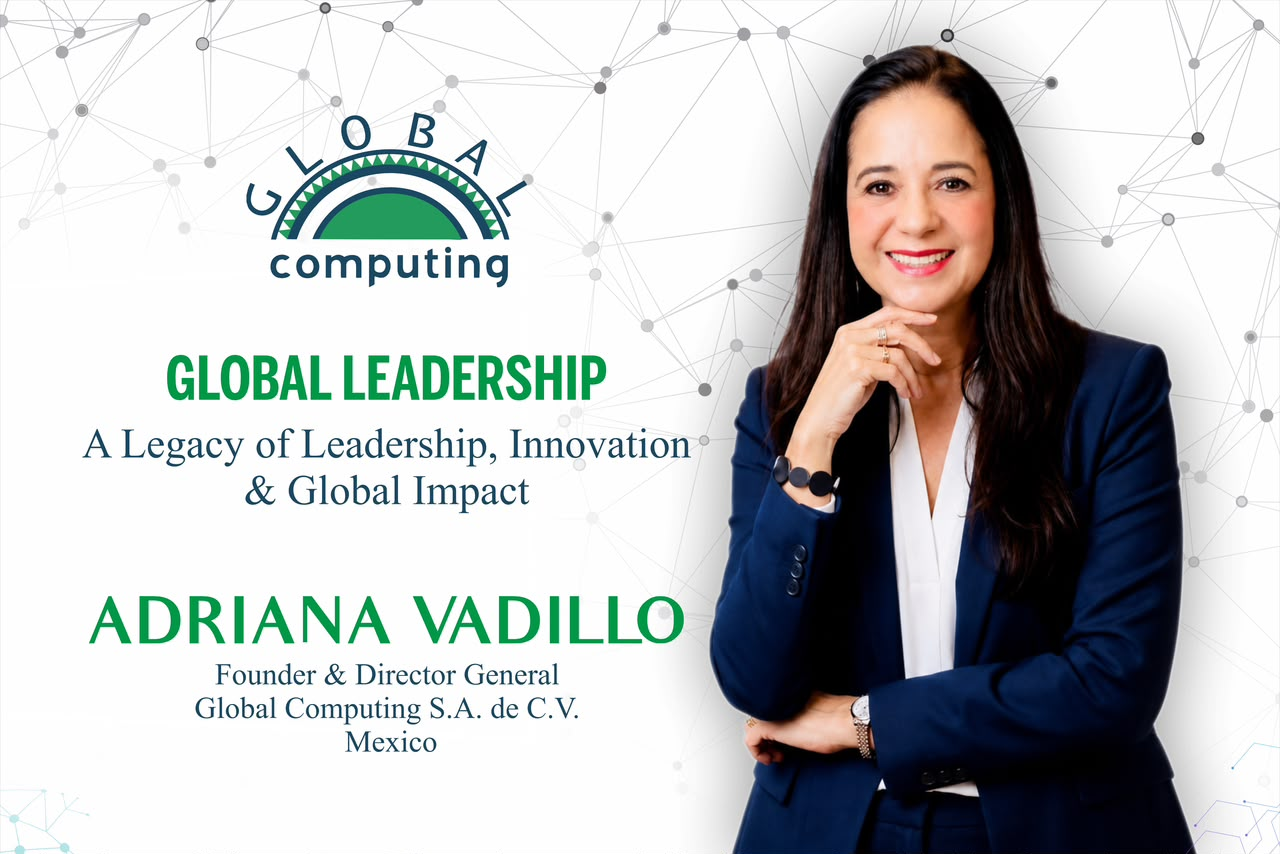 The Mexico City gathering brought together Adriana Vadillo, David Ramírez, and Marcela Ramírez for a discussion on technology leadership, knowledge transfer, and long-term digital capability.
MEXICO CITY, MX / ACCESS Newswire / August 1, 2026 / Global Computing S.A. de C.V. held its "Mentes Brillantes: Legado en Tecnología," or "Brilliant Minds: A Legacy in Technology," press event on Thursday, July 16, at Hacienda de los Morales in Mexico City.
The gathering brought together technology entrepreneur and Global Computing founder Adriana Vadillo, aerospace and mechanical engineer David Ramírez, and Human-Centered Design and Development (HCDD) student Marcela Ramírez for a conversation on technological leadership, innovation, education, and the institutional capabilities required to participate in the AI-driven economy.
The discussion addressed Global Computing's success in the IT industry. It was emphasized how Global Computing has overcome the challenges for organizations across Mexico and other emerging economies: adopting artificial intelligence tools does not necessarily mean that an institution is prepared to use them responsibly or sustainably.
The event also celebrated the founder's career and accomplishments, having received an honorary doctorate and being recognized internationally.
Participants discussed Global Computing's role in shaping the next wave of the field's rising talent, including topics such as simulating fluidically shaped geometries and the benefits of AI on human capabilities.
Participants considered the importance of developing the infrastructure, technical expertise, educational capacity, data systems, governance processes, and organizational knowledge required to integrate emerging technologies into long-term operations.
"True AI readiness requires infrastructure, talent, and institutional capacity-not only algorithms," Dr. Vadillo said.
Moving Beyond Short-Term Technology Adoption
A central theme of the event was the distinction between purchasing new technology and developing the internal capability to derive lasting value from it.
Organizations can introduce generative AI platforms, automation tools, advanced analytics, or specialized software relatively quickly. However, successful implementation also depends on reliable infrastructure, trained professionals, data quality, cybersecurity, technical leadership, and clearly defined governance responsibilities.
Without these foundations, technology initiatives may remain isolated experiments rather than becoming sustainable organizational capabilities.
The discussion also examined how local conditions influence technology adoption. Universities, public institutions, research centres, and businesses may have ambitious projects and capable professionals while still facing limitations related to budgets, procurement, licensing, infrastructure, training, and access to specialised technical support.
These factors can determine whether a technology investment produces measurable value or remains underused.
Education and Knowledge Transfer as Part of Technology Legacy
The event's title, "Legado en Tecnología," placed particular emphasis on the long-term value created through education, mentorship, professional experience, and knowledge transfer.
Rather than defining technological legacy only through products or commercial achievements, the discussion considered what remains within institutions after a technology project has been introduced.
That legacy may include trained professionals, stronger research capabilities, wider access to specialised tools, better governance practices, local technical expertise, and an improved ability to evaluate future technologies independently.
Universities and research centres were identified as especially important to this process because they prepare engineers, researchers, data professionals, entrepreneurs, and policymakers who will influence the next stage of digital development.
Vadillo has consistently advocated for expanding access to professional technology tools, training, and technical support across academic and scientific communities.
"Technology should not remain limited to developed markets," Vadillo said. "It must become a bridge for education, innovation, and national progress."
David Ramírez plays a relevant role in closing capability gaps by putting engineering to work in service of humanity.
"My academic career has not only helped me advance toward my goal of becoming an astronaut, but it has also ensured my projects make an impact here on Earth," Mr. Ramírez said. "My Master's thesis in the field of fluid mechanics, which I recently completed, has applications ranging from eyewear and medical robots to space telescopes and complex architecture," he said.
Marcela's mission as an HCDD student is to raise awareness about AI and how it can enhance human capabilities through empathetic, innovative solutions, rather than feed uncertainty about AI replacing humans.
"HCDD's goal is to study how humans do their jobs using specialized design and coding methods, and use that understanding to enhance human capabilities with AI," Ms. Ramírez said. "With HCDD, there is no room for AI replacing humans, only a revolutionary path forward for technology."
Strengthening Digital Capability in Emerging Economies
The event also considered the wider question of how emerging economies can strengthen their participation in the global technology sector.
As institutions become increasingly dependent on internationally developed platforms, they may face challenges involving data control, pricing, technical integration, compliance, access, and long-term technological direction.
Building internal expertise does not require rejecting international technology providers. Instead, it allows institutions to assess technologies more effectively, negotiate with suppliers, protect sensitive information, manage implementation, and adapt systems to local requirements.
This institutional capacity is closely connected to the wider concept of digital sovereignty: the ability of countries and organizations to strengthen their own digital infrastructure, technical knowledge, data systems, and decision-making capabilities.
For emerging economies, this may determine whether they primarily consume technologies created elsewhere or develop the expertise required to adapt, manage, and contribute to those technologies.
AI regulation and data governance remain critical global issues, and Dr. Vadillo is helping close that gap as a lifetime member of the AI For Developing Countries (AIFOD) forum, having been selected among fellow participants for her contributions across United Nations offices worldwide.
That recognition extends beyond Dr. Vadillo herself: it reflects her ongoing work researching and developing better AI systems and processes while representing Mexico on the global stage. It reflects Global Computing's own mission: "Our clients don't choose us only for our great customer service and trust," Dr. Vadillo said. "They choose us because we're the difference in the market, and because we create a tangible impact."
Nearly Three Decades in Mexico's Technology Sector
Vadillo's perspective is informed by nearly three decades of experience in the technology industry.
She began working in the sector at the age of 22, initially with Microsoft and later with Sybase. She subsequently helped establish the Mexican subsidiary of an international software company, gaining experience across sales, consulting, technical support, training, customer service, and business operations.
She later founded Global Computing to help universities, researchers, government organizations, engineers, and businesses gain access to specialised software, technical education, consulting, and local implementation support.
Global Computing's work has included scientific computing, statistical analysis, simulation, geospatial technology, visualization, digital signal and image processing, engineering applications, high-performance computing, hardware integration, and technical training.
The company has also supported academic, scientific, industrial, and public-sector institutions seeking to implement complex technologies within local operational environments.
Through "Mentes Brillantes: Legado en Tecnología," Global Computing sought to broaden the conversation surrounding artificial intelligence and digital transformation by focusing on the institutional systems, professional expertise, and educational foundations that enable technology to generate meaningful and lasting value.
About Global Computing
Global Computing S.A. de C.V. is a Mexico-based technology company providing specialised software, technical support, training, consulting, and computing solutions to academic, scientific, government, engineering, and industrial institutions.
The company works across scientific computing, statistical analysis, simulation, geospatial applications, visualization, engineering technologies, high-performance computing, and data analysis.
Media Contact
Name: Adriana Vadillo
Organization: Global Computing S.A. de C.V.
LinkedIn: https://www.linkedin.com/in/adriana-vadillo-93ab6b13/
SOURCE: Adriana Vadillo