
Hanwha Power Signs Strategic Memorandum of Understanding with Canadian Energy Company Pembina Pipeline for Lower-Carbon Power Generation Business
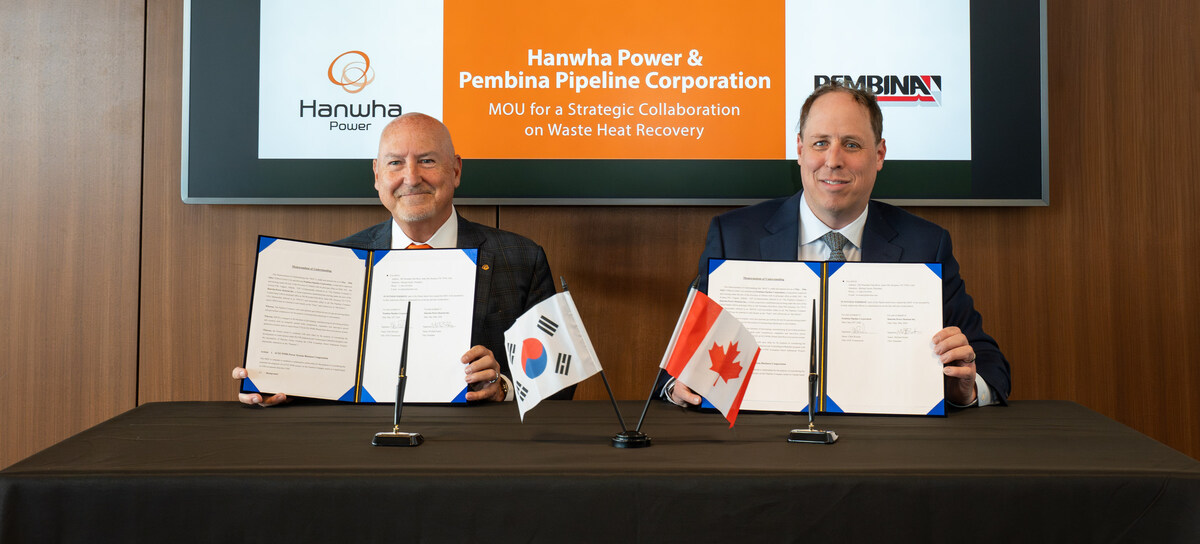 CALGARY, AB and SEOUL, South Korea, May 20, 2026 /PRNewswire/ -- Hanwha Power (CEO Rafi Balta) announced on the 20th local time that it had signed a non-binding memorandum of understanding (MOU) with Pembina Pipeline Corporation (Pembina), a leading Canadian energy transportation and midstream service provider that has served North America's energy industry for more than 70 years, to collaborate on a low-carbon power generation project.
This collaboration is being pursued in parallel with a waste heat recovery (WHR) project based on supercritical carbon dioxide at compressor stations operated by Pembina, as well as industrial and technological benefits (ITB) linked to Hanwha Ocean's participation in the Canadian Patrol Submarine Project (CPSP).
The MOU is significant as a proposed strategic collaboration that connects Hanwha Group's energy technology capabilities with Canada's local industrial ecosystem. Under this MOU, the two companies plan to jointly assess the feasibility of deploying WHR power generation systems at Pembina's compressor stations and gas infrastructure.
Specifically, the two companies will work together to identify pilot project candidates, jointly assess their technical and economic feasibility, and collaborate on lower-carbon power generation opportunities in the North American midstream market.
Hanwha Power's WHR power generation system is a next-generation technology that uses supercritical carbon dioxide, a working fluid with both liquid and gas properties. It can reduce equipment size, and it is characterized by 100% water-free operation and uncrewed operation.
In particular, this technology is expected to be a promising lower-carbon solution in the North American oil and gas market, where water use is limited, and the need to reduce carbon emissions is high. It can generate electricity without additional fuel consumption by reusing waste heat from industrial equipment, such as gas turbines, thereby improving energy efficiency and reducing carbon emissions. Compared with organic Rankine cycle (ORC) power generation, which uses low-temperature waste heat from factories and incineration plants, it offers better performance, a more compact system, and a non-explosive, non-toxic working fluid.
Pembina, headquartered in Calgary, Alberta, Canada, owns an extensive network of strategically located assets, including hydrocarbon liquids and natural gas pipelines, gas gathering and processing facilities, oil and natural gas liquids infrastructure and logistics services, and an export terminals business. Through this collaboration, Pembina is expected to improve the energy efficiency of its existing assets, reduce carbon emissions, and explore the application of new green technologies.
Through this collaboration, Hanwha Power plans to expand strategic cooperation in Canada based on its CPSP-linked ITB strategy and strengthen its entry base into the North American market. The company aims to further expand its global business in green power generation solutions.
Hanwha Power's Michael Sicker, Head of the Americas, said, "This collaboration is a meaningful first step toward expanding our green energy solutions business in the Canadian market. By combining ITB-based industrial cooperation with lower-carbon technology, we will contribute to mutual growth with local industry and create long-term business value."
Pembina's Chris Rousch, Senior Vice President, Commercial, said, " Actively exploring opportunities to enhance the efficiency and long-term value of our operating assets is core to our business at Pembina. Our collaboration with Hanwha creates further opportunity to deliver differentiated value for our customers and stakeholders."
SOURCE Hanwha Power