
Vadzo Imaging Releases Engineering Guide for Barcode Scanning Camera Design: Global vs Rolling Shutter, GSD, and Optical Parameters
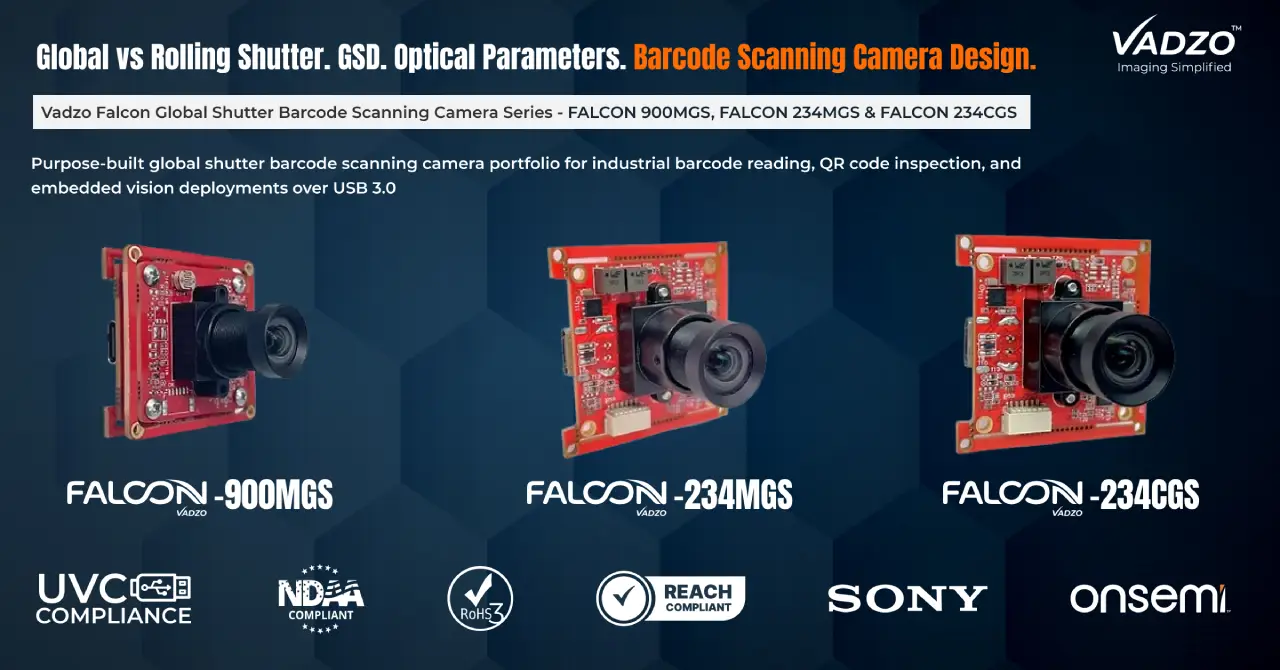 Vadzo Imaging's Falcon USB 3.0 camera series addresses the core optical and sensor-level engineering decisions in barcode scanning camera design, covering global shutter selection rationale, ground sample distance calculation methodology, and lens parameter trade-offs across three purpose-built barcode imaging camera configurations powered by the Sony Pregius S IMX900, Onsemi AR0234 monochrome, and Onsemi AR0234 color global shutter sensors.
FORT WORTH, TX / ACCESS Newswire / May 22, 2026 / Vadzo Imaging, a provider of embedded vision camera for OEMs and system integrators, is releasing a technical engineering guide addressing the sensor and optical design decisions that determine whether a barcode scanning camera deployment performs reliably in production or accumulates decode failures that surface only after system integration. The guide is grounded in three products from Vadzo's Falcon USB Camera series - the FALCON 900MGS IMX900 Monochrome USB 3.0 Camera, FALCON 234MGS AR0234 Monochrome USB 3.0 Camera, and FALCON 234CGS AR0234 Color Global Shutter USB 3.0 Camera, each built for distinct imaging requirements within industrial barcode reader and QR code scanning camera architectures.
Why Shutter Architecture Is the First Decision in Barcode Scanning Camera Design
Every barcode scanning camera deployment starts with the same engineering question: does the target move relative to the sensor during image capture? On a fixed-mount conveyor, in a robotic pick-and-place verification cell, or in a handheld gun replacement terminal, the answer almost always introduces motion. Rolling shutter sensors read the image line by line, and any movement during that readout window produces geometric distortion on 1D barcodes and symbol warping on QR codes and Data Matrix symbols that decode software cannot reliably compensate for. A global shutter barcode camera exposes every pixel simultaneously, eliminating motion-induced distortion regardless of target velocity, line vibration, or camera movement.
The choice between monochrome and color introduces a second constraint. Monochrome global shutter sensors collect approximately 1.7x more photons per pixel than equivalent color sensors because they eliminate the Bayer filter mosaic. In embedded vision barcode scanning environments where contrast between symbol bars and background drives the decode signal, monochrome sensors deliver sharper edge definition at lower illumination levels, translating directly to higher decode rates and reduced false reject counts in machine vision barcode scanner deployments.
Ground Sample Distance and the Optics Constraint in Industrial Barcode Vision System Design
GSD (ground sample distance) defines the real-world dimension each pixel resolves at a given working distance and focal length. For a machine vision barcode scanner to decode a 1D barcode reliably, the narrowest bar width must span a minimum of 2 pixels in the image. For 2D symbols, including QR code and Data Matrix, the narrowest module must cover at least 2 to 3 pixels. The governing equation is:
GSD = (pixel pitch × working distance) / focal length
For a barcode imaging camera with 2.25µm pixel pitch deployed at 500 mm working distance with a 25 mm lens: GSD = (0.00225 mm × 500 mm) ÷ 25 mm = 0.045 mm per pixel. A 0.1 mm minimum bar width maps to approximately 2.2 pixels, which sits at the functional decode threshold for an industrial barcode reader. OEM developers building industrial barcode vision systems need to work through this calculation for every deployment geometry before selecting a lens, not after.
Depth of field follows directly from the same variables. Shorter focal length lenses increase the field of view but compress the depth of field, which, on conveyor systems where product height varies, means either defocus-induced decode failures or a multi-shot acquisition strategy. These are system-level design decisions that the barcode scanning camera's sensor format and pixel pitch directly constrain. The three Falcon global shutter barcode scanning camera products below give embedded engineers the sensor parameters to work from.
"Barcode decode failures in production are rarely a software problem. They trace back to sensor and optics decisions made before the first line of integration code is written. The Falcon global shutter barcode scanning camera series is built around the physics of the problem, simultaneous pixel exposure, BSI architecture for contrast in low-illumination scanning environments, and GSD margins that leave decode engines room to work. OEM teams get the sensor performance and the SDK access to integrate that into whatever scanning architecture they are building." - Alwin Vincent, Product Manager, Vadzo Imaging
FALCON 900MGS: IMX900 Monochrome Global Shutter USB 3.0 Camera for High-Contrast Barcode Scanning
When the decode rate in a high-throughput scanning line matters more than maximizing pixel count, the sensor foundation of the barcode scanning camera becomes the limiting variable. The FALCON 900MGS is Vadzo's IMX900 Monochrome Global Shutter USB 3.0 Camera, built on the Sony Pregius S IMX900 CMOS sensor in 1/3.1" format with 2.25µm BSI pixels. It resolves 3.2MP (2064×1552) with a global shutter that eliminates motion artifacts at target velocities that would make rolling shutter output undecodable for any embedded barcode camera deployment. Quad HDR up to 120 dB handles the contrast extremes common in mixed-lighting scanning environments, where direct overhead illumination creates specular reflection on glossy label surfaces while adjacent print sits in partial shadow. USB 3.0 connectivity delivers 5 Gbps bandwidth with plug-and-play host integration. Vispa ARC SDK support gives embedded developers full programmatic control over gain, exposure, trigger timing, region of interest, and GPIO for external strobe synchronization, which is critical for suppressing ambient light interference in factory floor industrial barcode vision system installations.
Key specs: 3MP (2064×1552) | Sony Pregius S IMX900 | Global Shutter | 1/3.1" 2.25µm BSI Pixel | USB 3.0 (5 Gbps) | Quad HDR (120 dB) | NIR | S-Mount (M12) | −30°C to 70°C
FALCON 234MGS: AR0234 Monochrome Global Shutter USB 3.0 Camera for Cost-Efficient Fixed-Mount Barcode Reader Deployments
Not every barcode reading camera deployment demands 3MP resolution. Fixed-mount industrial barcode reader replacements on narrow conveyor lanes, access gate verification terminals, and embedded barcode camera nodes in kiosk systems frequently need the capture geometry of 1080p with the shutter integrity of a global shutter sensor and nothing more. The FALCON 234MGS delivers exactly this as an AR0234 Monochrome Global Shutter USB 3.0 Camera built on the Onsemi AR0234 sensor. At 1/2.6" format with 3.0µm pixel pitch and 2MP (1920×1200) resolution, it provides a wider per-pixel field of view than smaller-format sensors at equivalent focal length, which benefits depth-of-field margins in variable working distance QR code reading camera applications. Monochrome output maximizes contrast sensitivity for black-on-white and black-on-silver barcode substrates without demosaicking overhead. At 60 fps, it supports high-cycle-rate trigger acquisition in fast conveyor environments without frame loss, and Vispa ARC SDK integration covers all trigger, strobe, and region-of-interest parameters for this 1080p AR0234 USB 3.0 Camera.
Key specs: 2MP (1920×1200) | Onsemi AR0234 | Global Shutter | 1/2.6" 3.0µm Pixel | USB 3.0 (5 Gbps) | HDR | NIR | S-Mount (M12) | −40°C to 85°C
FALCON 234CGS: AR0234 Color Global Shutter USB 3.0 Camera for QR Code Inspection and Color Label Verification
Some barcode scanning applications cannot treat color as optional. Pharmaceutical track-and-trace systems verify Data Matrix symbols printed on colored packaging, where specific color channels deliver higher contrast than a grayscale image. Industrial QR code camera deployments in retail logistics read symbols on multi-color labels where color separation improves edge definition over monochrome in specific ink-substrate combinations. Color-coded routing verification requires simultaneous symbol decode and product color classification from a single acquisition. The FALCON 234CGS is Vadzo's AR0234 Color Global Shutter USB 3.0 Camera, purpose-built for embedded vision barcode scanning deployments where color information carries direct verification value alongside symbol content. This QR code scanner camera shares the Onsemi AR0234 sensor platform with the FALCON 234MGS, maintaining identical global shutter performance and 60 fps acquisition rate, while the Bayer filter array delivers accurate color reproduction for label verification and QR code scanning camera tasks requiring color fidelity. Vispa ARC SDK integration is consistent across the entire Falcon camera series, so integrators building mixed-sensor barcode scanning camera portfolios work from a single, unified software interface.
Key specs: 2MP (1920×1200) | Onsemi AR0234 | Global Shutter | 1/2.6" 3.0µm BSI Pixel | USB 3.0 (5 Gbps) | HDR | NIR | S-Mount (M12) | −40°C to 85°C
Vispa ARC SDK: Embedded Barcode Camera Control for Developers and Integrators
All three Falcon USB 3.0 barcode scanning camera products are supported by Vadzo's Vispa ARC SDK, which provides programmatic access to streaming, encoding, camera parameters, GPIO, region of interest configuration, smart GPIO control, and firmware updates. The SDK supports C, C++, and Python, with compatibility across Windows, Linux, and Android platforms. Security integrators, industrial automation developers, and OEM product teams can integrate barcode scanning camera control directly into their application stack without writing low-level driver code, with full GPIO access for trigger input and strobe output synchronization.
Barcode Scanning and QR Code Scanning Camera Applications
The Falcon global shutter camera portfolio addresses the full range of embedded barcode reading camera and QR code inspection camera requirements across modern industrial and commercial deployments.
Industrial Conveyor Barcode Scanning and Fixed-Mount Industrial Barcode Reader Systems: FALCON 900MGS and FALCON 234MGS
High-speed conveyor systems and fixed-mount vision system barcode camera nodes require global shutter capture at trigger-synchronized acquisition rates that rolling shutter sensors cannot support. The FALCON 900MGS 3MP IMX900 Mono USB 3.0 Camera handles high-contrast 1D and 2D symbol scanning under mixed lighting with its Quad HDR IMX900 USB 3.0 Camera architecture, making it the right choice for demanding OCR barcode camera and license plate-adjacent decode applications. The FALCON 234MGS covers cost-sensitive fixed mount barcode scanner replacement applications where the 2MP AR0234 Mono USB 3.0 Camera delivers the right engineering trade-off between GSD, depth of field, and per-unit cost in a barcode scanner camera deployment.
QR Code Inspection and Color Label Verification: FALCON 234CGS
The FALCON 234CGS 2MP AR0234 Global Shutter USB 3.0 Camera handles industrial QR code camera tasks where label color is part of the verification logic, including pharmaceutical packaging track-and-trace, retail logistics, and color-coded routing systems where a barcode camera delivers both symbol decode and color classification from a single frame.
What the Falcon Camera Series Shares: Vadzo's OEM Commitment to Barcode Vision Integrators
Across all three Falcon products, Vadzo Imaging provides a consistent set of OEM services that embedded vision barcode scanning product developers rely on beyond the camera hardware itself. Evaluation kits are dispatched promptly, enabling engineering teams to validate barcode scanning camera performance in their actual deployment environment before committing to a production design. Full OEM camera customization is available, covering board redesigns, firmware modifications, lens holder and filter modifications, and IP-rated enclosure design and manufacturing. ISP tuning is calibrated for real industrial scanning environments across Sony Pregius S and Onsemi AR0234 sensors. Volume pricing, production support, and direct applications engineering support for design-in assistance and production ramp are available on request.
Frequently Asked Questions (FAQs)
1) How does global shutter eliminate barcode decode failures in high-speed industrial scanning systems?
A rolling shutter reads the image line by line. When a barcode label or QR code moves during that readout window, each line captures the target at a slightly different position, producing geometric distortion that no decode engine can correct in software.
Global shutter exposes every pixel simultaneously. No motion skew, no symbol warping, no lost decode margin. At conveyor speeds of 0.5 m/s to 2 m/s and beyond, this is not a feature preference; it is a fundamental sensor requirement. The Sony Pregius S IMX900 ( IMX900 Monochrome Global Shutter USB 3.0 Camera ) and Onsemi AR0234 ( Monochrome Global Shutter USB 3.0 Camera ) sensors both use simultaneous global exposure, making them the correct architecture for any embedded barcode scanning camera deployed in motion-critical industrial environments.
2) What GSD value does a barcode scanning camera need to reliably decode a 1D barcode with a 0.1mm minimum bar width?
Reliable 1D barcode decode requires a minimum of 2 pixels per bar width. For a 0.1mm minimum bar, your GSD must be 0.05mm per pixel or better.
Formula: GSD = (pixel pitch × working distance) ÷ focal length.
For a 2.25µm pixel pitch sensor at 500mm working distance with a 25mm lens: GSD = 0.045mm per pixel mapping the 0.1mm bar to 2.2 pixels, right at functional threshold. Tightening the working distance or increasing the focal length adds decode margin. Vadzo's global shutter barcode scanning camera series, built on the IMX900 and AR0234 sensors, gives engineers the exact pixel pitch values to run this calculation before lens selection.
3) Which USB 3.0 global shutter camera sensor suits industrial barcode scanning better - Sony Pregius S IMX900 or Onsemi AR0234?
The IMX900 is a 3.2MP (2064×1552) sensor with 2.25µm BSI pixels and Quad HDR up to 120dB. Its finer pixel pitch delivers higher spatial resolution at equivalent focal length, ideal for long-working-distance scanning and high-density 2D symbol decoding under mixed lighting.
The Onsemi AR0234 at 2MP (1920×1200) with 3.0µm pixel pitch provides a wider per-pixel field of view and better depth-of-field margins in variable working distance applications. Both use a global shutter. The choice between them comes down to GSD requirement and whether your application needs a 2MP AR0234 Mono USB 3.0 camera for pure contrast or a 2MP AR0234 Color USB 3.0 camera for QR code inspection with color label verification.
4) How do you suppress ambient light interference in an embedded barcode scanning camera on a factory floor?
Standard auto-exposure adjusts gain and exposure between frames in response to ambient variation, shifting barcode-to-background pixel contrast across a production shift and degrading decode consistency.
The correct fix is strobe-synchronized acquisition. A dedicated LED illuminator fires in a short pulse, typically 50µs to 200µs, synchronized with the sensor's exposure window via GPIO. This makes strobe contribution orders of magnitude greater than ambient, effectively suppressing it.
Vadzo's global shutter barcode scanning camera series supports hardware trigger input and strobe output through GPIO. Vispa ARC SDK gives engineers full control over trigger mode, exposure timing, and strobe pulse width in C, C++, or Python, keeping acquisition consistent regardless of floor lighting conditions.
5) What is the best global shutter USB 3.0 camera for QR code inspection on colored pharmaceutical packaging?
Pharmaceutical QR code inspection requires two things simultaneously: reliable symbol decoding and color label verification against a reference spec. A monochrome sensor handles the first. Color channel separation adds the second.
Vadzo's 2MP AR0234 Color Global Shutter USB 3.0 camera addresses both. The Onsemi AR0234 delivers 1920×1200 at 60fps with full-frame global shutter integrity. For ink-substrate combinations where a single color channel delivers higher contrast than blended grayscale, Vispa ARC SDK provides per-channel access and ROI configuration for targeted decode zone processing. It integrates directly with Cognex, Zebra, Dynamsoft, and ZXing over USB 3.0 with plug-and-play UVC compatibility - no custom driver work required.
Availability
All three Falcon barcode scanning camera products are available for OEM evaluation. The FALCON 900MGS 3MP IMX900 USB 3.0 Camera, FALCON 234MGS AR0234 Monochrome USB 3.0 Camera, and FALCON 234CGS AR0234 USB Camera ship within standard lead times. Evaluation kits, technical documentation, and integration support are available directly from Vadzo Imaging. Volume pricing, firmware customization, optics, and enclosure design services are available upon request. For inquiries, contact the Vadzo sales team at [email protected].
About Vadzo Imaging
Vadzo Imaging develops high-performance embedded and machine vision cameras for OEMs and system integrators building next-generation intelligent systems. The company's USB camera series, alongside MIPI, GigE, Wi-Fi, and SerDes interface imaging platforms, supports applications in industrial automation, robotics, smart surveillance, smart city infrastructure, and edge AI. Beyond hardware, Vadzo provides end-to-end imaging expertise, including sensor integration, ISP tuning, firmware development, and OEM camera customization services that accelerate development and deployment at scale.
Media Contact
Alwin Vincent
Vadzo Imaging
Email: [email protected]
LinkedIn: Vadzo Imaging
YouTube: Vadzo Imaging
X: Vadzo Imaging
SOURCE: Vadzo Imaging