
Global Mechanical and Electronic Fuzes Market Outlook 2026-2036: Precision Munitions Demand to Drive USD 3.53 Billion Opportunity
 Next-Generation Fuzing Technologies Gain Momentum as Defense Forces Prioritize Precision, Safety, and Rapid Deployment Capabilities
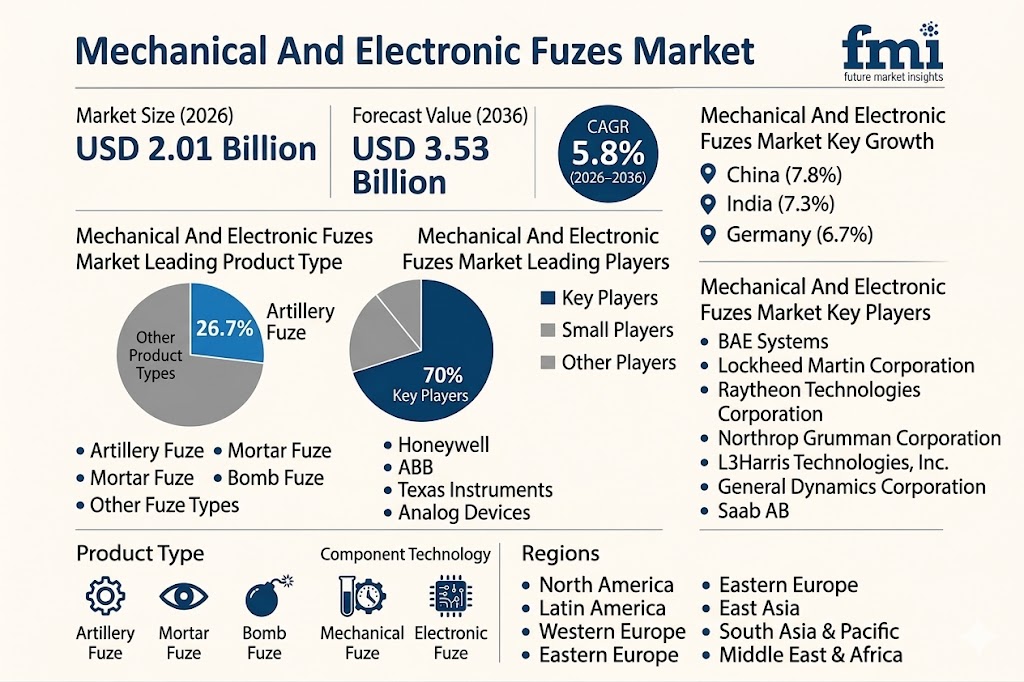
NEWARK, DE / ACCESS Newswire / April 8, 2026 / According to the latest analysis by Future Market Insights, the global mechanical and electronic fuzes market is entering a critical growth phase, fueled by accelerating defense modernization programs, rising geopolitical tensions, and the rapid transition toward precision-guided munitions. Valued at USD 2.01 billion in 2026, the market is projected to reach USD 3.53 billion by 2036, expanding at a steady CAGR of 5.8%.
The increasing emphasis on accuracy, safety, and programmable detonation systems is transforming the role of fuzes from basic triggering mechanisms into highly engineered, mission-critical components across modern warfare ecosystems.
Get detailed market forecasts, competitive benchmarking, and pricing trends:
https://www.futuremarketinsights.com/reports/sample/rep-gb-2661
Quick Stats: Mechanical and Electronic Fuzes Market (2026-2036)
Category
Metric / Detail
Market Size (2026)
USD 2.01 Billion
Forecast Value (2036)
USD 3.53 Billion
Growth Rate (CAGR)
5.8% (2026-2036)
Incremental Opportunity
USD 1.52 Billion
Top Growth Countries
China (7.8%), India (7.3%), Germany (6.7%)
Leading Product Type
Artillery Fuze (26.7% Share)
Leading Function Segment
Proximity Fuze (24.5% Share)
Dominant Application
Ground-to-Ground (37.8% Share)
Market Overview: From Legacy Detonation to Intelligent Fuzing Systems
The mechanical and electronic fuzes market is witnessing a paradigm shift as defense forces move away from traditional impact-based detonation systems toward multi-mode, programmable, and proximity-triggered technologies.
Modern fuzes now integrate sensor-based triggering, timing precision, and environmental adaptability, significantly enhancing mission success rates while minimizing collateral damage. This evolution is closely aligned with the broader adoption of smart munitions and network-centric warfare systems.
Demand Drivers: Defense Modernization and Smart Munition Integration
Global demand is primarily driven by:
Multi-year defense modernization programs across NATO and Asia-Pacific
Increasing procurement of precision-guided artillery, missiles, and aerial bombs
Rising need for multi-mode fuzing systems with programmable capabilities
Enhanced focus on operational safety, reliability, and reduced misfire risks
The transition from single-mode impact fuzes to proximity and programmable variants is significantly increasing the value per unit of ammunition systems, creating strong revenue growth opportunities.
Product & Segment Insights: Artillery and Proximity Systems Lead
The market is segmented across product type, function, and application:
Artillery Fuzes (26.7%) dominate due to widespread deployment in land-based combat systems
Proximity Fuzes (24.5%) lead by function, enabling detonation near targets for higher effectiveness
Ground-to-Ground Applications (37.8%) remain the largest segment, driven by artillery modernization
These segments are benefiting from advancements in miniaturized electronics, sensor integration, and programmable logic systems, enabling seamless integration into both legacy and next-generation platforms.
Speak to Analyst: Customize insights for your business strategy: https://www.futuremarketinsights.com/customization-available/rep-gb-2661
Regional Outlook: Asia-Pacific Emerges as Growth Engine
Regional dynamics highlight a clear shift toward emerging defense economies:
China (7.8% CAGR) leads global growth with strong domestic defense manufacturing
India (7.3% CAGR) is accelerating procurement under modernization initiatives
Europe (Germany, France, UK) shows steady growth driven by defense commitments
USA remains a mature but stable market with consistent defense spending
Asia-Pacific's rapid expansion is underpinned by geopolitical tensions, border security priorities, and indigenous defense production strategies.
Technology Evolution: The Rise of Programmable and Multi-Mode Fuzes
Innovation is at the core of competitive differentiation. Key advancements include:
RF-based proximity sensing for aerial and missile systems
Programmable time-delay and multi-mode detonation capabilities
Miniaturization of electronic components for enhanced reliability
Integration with guidance systems for precision targeting
These developments are enabling greater tactical flexibility, allowing armed forces to adapt fuze behavior based on mission requirements in real time.
Challenges: Regulatory Complexity and Integration Bottlenecks
Despite strong growth prospects, the market faces notable challenges:
Strict export control regulations and licensing requirements
Complex integration and certification timelines for new fuze systems
High R&D costs associated with advanced electronic fuzing technologies
Industry experts highlight that fuze qualification and integration cycles often act as bottlenecks, delaying deployment timelines for advanced weapon systems.
Competitive Landscape: Innovation and Pre-Qualification Drive Leadership
The market is highly competitive, with leading players focusing on product innovation, regulatory compliance, and global supply chain capabilities.
Key companies include:
BAE Systems
Lockheed Martin Corporation
Raytheon Technologies Corporation
Northrop Grumman Corporation
L3Harris Technologies, Inc.
General Dynamics Corporation
Saab AB
Strategically, companies are prioritizing pre-qualified fuze platforms that can be rapidly deployed across multiple munition systems-an approach increasingly favored in fast-moving defense procurement cycles.
Analyst Insight: Speed of Deployment Will Define Market Winners
The next phase of growth will depend less on weapon design and more on deployment readiness.
Suppliers that maintain pre-qualified, cross-platform compatible fuze systems are expected to secure faster contracts and gain a competitive edge in global procurement programs.
Future Outlook: From Component to Strategic Enabler
By 2036, mechanical and electronic fuzes will evolve from being supporting components to strategic enablers of modern warfare capabilities.
As defense forces prioritize precision, adaptability, and safety, fuzes will play a central role in enabling:
Smart artillery systems
Autonomous and AI-assisted targeting
Next-generation missile platforms
The market is set to maintain a stable and resilient growth trajectory, supported by continuous innovation, rising defense budgets, and the global shift toward precision-led military strategies.
Unlock 360° insights for strategic decision making and investment planning: https://www.futuremarketinsights.com/checkout/2661
Related Reports:
Demand for Electronic Circulation Pump in UK- https://www.futuremarketinsights.com/reports/demand-for-electronic-circulation-pump-in-uk
Demand for Electronic Circulation Pump in USA- https://www.futuremarketinsights.com/reports/demand-for-electronic-circulation-pump-in-the-usa
Chilled Beam System Market- https://www.futuremarketinsights.com/reports/chilled-beam-system-market
About Future Market Insights (FMI)
Future Market Insights (FMI) is a leading provider of market intelligence and consulting services, serving clients in over 150 countries. Headquartered in Delaware, USA, with a global delivery center in India and offices in the UK and UAE, FMI delivers actionable insights to businesses across industries including automotive, technology, consumer products, manufacturing, energy, and chemicals.
An ESOMAR-certified research organization, FMI provides custom and syndicated market reports and consulting services, supporting both Fortune 1,000 companies and SMEs. Its team of 300+ experienced analysts ensures credible, data-driven insights to help clients navigate global markets and identify growth opportunities.
For Press & Corporate Inquiries
Rahul Singh
AVP - Marketing and Growth Strategy
Future Market Insights, Inc.
+91 8600020075
For Sales - [email protected]
For Media - [email protected]
For web - https://www.futuremarketinsights.com/
SOURCE: Future Market Insights, Inc.