
Canola Meal Market to Reach USD 13.8 Billion by 2036, Expanding at 6.3% CAGR Amid Rising Demand for Sustainable Feed Nutrition
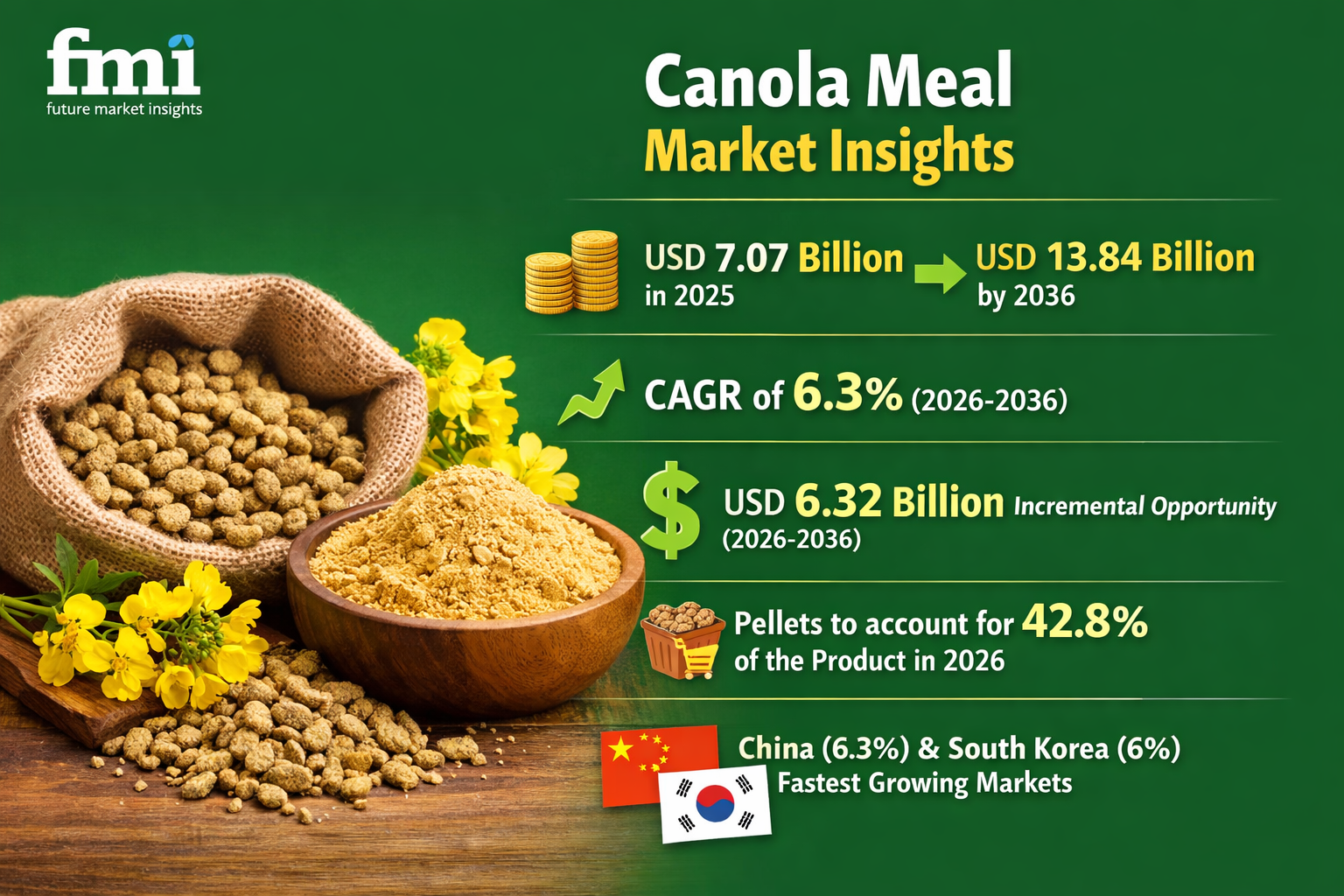 Global canola meal demand is rising with expanding livestock nutrition needs, sustainable feed sourcing trends, and growing adoption across modern agricultural supply chains.
NEWARK, DE / ACCESS Newswire / May 25, 2026 / According to the latest market analysis by Future Market Insights, the global canola meal market is entering a more efficiency- and nutrition-driven growth phase supported by rising demand for cost-effective animal feed ingredients, increasing focus on protein-rich feed formulations, expanding livestock production, and growing adoption of sustainable agricultural by-products across global feed supply chains.
The market is evolving from a conventional feed ingredient category into a more specification-sensitive ecosystem where feed manufacturers, livestock operators, agricultural distributors, and procurement managers increasingly prioritize nutritional consistency, supply reliability, formulation efficiency, and pricing stability before strengthening long-term sourcing partnerships.
Quick Stats Snapshot
Global market CAGR (2026-2036): 6.3%
Market value (2025): USD 7.1 billion
Expected market value (2026): USD 7.5 billion
Forecast market value (2036): USD 13.8 billion
Leading product type: Pellets (42.8% share)
Leading animal type: Ruminants (35.6% share)
Top growth market: China (6.3% CAGR)
Strong growth market: South Korea (6.0% CAGR)
Get detailed market forecasts, competitive benchmarking, and pricing trends: https://www.futuremarketinsights.com/reports/sample/rep-gb-16703
Market Outlook: Sustainable Feed Nutrition and Livestock Expansion Support Long-Term Growth
The canola meal market is projected to witness sustained expansion through 2036 as feed manufacturers, livestock operators, agricultural cooperatives, and distributors increasingly focus on nutritionally balanced and cost-efficient feed ingredients supported by expanding agricultural processing infrastructure and global livestock demand.
Canola meal continues gaining commercial importance because it offers high protein content, broad feed compatibility, and cost-effective nutritional performance for livestock operations. Procurement teams are simultaneously strengthening supplier qualification standards as feed manufacturers emphasize ingredient consistency, traceability, and supply continuity.
At the same time, increasing emphasis on sustainable feed sourcing and alternative protein ingredients is creating additional commercial momentum across developed and emerging agricultural markets.
The category is increasingly positioned as a strategic feed nutrition segment supporting livestock productivity, feed efficiency optimization, and sustainable agricultural supply chain development.
Growth Drivers: Livestock Nutrition Demand and Multi-Channel Distribution Accelerate Market Expansion
Several structural factors are supporting market growth:
1. Rising Demand for Protein-Rich Feed Ingredients Supports Market Expansion
Feed manufacturers continue prioritizing nutritionally efficient and protein-rich feed inputs that improve livestock productivity and feed conversion efficiency.
2. Expanding Livestock and Dairy Production Drives Consumption
Growing global demand for meat, milk, and animal-based nutrition products is accelerating adoption of canola meal across livestock feed applications.
3. Sustainable Feed Sourcing Creates Long-Term Opportunities
Increasing industry focus on sustainable agriculture and efficient by-product utilization is supporting broader adoption of canola meal formulations.
4. Distribution Expansion Improves Market Accessibility
Growth in agro-distribution networks, direct sales channels, and organized feed supply chains continues strengthening product availability across regional markets.
Key Challenges: Raw Material Volatility and Margin Pressure Remain Critical
Despite favorable growth prospects, the industry continues facing several operational and commercial challenges:
Volatility in agricultural commodity pricing
Weather-related disruptions affecting crop yields
Supply chain instability across global trade routes
Margin pressure from price-sensitive livestock producers
Regulatory compliance requirements for feed ingredients
Competition from alternative protein feed products
Companies capable of maintaining stable supply networks, product consistency, competitive pricing, and efficient distribution partnerships are expected to strengthen competitive positioning across global feed markets.
Emerging Opportunities: Functional Feed Ingredients and Premium Feed Formulations Expand Commercial Potential
Key opportunities are centered around feed innovation and sustainable agricultural development:
Growing interest in sustainable feed ingredients
Expansion of premium livestock nutrition solutions
Rising demand for high-protein feed formulations
Increasing investment in feed efficiency optimization
Greater adoption across aquaculture and poultry applications
Development of differentiated functional feed products
Segmentation Insights: Pellets and Ruminants Dominate Market Demand
By Product Type
Pellets are forecast to capture 42.8% share in 2026 as livestock operators increasingly prioritize convenient handling, storage efficiency, and optimized feed delivery systems.
By Animal Type
Ruminants are projected to account for 35.6% share in 2026 due to strong demand from dairy and cattle feed applications.
By Farm Type
Large farms are expected to account for 58.7% share due to increasing commercialization of livestock operations and large-scale feed procurement requirements.
By Sales Channel
Direct sales and agro-sales channels remain critical distribution pathways as agricultural supply networks continue strengthening regional accessibility.
Customize insights for your business strategy @ https://www.futuremarketinsights.com/customization-available/rep-gb-16703
Regional Analysis: China and South Korea Lead Market Expansion
China (6.3% CAGR)
China remains the leading growth market supported by expanding livestock production, urbanization, rising feed demand, and increasing focus on feed efficiency and protein-rich agricultural inputs.
South Korea (6.0% CAGR)
South Korea continues witnessing strong growth driven by advanced feed infrastructure, rising livestock productivity initiatives, and increasing adoption of sustainable feed ingredients.
Japan (4.7% CAGR)
Japan maintains stable growth supported by established feed manufacturing infrastructure and increasing emphasis on nutritional efficiency across livestock operations.
Germany (4.6% CAGR)
Germany supports market expansion through strong agricultural standards, sustainable feed sourcing initiatives, and advanced livestock nutrition awareness.
Italy (4.4% CAGR)
Italy continues experiencing demand growth supported by expanding feed applications and increasing agricultural modernization investments.
Asia-Pacific markets are expected to outperform mature regions due to rising livestock production, increasing protein consumption, and expanding agricultural infrastructure investment.
Competitive Landscape: Supply Reliability and Product Diversification Shape Competition
The canola meal market remains highly competitive, with global agricultural processors, feed ingredient manufacturers, and regional suppliers competing across livestock, dairy, poultry, and aquaculture feed channels.
Key companies include:
Cargill
Archer Daniels Midland
Bunge Limited
Wilmar International Limited
DowDuPont Inc.
Union Point Custom Feeds
Pacific Coast Canola
Leading suppliers continue strengthening market position through feed formulation innovation, integrated sourcing strategies, agricultural supply chain optimization, and geographic expansion initiatives.
Analyst Opinion
Nandini Roy Choudhury observes, "The canola meal market reflects growing demand for nutritionally efficient, cost-effective, and sustainable feed ingredients. Buyers increasingly evaluate supply reliability, protein consistency, pricing stability, and distribution capability before strengthening procurement partnerships. Companies capable of balancing operational efficiency with differentiated feed nutrition solutions will strengthen market positioning across global livestock applications."
Strategic Implications for Industry Leaders
For feed manufacturers, agricultural processors, livestock operators, and distributors, the market presents several strategic priorities:
Pellets remain essential for large-scale feed applications
Ruminant nutrition continues driving core market demand
Supply chain reliability remains central to procurement strategies
Sustainable sourcing is becoming increasingly important
Distribution expansion supports wider market penetration
Feed efficiency innovation strengthens product differentiation
Cost competitiveness remains critical across price-sensitive markets
Explore Industry Insights: https://www.futuremarketinsights.com/industry-analysis
Future Outlook: From Conventional Feed Ingredient Category to Sustainable Nutrition Ecosystem
The canola meal market is expected to evolve beyond a conventional feed ingredient segment into a more specification-sensitive ecosystem focused on sustainable feed nutrition, operational efficiency, supply chain resilience, and advanced livestock productivity solutions.
Key trends expected to shape the market include:
Expansion of sustainable and traceable feed sourcing
Greater investment in feed efficiency technologies
Rising demand for high-protein livestock nutrition
Increasing adoption across aquaculture and poultry sectors
Stronger focus on agricultural supply chain resilience
Continued premiumization of functional feed ingredients
Executive Takeaways
Pellets continue dominating commercial canola meal demand
Ruminants remain the leading animal type segment
Large-scale livestock farms support procurement growth
China and South Korea are leading global market expansion
Sustainable feed sourcing is creating long-term opportunities
Distribution expansion is improving product accessibility
Raw material volatility continues shaping pricing strategies
Nutritional efficiency and supply reliability remain central competitive priorities
As global demand for sustainable livestock nutrition and efficient feed ingredients continues expanding, companies capable of combining supply chain resilience, feed formulation expertise, scalable processing infrastructure, competitive pricing strategies, and strong distribution capabilities will be best positioned to capitalize on long-term canola meal market growth.
Explore In-Depth Food & Beverages Market Insights: https://www.futuremarketinsights.com/industry-analysis/food-and-beverage
Related Reports:
Canola Lecithin Market: https://www.futuremarketinsights.com/reports/canola-lecithin-market
Canola Proteins Market: https://www.futuremarketinsights.com/reports/canola-proteins-market
Fish Meal Market: https://www.futuremarketinsights.com/reports/fish-meal-market
Vegan Meals Market: https://www.futuremarketinsights.com/reports/vegan-meals-market
Blood Meal Market: https://www.futuremarketinsights.com/reports/blood-meal-market
About Future Market Insights (FMI)
Future Market Insights (FMI) is a leading provider of market intelligence and consulting services, serving clients in over 150 countries. Headquartered in Delaware, USA, with a global delivery center in India and offices in the UK and UAE, FMI delivers actionable insights to businesses across industries including automotive, technology, consumer products, manufacturing, energy, and chemicals.
An ESOMAR-certified research organization, FMI provides custom and syndicated market reports and consulting services, supporting both Fortune 1,000 companies and SMEs. Its team of 300+ experienced analysts ensures credible, data-driven insights to help clients navigate global markets and identify growth opportunities.
For Press & Corporate Inquiries
Rahul Singh
AVP - Marketing and Growth Strategy
Future Market Insights, Inc.
+91 8600020075
For Sales - [email protected]
For Media - [email protected]
For web - https://www.futuremarketinsights.com/
For Web : https://www.factmr.com/
SOURCE: Future Market Insights, Inc.