
Corporación América Airports S.A. Reports April 2026 Passenger Traffic
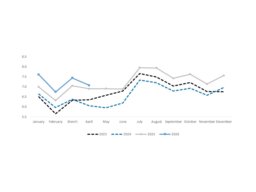 LUXEMBOURG--( BUSINESS WIRE)--Corporación América Airports S.A. (NYSE: CAAP), (“CAAP” or the “Company”), one of the world’s leading private airport operators, reported today a 2.6% year-on-year (YoY) increase in passenger traffic in April 2026.
Passenger Traffic, Cargo Volume and Aircraft Movements Highlights (2026 vs. 2025)
Statistics
Apr'26
Apr'25
% Var.
YTD’26
YTD’25
% Var.
Domestic Passengers (thousands)
3,405
3,529
-3.5%
14,057
14,169
-0.8%
International Passengers (thousands)
2,952
2,745
7.6%
11,859
10,579
12.1%
Transit Passengers (thousands)
718
624
15.0%
2,955
2,518
17.4%
Total Passengers (thousands)
7,075
6,898
2.6%
28,870
27,266
5.9%
Cargo Volume (thousand tons) – Excl. Argentina 1
15.3
15.1
1.3%
61.4
61.0
0.7%
Total Aircraft Movements (thousands)
70.9
71.7
-1.1%
284.5
278.0
2.3%
1 In Argentina, cargo volume data remains under review to ensure consistency and accuracy.
Passenger Traffic Overview
Total passenger traffic increased by 2.6% in April compared to the same month in 2025. Domestic traffic decreased by 3.5% year over year, primarily driven by a decline in Argentina. International traffic, meanwhile, grew by 7.6%, with all operating countries contributing positively on a year-over-year basis except Brazil and Uruguay. This included high single-digit growth in Argentina, Italy, and Armenia, as well as double-digit growth in Ecuador. Traffic performance in Armenia during March and April was partially impacted by disruptions related to the conflict in Iran, which resulted in flight cancellations and airspace restrictions across the region. However, the impact was more limited than initially expected.
In Argentina, total passenger traffic decreased slightly by 0.4% year over year in April, as growth in international traffic was more than offset by a decline in domestic traffic volumes. Domestic travel declined by 5.0% year over year, reflecting reduced capacity from Flybondi, partially offset by increased activity from Aerolíneas Argentinas and JetSMART. The top three domestic destinations were Iguazú, Córdoba, and Bariloche. International traffic remained robust, rising by 8.6% year over year, supported by double-digit growth in seat capacity, mainly driven by Central and North America. In fact, Argentina is the South American country with the highest growth in seat capacity for the first half of 2026. Outbound traffic was primarily supported by destinations within the region and the Caribbean, while the recovery in inbound traffic was mainly driven by routes from Brazil and the U.S./Canada. The top three international destinations in April were Santiago de Chile, São Paulo, and Rio de Janeiro.
In Italy, passenger traffic increased by 6.4% year over year, driven by high single-digit growth in the international segment, partially offset by a slight decline in domestic traffic. International passenger traffic, which accounted for more than 80% of total traffic, rose by 8.0% year over year, reflecting solid performance at both Florence Airport and Pisa International Airport. Domestic passenger traffic declined slightly by 0.9% year over year, primarily due to lower volumes at Pisa airport, partially offset by modest growth at Florence airport.
In Brazil, total passenger traffic increased by 5.1% year over year, reflecting improved traffic trends following a prolonged period of challenges in the aviation environment. Domestic traffic, which accounted for more than 50% of total traffic, declined slightly by 0.9% year over year, while transit passengers increased by a strong 18.1% year over year. Brasília International Airport continues to benefit from its position as a key secondary hub within the domestic network.
In Uruguay, total passenger traffic, predominantly international, decreased by 1.1% year over year and was negatively impacted by the calendar shift of the Easter holidays. Among other developments, Azul Linhas Aéreas Brasileiras recently launched a new Montevideo–Belo Horizonte route, operating two weekly frequencies.
In Ecuador, where security concerns persist, passenger traffic performed well, increasing by 8.0% year over year. International traffic rose by a strong 15.6% year over year, mainly supported by solid performance on routes to the U.S., driven by an increased number of frequencies operated by American Airlines, Avianca, and LATAM Airlines. Domestic traffic increased by 1.2% year over year, although high airfares continued to weigh on travel demand.
In Armenia, passenger traffic increased by 8.7% year over year, despite disruptions related to the conflict in Iran, which resulted in flight cancellations and airspace restrictions across the region. However, the impact was more limited than initially expected, with traffic from Western and Eastern Europe, Asia, and Russia supporting overall growth. The new Wizz Air base at Zvartnots International Airport, launched in late 2025, continued to support connectivity with Europe.
Cargo Volume and Aircraft Movements
Cargo volume, excluding Argentina, increased by 1.3% year-over-year, driven by strong double-digit growth in Uruguay and mid-single-digit growth in Armenia, partially offset by declines in Italy, Ecuador, and Brazil. By country, performance was as follows: Uruguay (+28.4%), Armenia (+4.1%), Brazil (-3.6%), Ecuador (-8.1%), and Italy (-16.0%). In Argentina, cargo volume data remains under review to ensure consistency and accuracy.
Aircraft movements declined by 1.1% YoY, as positive contributions from Italy, Brazil, Ecuador, and Armenia were more than offset by declines in Uruguay and Argentina. Performance by country was as follows: Italy (+4.9%), Brazil (+4.3%), Ecuador (+1.8%), Armenia (+0.9%), Argentina (-3.5%), and Uruguay (-16.5%). Argentina, Brazil, and Italy accounted for more than 80% of total aircraft movements in April.
Summary Passenger Traffic, Cargo Volume and Aircraft Movements (2026 vs. 2025)
Apr'26
Apr'25
% Var.
YTD'26
YTD'25
% Var.
Passenger Traffic (thousands)
Argentina
3,643
3,658
-0.4%
16,479
15,826
4.1%
Italy
956
899
6.4%
2,702
2,528
6.8%
Brazil
1,399
1,331
5.1%
5,576
5,057
10.3%
Uruguay
188
190
-1.1%
865
844
2.5%
Ecuador
434
402
8.0%
1,649
1,536
7.4%
Armenia
455
418
8.7%
1,600
1,474
8.6%
TOTAL
7,075
6,898
2.6%
28,870
27,266
5.9%
Cargo Volume (tons)
Argentina 1
u.r.
17,147
u.r.
u.r.
67,194
u.r.
Italy
882
1,050
-16.0%
3,460
4,274
-19.0%
Brazil
5,134
5,328
-3.6%
20,269
20,605
-1.6%
Uruguay
2,999
2,335
28.4%
10,990
11,224
-2.1%
Ecuador
2,814
3,061
-8.1%
11,158
12,018
-7.2%
Armenia
3,459
3,324
4.1%
15,519
12,877
20.5%
TOTAL Excl Argentina
15,288
15,098
1.3%
61,396
60,998
0.7%
1 In Argentina, cargo volume data remains under review to ensure consistency and accuracy
Aircraft Movements
Argentina
37,541
38,891
-3.5%
160,758
158,318
1.5%
Italy
8,345
7,955
4.9%
24,133
22,722
6.2%
Brazil
12,762
12,240
4.3%
49,505
46,823
5.7%
Uruguay
2,503
2,996
-16.5%
12,877
12,907
-0.2%
Ecuador
6,501
6,387
1.8%
25,188
25,630
-1.7%
Armenia
3,263
3,233
0.9%
12,001
11,568
3.7%
TOTAL
70,915
71,702
-1.1%
284,462
277,968
2.3%
About Corporación América Airports
Corporación América Airports acquires, develops and operates airport concessions. Currently, the Company operates 52 airports in 6 countries across Latin America and Europe (Argentina, Brazil, Uruguay, Ecuador, Armenia and Italy). In 2025, Corporación América Airports served 86.7 million passengers, 9.8% above the 79.0 million passengers served in 2024. The Company is listed on the New York Stock Exchange where it trades under the ticker “CAAP”. For more information, visit http://investors.corporacionamericaairports.com.