
Global Molded Pulp Inserts Market Set for Steady Expansion as Sustainability Regulations and Circular Packaging Drive Adoption | Future Market Insights (FMI)
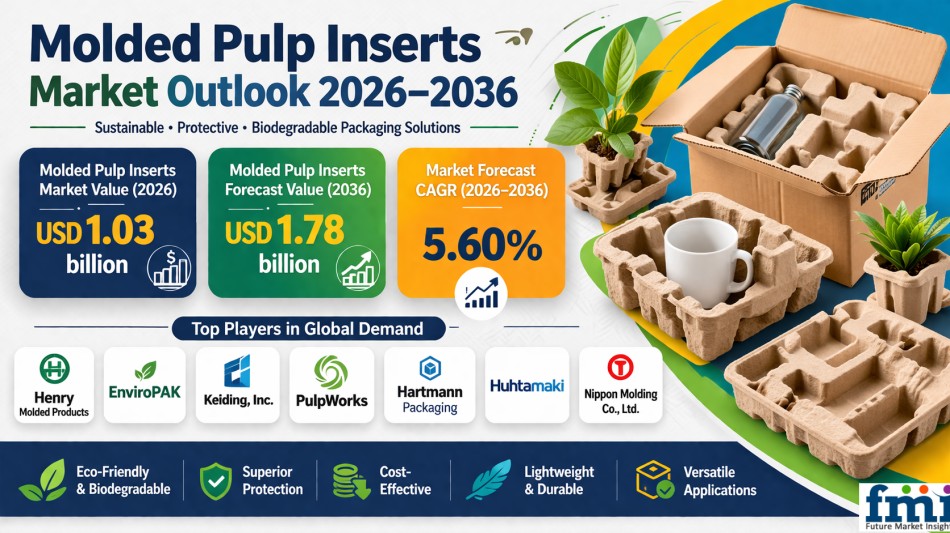 Molded pulp inserts are reshaping packaging with sustainable, recyclable solutions, replacing plastics while improving logistics efficiency and supporting circular economy goals.
NEWARK, DE / ACCESS Newswire / April 10, 2026 / According to the latest market analysis by Future Market Insights (FMI), the global molded pulp inserts market is entering a sustained growth phase as industries accelerate the shift toward recyclable, fiber-based protective packaging. The market, valued at USD 0.98 billion in 2025, is projected to reach USD 1.03 billion in 2026 and further expand to USD 1.78 billion by 2036, registering a CAGR of 5.60% over the forecast period.
The transition reflects a broader structural shift in packaging procurement, where sustainability compliance, logistics efficiency, and material circularity are becoming primary decision-making factors. Molded pulp inserts are increasingly replacing expanded polystyrene (EPS) and plastic-based cushioning formats, particularly in electronics, appliances, and consumer goods packaging.
Quick Stats: Molded Pulp Inserts Market
Market Size (2025): USD 0.98 Billion
Market Size (2026): USD 1.03 Billion
Market Forecast (2036): USD 1.78 Billion
Growth Rate: 5.60% CAGR (2026-2036)
Incremental Opportunity: USD 0.75+ Billion
Leading Segment: Inserts (41.0% share in 2026)
Top End-Use: Electronics (31.0% share in 2026)
Request Sample Report: Get detailed market forecasts, competitive benchmarking, and pricing trends:
https://www.futuremarketinsights.com/reports/sample/rep-gb-32620
Sustainability Regulations Reshaping Packaging Decisions
Global regulatory frameworks are accelerating the transition toward molded fiber solutions. The implementation of the EU's Packaging and Packaging Waste Regulation (PPWR) in 2025 has intensified demand for recyclable and mono-material packaging formats.
Procurement leaders are under increasing pressure to phase out non-recyclable materials such as EPS before packaging waste taxes begin impacting margins. As a result, molded pulp inserts are emerging as a preferred solution due to their recyclability, biodegradability, and compatibility with circular economy goals.
Additionally, the availability of recovered fiber-accounting for over 40% of packaging waste streams in key regions-supports scalable production and cost stability for manufacturers adopting molded pulp solutions.
Pricing Trends and Cost Optimization
Pricing dynamics in the molded pulp inserts market are evolving beyond upfront material costs. Buyers are now evaluating:
Total lifecycle cost
Logistics efficiency and space utilization
Compliance with environmental standards
Material sourcing stability
Molded pulp inserts offer significant cost advantages through improved nesting and stacking capabilities, reducing transportation and warehousing expenses. Unlike foam-based materials, fiber inserts enable higher logistics density, improving overall supply chain efficiency.
Technology Advancements and Design Innovation
Technological innovation is playing a critical role in expanding the application scope of molded pulp inserts. Advanced geometric designs and finite element analysis (FEA) are enabling manufacturers to replicate foam-like protective performance using fiber-based materials.
Modern molded pulp formats provide:
Enhanced shock absorption through ribbed structures
Improved surface finish for premium applications
Single-piece designs replacing multi-component assemblies
These advancements are making molded pulp inserts commercially viable across high-value segments such as electronics, cosmetics, and medical devices.
Installed Base Transition and Replacement Demand
A significant wave of replacement demand is driving market growth. Companies are transitioning from legacy packaging systems to fiber-based alternatives due to:
Increasing regulatory pressure
Rising cost of synthetic materials
Demand for sustainable brand positioning
Many manufacturers are redesigning packaging systems at the product development stage, integrating molded pulp inserts as a core component rather than an afterthought.
Production Capacity and Supply Chain Dynamics
Regional supply chain dynamics are shaping the competitive landscape:
Asia Pacific (India, China): Rapid growth driven by localized electronics and appliance manufacturing
Europe (Germany, UK): Strong compliance-driven demand and high-quality production standards
North America: Retail-driven sustainability mandates and logistics optimization
Localization of production is becoming critical, as bulky molded pulp components are costly to transport over long distances. Manufacturers are increasingly establishing facilities closer to recycling infrastructure and end-use industries.
Automation and Operational Efficiency Gains
The integration of molded pulp inserts into automated packaging lines is improving operational efficiency. Companies report:
Faster line speeds due to elimination of static-prone materials
Reduced manual handling errors
Improved repeatability in packaging processes
Automation compatibility is becoming a key selection criterion, particularly for high-volume electronics and appliance manufacturers.
Speak to Analyst: Customize insights for your business strategy:
https://www.futuremarketinsights.com/customization-available/rep-gb-32620
Key Buyers and Procurement Trends
Primary buyers in the molded pulp inserts market include:
OEMs
Contract packagers
Consumer electronics manufacturers
Appliance producers
Procurement priorities are shifting toward:
Certified, sustainable materials
Long-term cost efficiency
Reliable supply chains
Design ownership and flexibility
OEM-driven sourcing dominates the market, accounting for over 60% share, as inserts are typically specified during early product design stages.
After-Sales Performance and Lifecycle Value
End-users are increasingly focused on long-term performance metrics, including:
Durability under varying humidity conditions
Drop-test compliance (ISTA standards)
Reduced product damage and returns
Suppliers offering engineering support, design optimization, and consistent quality are gaining a competitive edge in long-term contracts.
Regulatory Compliance and Material Innovation
Environmental regulations are pushing innovation in fiber materials. Key areas of focus include:
Hydrophobic coatings to reduce moisture sensitivity
Improved fiber blending for enhanced strength
Development of high-performance recycled pulp formulations
Companies investing in material science and process innovation are better positioned to address challenges related to humidity, durability, and global shipping conditions.
Competitive Landscape
The molded pulp inserts market remains fragmented, with a mix of global and regional players competing on engineering capability, proximity to customers, and material sourcing.
Key companies include:
Huhtamaki
Hartmann Packaging
EnviroPAK
Henry Molded Products
PAPACKS
MM Group
Nissha Co., Ltd.
Competitive differentiation is increasingly driven by:
Design expertise and simulation capabilities
Local production and supply chain integration
Access to high-quality recycled fiber
Ability to meet evolving regulatory standards
Buy Full Report: Unlock 360° insights for strategic decision making and investment planning-
https://www.futuremarketinsights.com/checkout/32620
Outlook: Circular Packaging Driving Long-Term Growth
The outlook for the molded pulp inserts market remains positive as global industries align with sustainability targets and circular economy frameworks.
With increasing pressure to eliminate plastic waste, optimize logistics, and comply with environmental regulations, molded pulp inserts are expected to become a standard in protective packaging across industries.
As innovation continues to improve performance and cost efficiency, the market is well-positioned to achieve steady, long-term growth through 2036.
Explore More Research Reports by FMI
Molded Pulp Packaging Market: https://www.futuremarketinsights.com/reports/molded-pulp-packaging-market
Molded Pulp Basket Market: https://www.futuremarketinsights.com/reports/molded-pulp-basket-market
Molded Pulp Packaging Machines Market: https://www.futuremarketinsights.com/reports/molded-pulp-packaging-machines-market
Molded Fiber Pulp Packaging Market: https://www.futuremarketinsights.com/reports/moulded-fibre-pulp-packaging-market
Europe Molded Fiber Pulp Packaging Market: https://www.futuremarketinsights.com/reports/europe-molded-fiber-pulp-packaging-market
About Future Market Insights (FMI)
Future Market Insights (FMI) is a leading provider of market intelligence and consulting services, serving clients in over 150 countries. Headquartered in Delaware, USA, with a global delivery center in India and offices in the UK and UAE, FMI delivers actionable insights to businesses across industries including automotive, technology, consumer products, manufacturing, energy, and chemicals.
An ESOMAR-certified research organization, FMI provides custom and syndicated market reports and consulting services, supporting both Fortune 1,000 companies and SMEs. Its team of 300+ experienced analysts ensures credible, data-driven insights to help clients navigate global markets and identify growth opportunities.
For Press & Corporate Inquiries
Rahul Singh
AVP - Marketing and Growth Strategy
Future Market Insights, Inc.
+91 8600020075
For Sales - [email protected]
For Media - [email protected]
For web - https://www.futuremarketinsights.com/
SOURCE: Future Market Insights, Inc.