
Lab-Grown Leather Alternative Apparel Market Forecast 2026-2036: Industry to Reach USD 685.7 Million by 2036 at 22.1% CAGR
 Rising ESG mandates and demand for sustainable luxury materials accelerate global Lab-Grown Leather Alternative Apparel market expansion
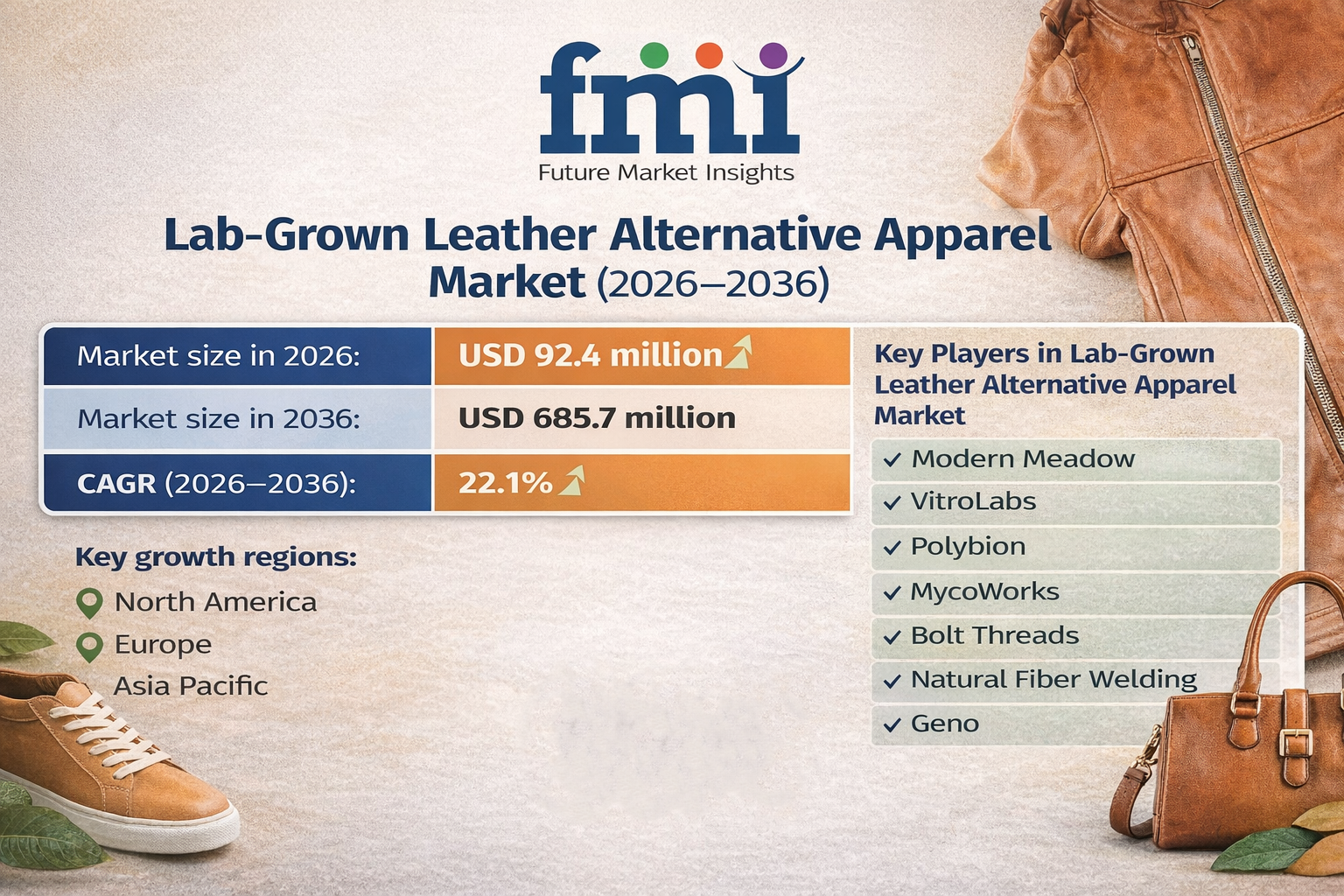
NEWARK, DE / ACCESS Newswire / March 20, 2026 / The global lab-grown leather alternative apparel market is set for exponential growth over the next decade, expanding from USD 92.4 million in 2026 to USD 685.7 million by 2036, registering a robust CAGR of 22.1%, according to the latest analysis by Future Market Insights (FMI). Growth is fueled by increasing investments in biotechnology, rising ESG compliance requirements, and the fashion industry's shift toward sustainable, high-performance material alternatives.
Traditional leather and synthetic substitutes face mounting scrutiny due to environmental impact, supply chain volatility, and waste inefficiencies. Lab-grown leather addresses these challenges through engineered cellular matrices that replicate the biochemical properties of animal hide while ensuring uniformity, reduced waste, and scalability-making it a transformative material for luxury apparel and accessories.
Lab-Grown Leather Alternative Apparel Market Snapshot (2026-2036)
Market size in 2026: USD 92.4 million
Market size in 2036: USD 685.7 million
CAGR (2026-2036): 22.1%
Leading apparel category: Luxury fashion apparel (~44.8% share)
Dominant material type: Cultured collagen leather (~41.6% share)
Key growth regions: North America, Europe, Asia Pacific
Fastest-growing countries: United States, France, Italy, United Kingdom, Germany, Japan, South Korea
Get Access of Report Sample: https://www.futuremarketinsights.com/reports/sample/rep-gb-32390
Market Momentum
The market begins at USD 92.4 million in 2026 and experiences rapid acceleration driven by early-stage adoption among luxury fashion houses and biotechnology scale-up initiatives. By 2031, increased bioreactor capacity and exclusive supplier partnerships push market valuation significantly higher.
Between 2031 and 2036, growth intensifies as commercial-scale production becomes viable, enabling broader integration into seasonal fashion lines. By 2036, the market reaches USD 685.7 million, maintaining a strong CAGR of 22.1% throughout the forecast period.
Why the Market Is Growing
Demand for lab-grown leather alternatives is rising due to their ability to combine sustainability with performance consistency. Luxury brands increasingly prioritize materials that meet ESG mandates while maintaining premium quality and durability.
Procurement teams are shifting toward biofabricated materials to mitigate risks associated with traditional leather supply chains, including land-use restrictions and environmental penalties. Additionally, engineered materials offer uniform thickness and eliminate natural defects such as scarring, significantly reducing cutting-room waste.
Biotechnology advancements allow precise control over material properties, enabling manufacturers to meet strict design and performance requirements across apparel and accessories.
Segment Spotlight
Apparel Category: Luxury Fashion Apparel Leads with ~44.8% Share
Luxury fashion dominates due to its ability to absorb high material costs while leveraging biofabricated leather for brand positioning and ESG compliance. Accessories and footwear follow as secondary adoption segments.
Material Type: Cultured Collagen Leather Anchors Demand (~41.6% Share)
Cultured collagen leather leads the market due to its compatibility with existing tannery infrastructure and ability to replicate the exact biochemical structure of natural hide. Mycelium-based and hybrid materials continue to evolve for specialized applications.
Production Technology: Cell Culture Bioreactor Production Leads (~46.3% Share)
Bioreactor-based production dominates as it enables continuous, scalable output necessary for commercial viability. Static fermentation methods remain limited to pilot-scale production.
Regional Growth: North America and Europe Drive Innovation, Asia Pacific Scales Production
North America leads in biotechnology innovation and venture capital investment, particularly in the United States, where advanced cellular agriculture infrastructure supports rapid scaling.
Europe drives adoption through stringent ESG regulations and strong influence from luxury fashion conglomerates in countries like France and Italy.
Asia Pacific is emerging as a key production hub, leveraging its manufacturing infrastructure to scale biofabrication processes efficiently.
Drivers, Opportunities, Trends, Challenges
Drivers:
Rising ESG mandates and sustainability compliance
Supply chain instability in traditional leather sourcing
Increasing investment in biotechnology and cellular agriculture
Opportunities:
Bioengineered material customization and performance tuning
Zero-waste manufacturing through precise material growth
Integration with heritage tannery finishing processes
Trends:
Shift toward biofabricated luxury materials
Strategic partnerships between fashion houses and biotech firms
Exclusive capacity agreements limiting early-stage supply
Challenges:
High capital expenditure for bioreactor scaling
Limited commercial-scale production capacity
Technical complexity in maintaining material integrity at scale
Country Growth Outlook (CAGR 2026-2036)
Country
CAGR
United States
23.8%
France
22.4%
Italy
21.7%
United Kingdom
20.9%
Germany
20.5%
Japan
19.4%
South Korea
18.8%
Competitive Landscape
The lab-grown leather alternative apparel market is highly specialized and innovation-driven, with competition centered on biotechnology capabilities, production scalability, and intellectual property.
Leading companies are focusing on scaling bioreactor capacity, optimizing collagen production processes, and forming exclusive partnerships with luxury fashion brands to secure long-term demand.
Key players include:
Modern Meadow, VitroLabs, Polybion, MycoWorks, Bolt Threads, Natural Fiber Welding, and Geno.
These companies compete based on their ability to deliver consistent, high-quality biofabricated materials at scale, while maintaining compatibility with existing fashion manufacturing infrastructure.
For an in-depth analysis of evolving formulation trends and to access the complete strategic outlook for the Lab-Grown Leather Alternative Apparel Market through 2036 , visit the official report page at: https://www.futuremarketinsights.com/reports/lab-grown-leather-alternative-apparel-market
Explore More Research Reports by FMI:
Solid Shampoo Bars Market: https://www.futuremarketinsights.com/reports/solid-shampoo-bars-market
Acne Treatment Solutions Market: https://www.futuremarketinsights.com/reports/acne-treatment-solution-market
Stick-Based Body Lotions Market: https://www.futuremarketinsights.com/reports/stick-based-body-lotions-market
Powdered Facial Toners Market: https://www.futuremarketinsights.com/reports/powdered-facial-toners-market
About Future Market Insights (FMI)
Future Market Insights (FMI) is a leading provider of market intelligence and consulting services, serving clients in over 150 countries. Headquartered in Delaware, USA, with a global delivery center in India and offices in the UK and UAE, FMI delivers actionable insights to businesses across industries including automotive, technology, consumer products, manufacturing, energy, and chemicals.
An ESOMAR-certified research organization, FMI provides custom and syndicated market reports and consulting services, supporting both Fortune 1,000 companies and SMEs. Its team of 300+ experienced analysts ensures credible, data-driven insights to help clients navigate global markets and identify growth opportunities.
For Press & Corporate Inquiries
Rahul Singh
AVP - Marketing and Growth Strategy
Future Market Insights, Inc.
+91 8600020075
For Sales - [email protected]
For Media - [email protected]
For web - https://www.futuremarketinsights.com/
SOURCE: Future Market Insights, Inc.