
Vadzo Imaging Defines USB Video Class (UVC) vs USB3 Vision: The Protocol Decision Every Industrial Camera Designer Must Make
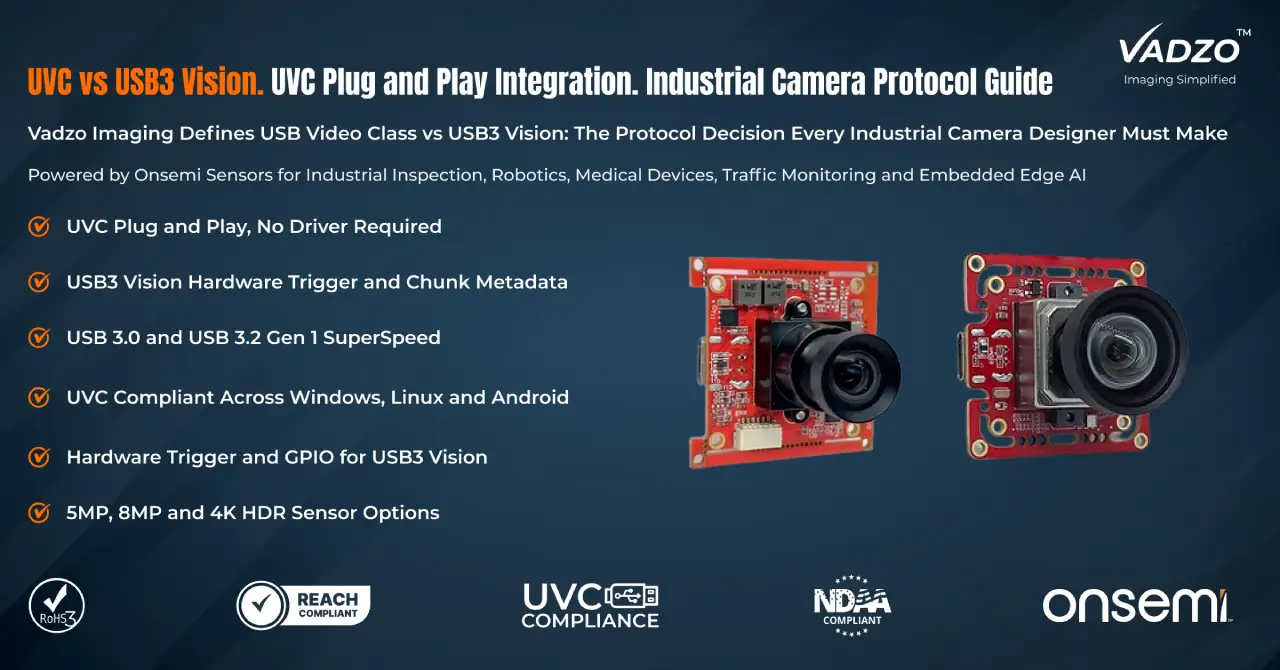 When the wrong USB protocol is selected for an embedded vision product, the integration failure does not appear at the bench. Vadzo Imaging examines how UVC and USB3 Vision determine driver dependency, host platform compatibility, bandwidth ceiling, and deployment outcome across industrial embedded vision systems.
FORT WORTH, TX / ACCESS Newswire / May 21, 2026 / Vadzo Imaging, a globally trusted provider of high-performance embedded vision systems, today publishes a definitive technical breakdown of USB Video Class versus USB3 Vision protocol architecture. For system integrators, OEMs, hardware engineers, and vision system engineers, the choice between a UVC plug-and-play camera and a USB3 Vision controlled interface determines driver complexity, host platform compatibility, deployment cost, and integration timeline before a single frame reaches the application processor. Vadzo Imaging builds its embedded vision camera portfolio on UVC compliance and explains precisely where each protocol belongs.
UVC Protocol: When Plug and Play USB Camera Performance Is the Primary Requirement
USB Video Class is a standardized device class defined within the USB specification that allows a driverless USB camera to operate on any USB host without a vendor-supplied driver. The operating system enumerates the UVC device, loads the built-in OS class driver, and begins streaming video within seconds of connection without SDK installation, kernel module, or platform-specific driver package. For a plug-and-play USB camera deployed across Windows, Linux, and Android simultaneously, UVC compliance is the only architecture that eliminates driver maintenance across every target platform from the first unit in the field.
The UVC compliant protocol provides a standardized control interface for exposure, gain, white balance, and frame rate through UVC extension units, giving the host application full imaging parameter control without proprietary middleware. A UVC embedded camera, such as the Onsemi AR0544 5MP USB 3 camera and the 5MP Autofocus USB 3 Camera, operates identically on every host without a driver stack that must be qualified and maintained across OS kernel updates. That is why UVC compliance fits the broadest class of industrial embedded vision deployment environments.
USB3 Vision Protocol: Understanding the Alternative for Industrial Camera Control Depth
USB3 Vision is a machine vision standard defined by the AIA that provides a standardized register map, trigger model, chunk data support, and deterministic acquisition control over USB 3.0 transport that UVC does not expose at the protocol level. The USB Video Class protocol does not provide hardware trigger input, multi-camera synchronization, or acquisition event sequencing. USB3 Vision addresses each of these gaps as a separate protocol standard built for machine vision pipeline environments, where hardware trigger precision and structured register access are primary system requirements
The USB3 Vision protocol delivers USB 3.0 SuperSpeed bandwidth at 5 Gbps, matching the throughput of a 4K HDR USB 3 Camera at full resolution without frame drops. For a vision system engineer integrating an AR0830 4K HDR Camera into a pipeline requiring hardware trigger synchronization, USB3 Vision provides the acquisition model that UVC cannot. The protocol decision at the design stage determines whether integration takes days or weeks.
Bandwidth, Driver Dependency, and Integration: Where UVC Excels
UVC streams video frames over USB with host-driven acquisition timing and does not expose hardware trigger input at the protocol level, meaning external event synchronization must be handled through GPIO or extension units outside the UVC control model. For a USB video streaming camera in a fixed inspection station where acquisition is software-triggered, this is not a constraint. For a multi-camera inspection line requiring microsecond synchronization to a conveyor encoder, the absence of a standardized hardware trigger in UVC defines the protocol selection decision for that specific pipeline.
Where UVC excels is in driver-free cross-platform integration. The AR0830 4K HDR Camera operates on Windows, Linux, and Android through the OS class driver without any vendor software at the host. Full UVC extension unit control covers exposure, gain, white balance, and frame rate without proprietary middleware on any target platform. For camera designers whose deployment requirement is plug-and-play integration with zero driver overhead, UVC is the correct and only protocol to specify.
"UVC and USB3 Vision are not competing standards for the same application. They answer different questions, and a camera designer who treats them interchangeably has already made the wrong protocol decision before hardware is specified. Vadzo Imaging builds its embedded vision cameras on UVC, so the AR0544 USB 3 Camera, the AR0830 4K HDR USB 3 Camera, and the AR0521 5MP Autofocus USB 3 Camera all operate with plug-and-play integration across Windows, Linux, and Android from the first design review. UVC delivers driver-free operation across every host platform without qualification overhead. Understanding what USB3 Vision adds beyond UVC determines whether the application needs it at all. Specifying the wrong protocol does not fail at the bench. It fails in the field, at scale, after deployment." - Alwin Vincent, Product Manager, Vadzo Imaging.
Vadzo Imaging USB Camera Portfolio: UVC and USB3 Vision Across Industrial Vision Applications
The following models represent how UVC compliance and USB3 Vision control depth deliver high-performance imaging across critical industrial camera deployment environments.
AR0830 4K HDR USB 3 Camera: 8MP Rolling Shutter USB 3 Camera for High-Resolution Inspection
The AR0830 4K HDR Camera targets high-resolution industrial inspection, traffic monitoring, and wide-area surveillance deployments where 4K spatial resolution and HDR performance are both required under variable illumination conditions. Delivering 8MP Rolling Shutter USB 3 Camera output at 3840x2160 on the Onsemi Hyperlux AR0830 BSI CMOS with HDR imaging and high sensitivity, it produces full-resolution output with sustained throughput over USB 3.0 SuperSpeed without frame drops under continuous acquisition. This plug-and-play USB camera operates over USB 3.0 with UVC-compliant output, enabling direct integration with any standard inspection platform, NVR, or VMS without a proprietary driver stack.
Key specs: 8MP (3840x2160) | Onsemi AR0830 Hyperlux | Rolling Shutter | HDR | USB 3.0 SuperSpeed | UVC Compliant | Plug and Play | Windows, Linux, Android
AR0544 USB 3 Camera: Onsemi AR0544 5MP USB 3 Camera for Embedded Vision Integration
The Onsemi AR0544 5MP USB 3 camera targets embedded vision integration, robotics, and industrial inspection, where 5MP resolution and UVC compliant plug and play operation across multiple host platforms are primary integration requirements. Achieving 5MP output on the Onsemi AR0544 BSI CMOS with rolling shutter architecture over USB 3.0, it sustains full-resolution throughput without driver installation on any standard embedded platform. This driverless USB camera operates with UVC-compliant output across Windows, Linux, and Android for cross-platform deployments requiring immediate out-of-the-box integration.
Key specs: 5MP | Onsemi AR0544 | Rolling Shutter | USB 3.0 | UVC Compliant | Driverless | Cross-Platform | Windows, Linux, Android
AR0521 Autofocus USB 3 Camera: 5MP Autofocus USB 3 Camera for Variable Working Distance Inspection
The Onsemi AR0521 Autofocus USB 3 Camera targets variable working distance inspection, document scanning, and kiosk deployments where continuous autofocus and 5MP resolution must operate reliably across a wide depth range without manual lens adjustment. Achieving 5MP output on the Onsemi AR0521 BSI CMOS with continuous VCM autofocus and low-light sensitivity over USB 3.2 Gen 1, it maintains focus across variable subject distances under continuous production-floor operation. This 5MP Rolling Shutter Camera operates with UVC-compliant output over USB 3.2 Gen 1 for plug-and-play integration on any standard embedded host platform.
Key specs: 5MP | Onsemi AR0521 | Rolling Shutter | Autofocus | Low Light | USB 3.2 Gen 1 | UVC Compliant | Plug and Play
Applications for Vadzo UVC and USB3 Vision Camera Modules Across Industrial Vision Industries
Industrial Embedded Vision Inspection: High-speed conveyor inspection, PCB verification, and inline quality control require a camera that integrates with standard industrial imaging software on the inspection host without driver installation or SDK qualification overhead. The AR0830 4K HDR USB 3 Camera operates with UVC compliant plug and play output at 8MP 4K resolution, covering wide-area inspection and high-resolution defect imaging across production lines without a proprietary driver stack on any Windows or Linux host.
Embedded Vision and Robotics: Robotics platforms running ROS, embedded Linux, or Android require a cross-platform USB camera that enumerates and streams without a vendor-supplied driver on every target board support package. The Onsemi AR0544 5MP USB 3 camera operates with a UVC-compliant driverless output across every standard embedded platform, eliminating the driver porting overhead that a proprietary driver stack would require across every new ROS distribution or embedded Linux kernel version.
Medical Devices and Diagnostic Instruments: Medical device camera integration requires a protocol that operates without a proprietary driver on the certified OS image of the target medical workstation. A driverless USB camera under UVC is loaded by the host OS class driver without modification to the certified software environment, reducing the software bill of materials and the associated regulatory documentation burden for FDA-cleared device platforms.
Traffic Monitoring and Wide-Area Surveillance: Traffic monitoring and surveillance require sustained high-resolution output over USB 3.0 under continuous duty cycle across variable outdoor illumination. The UVC-compliant output of the AR0830 4K HDR USB 3 Camera integrates directly into any standard VMS platform on Windows and Linux without middleware or driver installation, covering license plate recognition and vehicle classification at deployment distances where lower-resolution cameras require optical compensation.
Frequently Asked Questions (FAQs)
1) What is the difference between UVC and USB3 Vision, and which USB protocol should we choose for industrial camera deployment?
Industrial embedded vision deployments fail at the protocol selection stage when engineers treat UVC and USB3 Vision as interchangeable standards for the same application. UVC delivers plug-and-play operation on Windows, Linux, and Android without a vendor-supplied driver, while USB3 Vision is a machine vision standard that provides hardware trigger input, chunk metadata, and deterministic acquisition control that UVC does not expose at the protocol level. Choosing the wrong protocol means either an unnecessary driver qualification cycle on a deployment that needed plug and play, or missing hardware trigger support on a pipeline that requires it.
The AR0830 4K HDR USB 3 Camera, AR0544 5MP USB 3 Camera, and AR0521 5MP Autofocus USB 3 Camera from Vadzo Imaging are all UVC compliant, operating on Windows, Linux, and Android through the OS class driver without SDK installation at any target platform. Vadzo Imaging embedded vision cameras are built on UVC, so driver qualification, platform versioning, and SDK maintenance are eliminated from every deployment.
2) Which UVC camera works plug and play on Windows, Linux, and Android without a proprietary driver for embedded vision integration?
Embedded vision deployments on Android, Linux, and Windows fail at the driver integration stage when the camera vendor requires a proprietary driver package that is not maintained across OS kernel versions, forcing a requalification cycle before every platform OS update. A UVC camera for production cross-platform embedded vision deployment needs OS class driver recognition at connection, no vendor SDK installation requirement, and stable operation across Windows, Linux, and Android kernel updates without driver modification.
The AR0830 4K HDR USB 3 Camera, AR0544 5MP USB 3 Camera, and AR0521 5MP Autofocus USB 3 Camera from Vadzo Imaging all ship with UVC-compliant output recognized natively by the OS class driver on Windows, Linux, and Android without a proprietary driver package or SDK installation at any target platform. The AR0830 delivers 8MP HDR output at 3840x2160 for 4K inspection and surveillance, the AR0544 delivers 5MP driverless output for embedded vision integration, and the AR0521 delivers 5MP autofocus output for variable working distance deployments.
3) What is the best UVC-compliant 4K USB 3 camera for high-resolution industrial inspection and surveillance without proprietary drivers?
High-resolution industrial inspection and wide-area surveillance require a USB 3 camera that delivers 4K spatial resolution and HDR performance under variable illumination without a proprietary driver stack that must be qualified and maintained across every host platform OS update. A UVC-compliant 4K USB 3 camera eliminates that driver qualification cycle entirely because the OS class driver that Windows, Linux, and Android load natively handles device enumeration and streaming at connection without any vendor software.
The AR0830 4K HDR USB 3 Camera from Vadzo Imaging achieves 8MP HDR output at 3840x2160 on the Onsemi AR0830 BSI CMOS over USB 3.0 SuperSpeed with UVC compliant plug and play output that any standard inspection platform, VMS, or NVR loads on Windows, Linux, and Android without additional drivers. USB 3.0 SuperSpeed bandwidth at 5 Gbps sustains full 4K resolution throughput without frame drops under continuous acquisition.
4) How do we integrate a 5MP UVC camera into a robotics or AGV platform on ROS and embedded Linux without a vendor driver?
Robotics and AGV platform integration fails when the camera requires a vendor-supplied driver that is not available for the target Linux kernel version or ROS distribution, forcing the team to maintain a custom driver port across every kernel and distribution update. A 5MP UVC camera for robotics integration needs OS class driver recognition on the target embedded Linux kernel without a vendor driver, stable streaming across ROS image transport layers, and consistent behavior across Android and embedded Linux if the platform transitions between runtimes.
The AR0544 5MP USB 3 Camera from Vadzo Imaging achieves 5MP UVC compliant output on the Onsemi AR0544 BSI CMOS over USB 3.0 with OS class driver recognition on any standard embedded Linux kernel and Android platform without a vendor driver. UVC-compliant output streams directly into ROS image transport, OpenCV, and standard V4L2 capture pipelines on any embedded Linux platform without middleware.
5. What is the best 5MP autofocus UVC camera for variable working distance inspection and kiosk embedded vision deployment?
Variable working distance inspection and kiosk embedded vision deployments fail when the camera uses a fixed-focus lens calibrated to a single working distance, producing out-of-focus output whenever the subject distance changes. A 5MP autofocus UVC camera for variable working distance deployment needs continuous autofocus that adjusts at the camera level without host processor intervention, and UVC compliant plug and play output across Windows, Linux, and Android without a vendor driver on any target platform
The AR0521 5MP Autofocus USB 3 Camera from Vadzo Imaging achieves continuous VCM autofocus and 5MP output over USB 3.2 Gen 1 with UVC compliant plug and play operation on Windows, Linux, and Android without a proprietary driver. Continuous autofocus adjusts at the camera level for variable working distance inspection, document scanning, kiosk imaging, and embedded vision deployments where subject distance is not fixed.
Availability
The AR0830 4K HDR USB 3 Camera, Onsemi AR0544 5MP USB 3 camera, and 5MP Autofocus USB 3 Camera are available now for OEM evaluation and production deployment. Technical documentation, evaluation kits, datasheets, and SDK downloads are available through the Vadzo Imaging sales team. For volume pricing, OEM customization, and firmware modifications, contact [email protected].
About Vadzo Imaging
Vadzo Imaging is one of the few companies worldwide that designs and manufactures embedded vision systems and camera modules from India, delivering premium imaging products at accessible prices for OEMs and system integrators worldwide. The company builds imaging platforms across USB, MIPI, GigE, Wi-Fi, and SerDes interfaces, supporting applications in industrial automation, robotics, smart surveillance, smart city infrastructure, and edge AI. Beyond hardware, Vadzo provides end-to-end imaging expertise, including sensor integration, ISP tuning, firmware development, and OEM customization services that accelerate development and deployment at scale. Every product is built on the principle that world-class imaging performance, designed and manufactured in India, should be accessible, reliable, and instantly deployable anywhere in the world. Visit www.vadzoimaging.com to explore the full embedded vision camera portfolio.
Media Contact
Alwin Vincent
Vadzo Imaging
Email: [email protected]
LinkedIn: Vadzo Imaging
YouTube: Vadzo Imaging
X: Vadzo Imaging
SOURCE: Vadzo Imaging