
25 Years After 9/11: Building Security Technology Failed to Keep Up
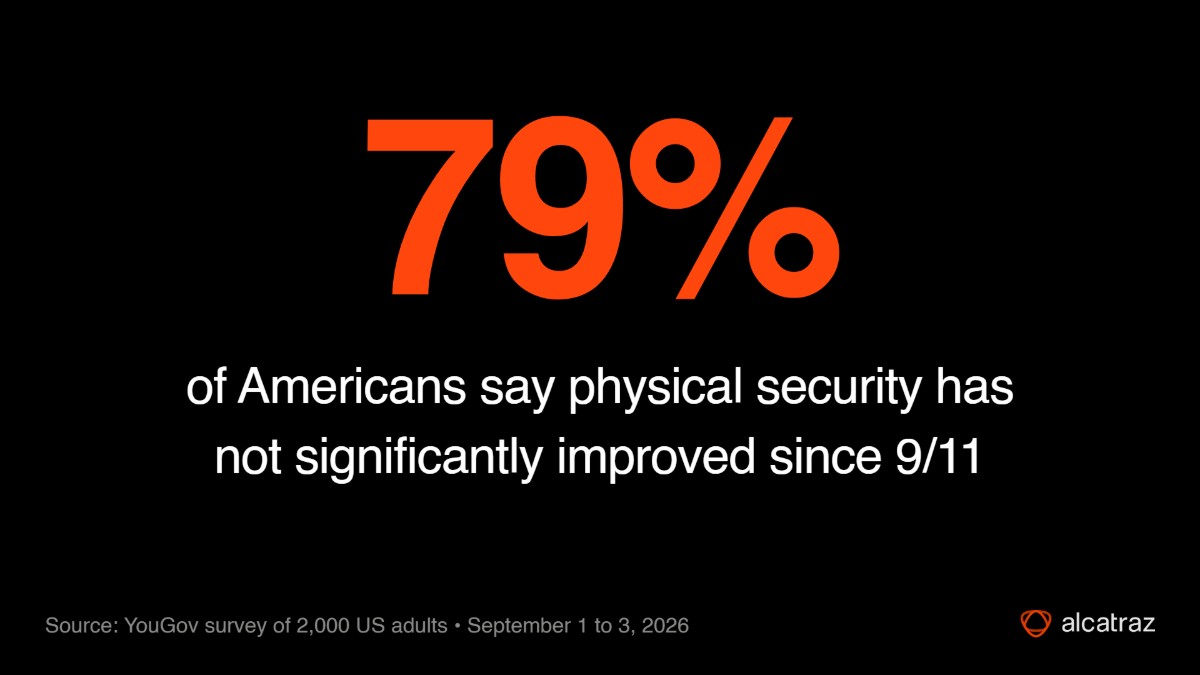 New national survey finds 79% of Americans don't believe physical security has significantly improved in buildings since 9/11
CUPERTINO, Calif., Sept. 10, 2026 /PRNewswire/ -- Twenty-five years after the September 11 attacks reshaped aviation security in the United States, a new national survey finds most Americans do not believe physical security in the country's buildings has kept pace. According to the survey, 79% of U.S. adults do not believe physical security has significantly improved since 9/11, and 76% say office buildings never received investment comparable to what went into airports. The survey, conducted by YouGov, is the first national survey to measure public trust in badge- and credential-based physical security systems, 25 years after 9/11.
The survey was funded by Alcatraz after a summer of security breaches at four prominent U.S. buildings. In May, an intruder tailgated students through secured doors into UCLA dormitories, where he is accused of sexually assaulting four women in their rooms. That same week, a man followed a student through a card-secured gate and then a badge-secured door at Harvard University's Lowell House. He attempted to kidnap a female undergrad before she fought him off with the help of other students. In June, two people purchased tickets to the Empire State Building's 86th-floor observatory, hid inside after closing, and cut through two locks overnight to reach restricted floors. They went undetected until they livestreamed the breach from the building's spire to nearly two million followers that afternoon. Weeks later, a man followed an employee through a badge-secured door at 30 Rockefeller Center in New York and confronted TODAY show anchor Craig Melvin, before being detained by security.
Three of the four incidents involved tailgating, in which an unauthorized person follows someone with a valid credential through a secured door. It is the number one breach of secure spaces. Security industry researchers have identified tailgating as a persistent vulnerability in badge-based access control systems, which are designed to verify a credential but not the identity of the person using it.
"We have spent 25 years upgrading aviation security with the latest technologies but have not kept pace in the spaces where most of us live and work. Keycard and badge technology is 30 years old. It is completely unintelligent. These headline breaches this summer are a warning about the need to upgrade physical security in our buildings, and Americans are saying it is urgent," said Tina D'Agostin, CEO of Alcatraz AI. D'Agostin is a security expert who helped shape physical security efforts for Chase Center and Salesforce Tower while at Johnson Controls.
Survey findings
"I spent a big part of my career securing airports. After 9/11, airports received investment, became more secure and learned to balance security with the passenger experience. We never did the same for the buildings people spend their days in. Nuclear and energy companies, data centers and critical infrastructure use state of the art technology. Updating technology to secure everyday spaces is long overdue, and the survey shows Americans understand that," said Matthew Powell, Senior Director of Infrastructure Markets at Alcatraz AI.
About Alcatraz AI
Alcatraz is known as the Face ID of physical spaces. Alcatraz is an AI-powered physical access control company headquartered in Cupertino, California. Its flagship product, the Rock, replaces badge-based and legacy biometric security with fully anonymized facial authentication and real-time tailgating detection. Alcatraz AI is trusted where security standards are highest and certifications hardest to earn: hyperscale data centers, financial institutions, airports, and nuclear and energy infrastructure. Its technology protects professional sports teams from the NBA to the NFL, Fortune 100 companies, universities, stadiums, and private individuals.
Media Contact
[email protected]
SOURCE Alcatraz