
Japan Ready-to-Drink Cocktails Market, Set to Reach USD 358.67 Million by 2036 | Diageo, Bacardi, Brown-Forman Drive Growth, FMI Report
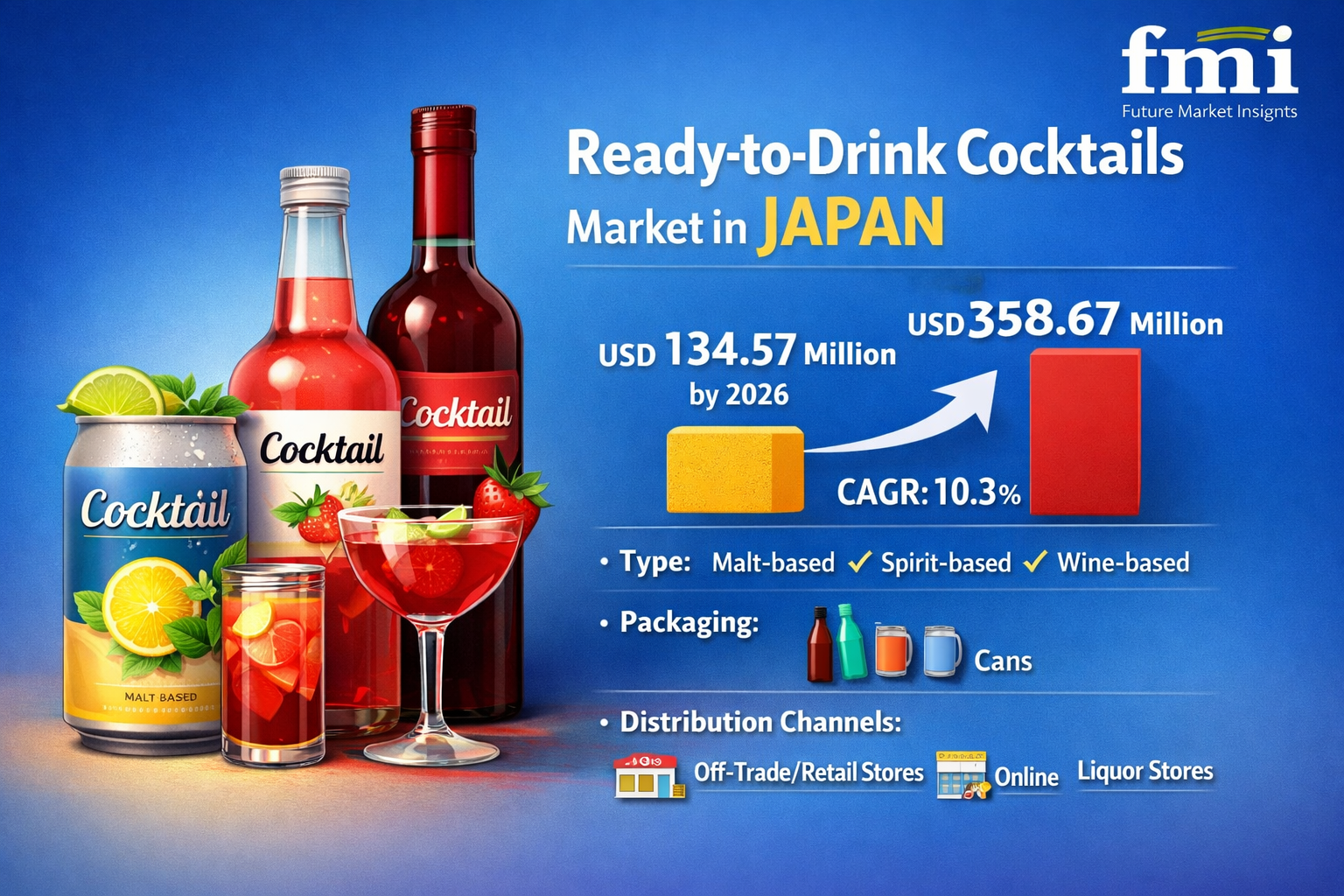 Japan leads the global RTD cocktails market, driven by convenience trends, retail expansion, and innovation, with strong growth supported by major beverage companies.
NEWARK, DE / ACCESS Newswire / April 7, 2026 / The Japan Ready-to-Drink (RTD) Cocktails Market is emerging as one of the fastest-growing segments within the broader food & beverages industry, supported by evolving consumer lifestyles and strong retail infrastructure.
According to the latest analysis by Future Market Insights (FMI):
Market Value (2025): USD 122.00 Million
Estimated Value (2026): USD 134.57 Million
Forecast Value (2036): USD 358.67 Million
CAGR (2026-2036): 10.3%
Incremental Opportunity: USD 224.10 Million
The category is defined by format-driven consumption, where single-serve convenience, retail shelf visibility, and rapid product innovation cycles determine competitive success.
Request Your Sample Now - Unlock Growth Potential and Discover Key Market Opportunities! https://www.futuremarketinsights.com/reports/sample/rep-gb-29621
Executive Summary for Decision-Makers
RTD cocktails in Japan represent a format-driven, retail-controlled growth market, where success is less dependent on brand equity and more on distribution access, pricing optimization, and product innovation velocity. The competitive battleground is shifting toward convenience store shelf access (konbini) and seasonal SKU rotation cycles.
Key Demand Drivers
1. Convenience-Led Consumption Patterns
Urban consumers increasingly prefer single-serve, ready-mixed beverages that eliminate preparation time. RTD cocktails align with on-the-go and at-home drinking occasions.
2. Expansion of At-Home Drinking Culture
Post-pandemic behavioral shifts continue to sustain off-trade demand, with consumers seeking variety and premium experiences at home.
3. Favorable Excise Tax Structure
Japan's regulatory framework provides tax advantages for malt-based RTDs, enabling competitive pricing against beer and traditional alcoholic formats.
4. Innovation and Flavor Proliferation
Frequent product launches featuring seasonal, fruit-based, and low-alcohol variants are expanding consumer appeal, particularly among younger demographics.
Supply Chain Dynamics: Who Supplies Whom
The RTD cocktail value chain in Japan is tightly integrated and retail-driven:
Raw Material Suppliers:
Alcohol bases (malt, spirits, wine), flavoring agents, carbonation inputs, and packaging materials are supplied to manufacturers.
Manufacturers / Brand Owners:
Companies such as Ranch Rider Spirits Co., House of Delola, LLC, Diageo plc, Brown-Forman, and Bacardi Limited produce and brand RTD cocktails.
Distributors / Wholesalers:
National and regional beverage distributors manage logistics, compliance, and retailer relationships.
Retail Channels (Primary Demand Gatekeepers):
Convenience stores (dominant channel)
Supermarkets
Liquor stores
E-commerce platforms
End Consumers:
Urban professionals, younger consumers, and at-home drinkers.
Critical Insight:
Convenience store listing agreements determine market access, making distribution partnerships more valuable than marketing spend for new entrants.
Segment Analysis
By Product Type
Malt-Based RTDs: 60% market share (2026)
Driven by tax benefits and familiarity (e.g., chuhai, highballs)
Spirit-Based RTDs
Wine-Based RTDs
By Packaging
Bottles: 72% share (2026)
Premium perception, resealability, longer shelf life
Cans
By Distribution Channel
Off-trade retail (dominant)
Online platforms
Liquor stores
Pricing Trends and Margin Dynamics
Price Competitiveness: Malt-based RTDs benefit from lower excise duties, enabling price parity or advantage over beer.
Premiumization: Bottle formats support higher price points, especially for craft and imported variants.
Promotional Cycles: Frequent seasonal rotations lead to short-term discounting strategies to maintain shelf presence.
Margin Pressure: Retailers, especially konbini chains, exert strong control over pricing and shelf allocation, compressing supplier margins.
Regional Analysis
Region
CAGR (2026-2036)
Key Growth Drivers
Kyushu & Okinawa
12.8%
Tourism, hospitality expansion
Kanto
11.8%
Urban density, Tokyo consumption hub
Kansai
10.4%
Food culture, nightlife
Chubu
9.1%
Growing urban demand
Tohoku
8.0%
Gradual adoption
Rest of Japan
7.6%
Replacement-driven demand
Strategic Insight:
High-growth regions (Kyushu & Okinawa, Kanto) are characterized by dense distribution networks and high consumption velocity, making them priority markets for expansion.
Competitive Landscape
The competitive environment is shaped by four critical factors:
Retail Shelf Access (Konbini Listings)
Speed of Product Innovation
Excise Category Optimization
Seasonal Portfolio Rotation
Key Players:
Ranch Rider Spirits Co.
House of Delola, LLC
Diageo plc
Brown-Forman
Bacardi Limited
Market Reality:
Established players with existing retail relationships and distribution infrastructure hold a structural advantage over new entrants.
Key Trends Shaping the Market
The Japan RTD cocktails market is being shaped by rapid seasonal SKU rotations in convenience stores, rising demand for low-alcohol and functional beverages, and increasing preference for premium glass bottle packaging, which enhances value perception. At the same time, frequent flavor innovations are shortening product lifecycles, while retail consolidation is strengthening buyer power, making shelf access more competitive.
However, the market faces notable constraints, including a growing health-conscious shift toward low- and no-alcohol alternatives, potential regulatory and tax changes affecting pricing, and intense competition from beer, sake, and traditional spirits. Additionally, limited shelf space in retail outlets and consumer fatigue from excessive product variety may hinder sustained growth.
Despite these challenges, significant investment opportunities exist. Strategic focus on konbini (convenience store) distribution partnerships offers high returns through strong market access. Expanding malt-based RTDs can capitalize on tax benefits, while premium and craft offerings appeal to urban consumers. Further growth can be unlocked through regional expansion in high-growth areas like Kyushu & Okinawa and Kanto, alongside building agile innovation pipelines aligned with fast-changing retail cycles.
Future Outlook (2026-2036)
The Japan RTD cocktail market is expected to evolve into a high-frequency innovation category where:
Retail ecosystems dictate success more than brand equity
Speed-to-market becomes a core competitive capability
Premiumization and convenience converge to define product positioning
Over the next decade, companies that successfully integrate distribution control, pricing strategy, and rapid product innovation will capture disproportionate market share.
Analyst Perspective
Industry analysts emphasize that Japan's RTD cocktail segment is among the fastest-moving categories in the alcoholic beverage space, where distribution access-not branding-determines consumer adoption. Suppliers lacking established convenience store networks face significant structural barriers despite strong product offerings.
Conclusion
Japan's RTD cocktail market presents a high-growth, high-barrier opportunity within the broader food & beverages industry. For decision-makers, success will depend on strategic alignment with retail channels, regulatory optimization, and continuous product innovation, positioning RTD cocktails as a cornerstone of the next-generation alcoholic beverage landscape.
For an in-depth analysis of evolving formulation trends and to access the complete strategic outlook for the Demand for Ready To Drink Cocktails in Japan through 2036, Full Report Request - https://www.futuremarketinsights.com/reports/japan-ready-to-drink-cocktails-market
Related Reports:
Ready To Drink Cocktails Market: https://www.futuremarketinsights.com/reports/ready-to-drink-cocktails-market
Ready-to-drink Beverage Market: https://www.futuremarketinsights.com/reports/ready-to-drink-beverages-market
Ready-to-Serve Cocktails Market: https://www.futuremarketinsights.com/reports/ready-to-serve-cocktails-market
RTD Cocktail Market: https://www.futuremarketinsights.com/reports/rtd-cocktails-market
RTD Bottled Cocktail Market: https://www.futuremarketinsights.com/reports/rtd-bottled-cocktails-market
About Future Market Insights (FMI)
Future Market Insights (FMI) is a leading provider of market intelligence and consulting services, serving clients in over 150 countries. Headquartered in Delaware, USA, with a global delivery center in India and offices in the UK and UAE, FMI delivers actionable insights to businesses across industries including automotive, technology, consumer products, manufacturing, energy, and chemicals.
An ESOMAR-certified research organization, FMI provides custom and syndicated market reports and consulting services, supporting both Fortune 1,000 companies and SMEs. Its team of 300+ experienced analysts ensures credible, data-driven insights to help clients navigate global markets and identify growth opportunities.
For Press & Corporate Inquiries
Rahul Singh
AVP - Marketing and Growth Strategy
Future Market Insights, Inc.
+91 8600020075
For Sales - [email protected]
For Media - [email protected]
For web - https://www.futuremarketinsights.com/
SOURCE: Future Market Insights, Inc.