
Unified Namespace Market to Surpass USD 11.6 Billion by 2036 as Industrial Data Architectures Evolve
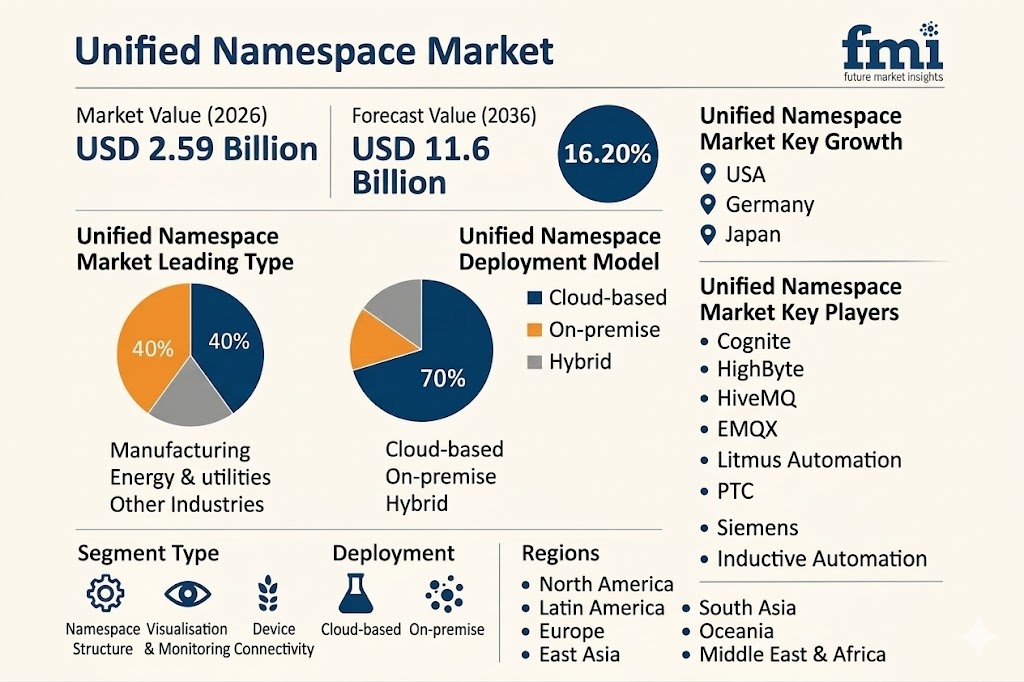 Accelerated adoption of event-driven architectures and real-time data standardization is transforming industrial ecosystems, positioning Unified Namespace as the backbone of next-generation smart manufacturing and IIoT integration.
NEWARK, DE / ACCESS Newswire / March 18, 2026 / The global Unified Namespace (UNS) market is undergoing rapid expansion as industrial enterprises modernize their data infrastructure to support real-time analytics and scalable digital transformation. Valued at USD 2.59 billion in 2026, the market is projected to reach USD 11.6 billion by 2036, registering a strong CAGR of 16.2%, according to recent insights from Future Market Insights (FMI).
This surge is driven by the growing need to replace fragmented, point-to-point industrial communication systems with centralized, event-driven architectures capable of handling high-frequency machine data across enterprise ecosystems.
Get Access of Report Sample: https://www.futuremarketinsights.com/reports/sample/rep-gb-32174
Industrial Data Transformation Drives Unified Namespace Adoption
The rise of smart manufacturing, industrial IoT (IIoT), and AI-powered analytics is pushing traditional automation systems beyond their limits. Legacy SCADA-based architectures are increasingly unable to manage the volume, velocity, and variety of modern industrial data.
Unified Namespace has emerged as a critical middleware layer, enabling organizations to standardize and contextualize operational technology (OT) data in real time.
Key transformation drivers include:
Increasing demand for real-time, low-latency data pipelines
Transition toward event-driven, publish-subscribe architectures (MQTT)
Growing need for enterprise-wide data visibility and interoperability
Expansion of AI and predictive maintenance applications
Market Forecast Overview (2026-2036)
Metric
Details
Market Value (2026)
USD 2.59 Billion
Forecast Value (2036)
USD 11.6 Billion
Projected CAGR
16.2%
Leading Component
Software (64% Share)
Leading Deployment
Hybrid (52% Share)
Leading End Use
Energy & Utilities (52% Share)
High-Growth Regions
Asia-Pacific, North America, Europe
From Legacy Systems to Event-Driven Architectures
Industrial enterprises are actively dismantling outdated telemetry infrastructures to unlock scalable data integration. Unified Namespace architecture replaces rigid point-to-point connections with a centralized data model that ensures a single source of truth across operations.
System integrators and automation architects are prioritizing UNS as a foundational requirement in digital transformation initiatives.
Strategic benefits include:
Elimination of complex custom middleware
Seamless integration between factory floor and cloud platforms
Standardized data models across multi-vendor environments
Faster deployment through pre-configured integration templates
Segment Insights: Software and Hybrid Deployment Lead Growth
The market is witnessing strong traction across software platforms and hybrid deployment models, as enterprises seek flexibility and scalability.
Software Segment (64% Share): Enterprises favor commercial, off-the-shelf platforms offering enterprise-grade security, support, and compliance features.
Hybrid Deployment (52% Share): Combines on-premise control for critical operations with cloud-based analytics for scalability and advanced insights.
Data Contextualization & Modeling (36% Share): Increasing demand for automated semantic modeling tools that eliminate manual data tagging.
End-Use Expansion: Energy & Utilities Dominate Demand
The energy and utilities sector leads adoption, accounting for approximately 52% of market share, driven by grid modernization and renewable energy integration.
Key use cases include:
Real-time monitoring of distributed energy assets
Integration of renewable sources like solar and wind
Edge processing for low-latency decision-making
AI-driven predictive maintenance in critical infrastructure
Regional Outlook: Asia-Pacific Emerges as High-Growth Hub
Regional growth patterns highlight strong adoption across industrial economies, with Asia-Pacific leading the acceleration.
India (20.0% CAGR): Rapid industrial digitalization and pilot-led adoption among tier-1 manufacturers
China (19.0% CAGR): Government-driven automation mandates and large-scale digital infrastructure investments
Germany (18.0% CAGR): High robot density and demand for interoperable industrial standards
USA (17.0% CAGR): Strong cybersecurity frameworks and enterprise AI adoption
These trends underscore the global shift toward standardized, scalable industrial data architectures.
Challenges: Cybersecurity and Integration Complexity
Despite strong growth, the Unified Namespace market faces several structural challenges that could influence adoption rates.
Key constraints include:
Rising cybersecurity risks in interconnected industrial networks
Integration complexity with legacy systems and proprietary protocols
High initial investment in infrastructure transformation
Shortage of skilled professionals in OT-IT convergence
To address these issues, organizations are increasingly adopting zero-trust architectures and secure MQTT brokers with granular access controls.
Competitive Landscape: Innovation and Partnerships Shape Market Dynamics
The Unified Namespace ecosystem is highly competitive, with leading technology providers focusing on innovation, interoperability, and strategic collaborations.
Key players include:
Cognite
HighByte
HiveMQ
EMQX
Litmus Automation
PTC
Siemens
Inductive Automation
These companies are investing in:
AI-powered data contextualization
Edge-to-cloud integration platforms
Pre-built industrial connectors and templates
Advanced security and governance frameworks
Strategic partnerships between industrial software vendors and cloud providers are further accelerating market adoption.
Executive Takeaways: Strategic Imperatives for Industry Leaders
As Unified Namespace becomes central to industrial digital transformation, organizations must align their strategies to remain competitive.
Key recommendations:
Prioritize platforms with native edge-to-cloud integration capabilities
Standardize data models across all new equipment deployments
Invest in secure, low-latency messaging infrastructure
Partner with vendors offering proven interoperability and scalability
The Road Ahead: From Optional Architecture to Industrial Standard
By 2036, Unified Namespace is expected to evolve from a specialized architectural approach into a core requirement for industrial data management. As enterprises increasingly rely on real-time insights, AI, and automation, the need for a unified, scalable, and secure data backbone will become non-negotiable.
With strong momentum across industries and regions, the Unified Namespace market is poised to redefine how industrial data is structured, accessed, and leveraged-unlocking a new era of efficiency, intelligence, and innovation in global manufacturing ecosystems.
For an in-depth analysis of evolving formulation trends and to access the complete strategic outlook for the Collaborative Mobile-Manipulator Robots Market through 2036, Full Report Request: https://www.futuremarketinsights.com/reports/unified-namespace-market
Related Reports:
Autonomous Machines for Non-Standard Industrial Tasks Demand- https://www.futuremarketinsights.com/reports/autonomous-machines-for-non-standard-industrial-tasks-demand
Industrial AGV Swarm-Management Software Market- https://www.futuremarketinsights.com/reports/industrial-agv-swarm-management-software-market
Industrial DataOps Market- https://www.futuremarketinsights.com/reports/industrial-dataops-market
About Future Market Insights (FMI)
Future Market Insights (FMI) is a leading provider of market intelligence and consulting services, serving clients in over 150 countries. Headquartered in Delaware, USA, with a global delivery center in India and offices in the UK and UAE, FMI delivers actionable insights to businesses across industries including automotive, technology, consumer products, manufacturing, energy, and chemicals.
An ESOMAR-certified research organization, FMI provides custom and syndicated market reports and consulting services, supporting both Fortune 1,000 companies and SMEs. Its team of 300+ experienced analysts ensures credible, data-driven insights to help clients navigate global markets and identify growth opportunities.
For Press & Corporate Inquiries
Rahul Singh
AVP - Marketing and Growth Strategy
Future Market Insights, Inc.
+91 8600020075
For Sales - [email protected]
For Media - [email protected]
For web - https://www.futuremarketinsights.com/
SOURCE: Future Market Insights, Inc.