
New Index Reveals Gaps in Global Food System Resilience and How to Close Them
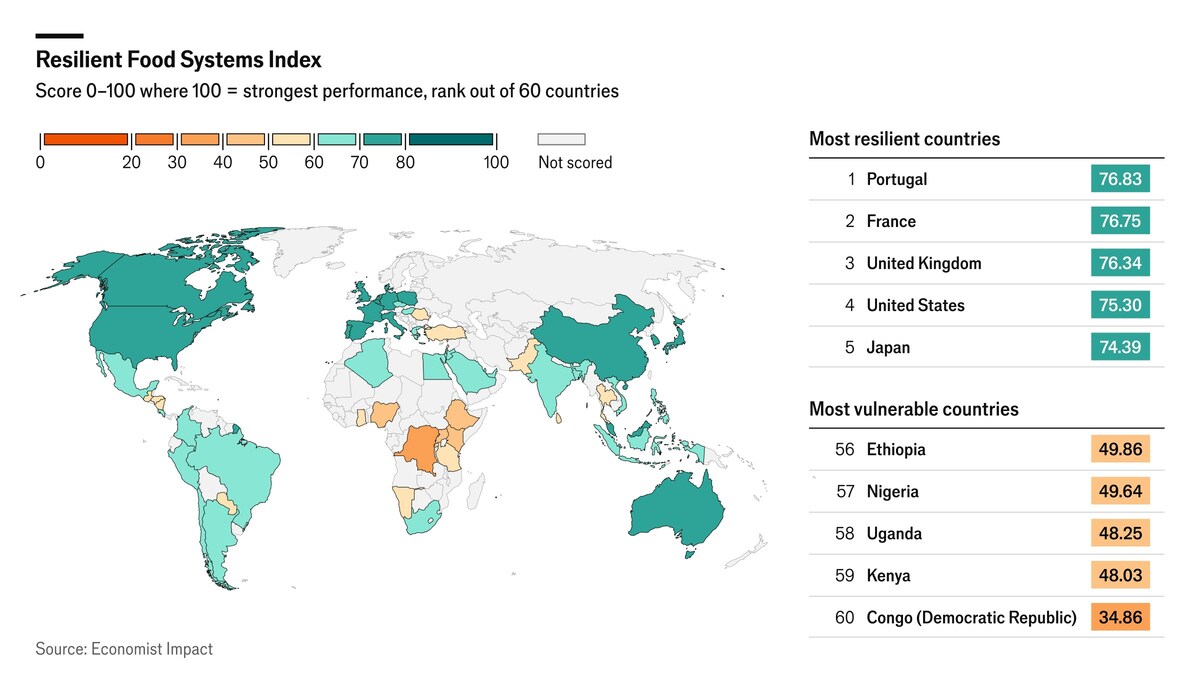 LONDON, March 17, 2026 /PRNewswire/ -- As global food systems face the challenge of feeding ten billion people by 2050, new data from Economist Impact's inaugural Resilient Food Systems Index (RFSI) offers a clear roadmap to build stronger, more shock-resistant systems.
The Index ranks 60 countries across four pillars, finding a striking 42-point gap between Portugal and the Congo (Dem. Rep.), the most and least resilient food systems. While no country is fully resilient, nearly half of countries fall into the "middle zone" with average scores of 56 to 71 on a 100-point scale, signaling significant potential to strengthen system-wide resilience.
The strongest-performing pillar overall is affordability of food, but alone it does not guarantee resilience. In 62% of countries, the cheapest healthy diet absorbs nearly two-thirds of the poorest households' income, underscoring the need to pair affordability with equitable access to nutritious food.
This access depends on reliable supply and trade. The Index highlights that the fifteen largest exporters producing 70% of the world's food have an average resilience score of 71, reinforcing the need to monitor risks and opportunities. These countries play an outsized role in global food-system resilience: when they function well, they stabilize markets globally; when they falter, the impact is felt around the world.
"The data show food systems are deeply interconnected: when countries implement targeted, coordinated action across key resilience levers, the benefits ripple across entire systems." said Jonathan Birdwell, global head of policy and insights at Economist Impact. "But if these interventions fall short or happen in isolation, overall system resilience will deteriorate."
Key Findings from the Resilient Food Systems Index
The RFSI is based on novel, independent research led by Economist Impact, building on more than a decade of food systems research. It uses a dynamic benchmarking model of 71 qualitative and quantitative indicators across four pillars. The Index outlines key gaps across global food systems:
Despite cost-of-living increases, food affordability is strong, but access and nutrition gaps persist.
Infrastructure remains an essential, yet lagging, foundation for food availability.
Limits in climate resilience threaten food system stability.
Three key strategies to accelerate future-proof food systems
To address these vulnerabilities and lift countries out of the "middle zone," the Index outlines priority areas for coordinated action:
"Everyone needs dependable access to nutritious, affordable food," said Brian Sikes, Board Chair and CEO of Cargill. "This research offers valuable insights that can help strengthen the world's food systems. Cargill is proud to do our part to advance this important work, innovating with farmers, customers, and partners across our global supply chains to help ensure food moves where it's needed, when it's needed."
The Resilient Food Systems Index is part of The Food Imperative, a multi-year program from Economist Impact exploring the future of global food systems through data, insight and policy engagement. The RFSI was supported by Cargill.
To access the full Resilient Food Systems Index and methodology, visit: https://impact.economist.com/energy-environment/resilient-food-systems-index
About Economist Impact
Economist Impact combines the rigour of a think-tank with the creativity of a media brand to engage a globally influential audience. We believe that evidence-based insights can open debate, broaden perspectives and catalyse progress. The services offered by Economist Impact previously existed within The Economist Group as separate entities, including EIU Thought Leadership, EIU Public Policy, Economist Events, El Studios and SignalNoise.
Our track record spans 75 years across 205 countries. Along with creative storytelling, events expertise, design-thinking solutions and market-leading media products, we produce framework design, benchmarking, economic and social impact analysis, forecasting and scenario modelling, making Economist Impact's offering unique in the marketplace. Visit www.economistimpact.com for more information.
About Cargill
Cargill is committed to providing food, ingredients, agricultural solutions, and industrial products to nourish the world in a safe, responsible, and sustainable way. Sitting at the heart of the supply chain, we partner with farmers and customers to source, make and deliver products that are vital for living.
Our 155K+ employees innovate with purpose, providing customers with life's essentials so businesses can grow, communities prosper, and consumers live well. With 160 years of experience as a family company, we look ahead while remaining true to our values. We put people first. We reach higher. We do the right thing—today and for generations to come. For more information, visit Cargill.com and our News Center.
SOURCE Economist Impact