
EV Lighting Market to Reach USD 22.42 Billion by 2036 as LED and Adaptive Systems Transform Electric Vehicle Design
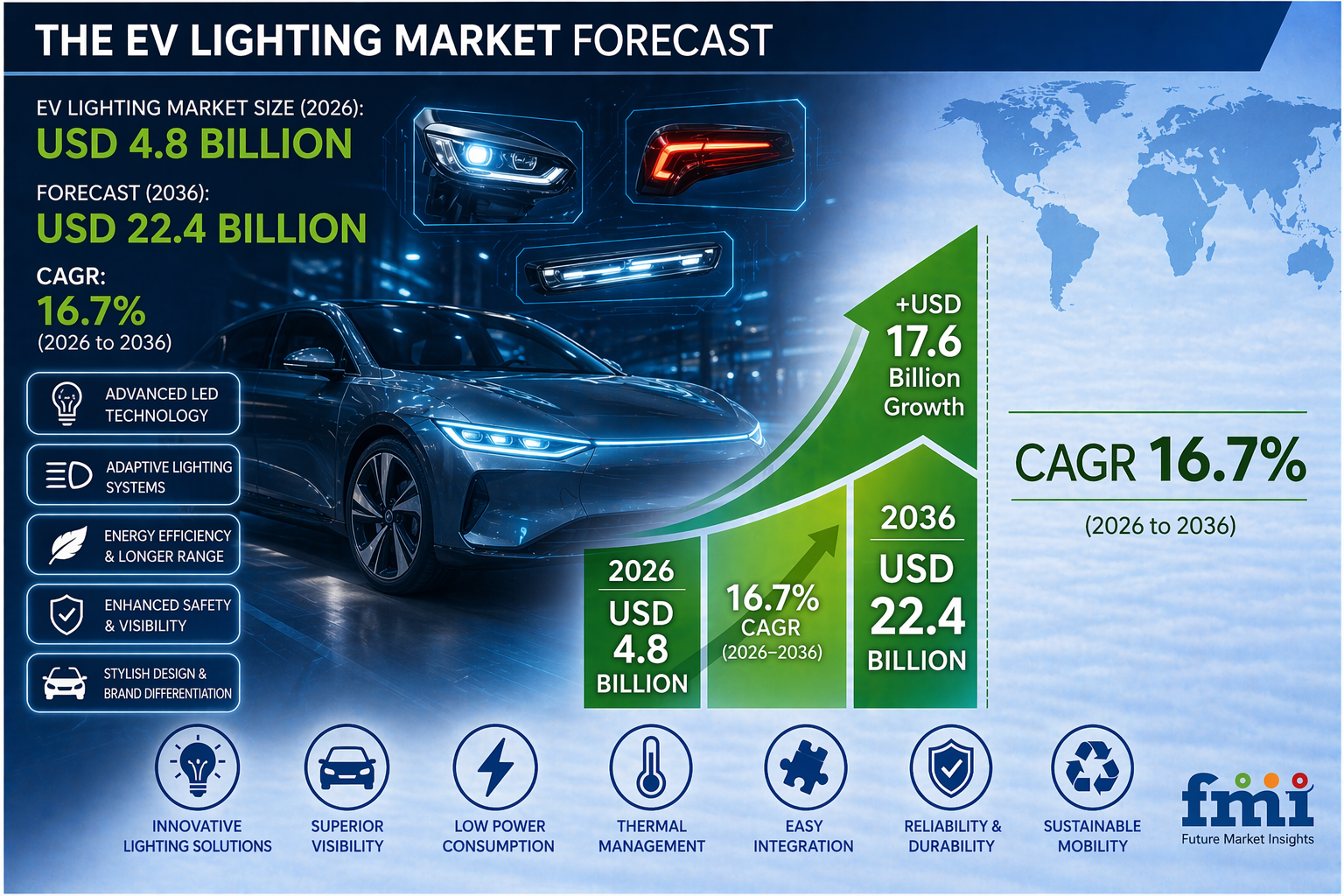 Rising EV production, OEM integration of advanced lighting technologies, and growing demand for energy-efficient and smart lighting solutions drive a 16.7% CAGR through 2036
NEWARK, DE / ACCESS Newswire / April 27, 2026 / According to the latest analysis by Future Market Insights, the global EV lighting market is entering a high-growth phase as electric vehicle production accelerates and OEMs increasingly integrate advanced lighting technologies to enhance efficiency, safety, and vehicle design. Valued at USD 4.10 billion in 2025, the market is projected to reach USD 4.78 billion in 2026 and expand significantly to USD 22.42 billion by 2036, registering a CAGR of 16.7% during the forecast period.
This growth reflects a structural transformation in the automotive industry, where lighting systems are evolving from basic functional components into high-value, technology-driven systems that contribute to energy efficiency, brand differentiation, and advanced driver assistance capabilities. As EV adoption rises globally, lighting systems-particularly LED and adaptive technologies-are becoming standard across vehicle platforms.
Get detailed market forecasts, competitive benchmarking, and pricing trends:
https://www.futuremarketinsights.com/reports/sample/rep-gb-16571
Market Value Analysis: EV Production Growth Drives Lighting Demand
Between 2026 and 2030, demand for EV lighting systems is expected to accelerate as OEMs scale production and integrate advanced lighting technologies into new vehicle architectures.
Organizations are increasingly focusing on:
Integration of LED and adaptive lighting systems in EV platforms
Enhancing vehicle energy efficiency through low-power lighting solutions
Developing distinctive lighting signatures for brand identity
Expanding use of smart lighting in safety and driver assistance systems
Strengthening OEM-supplier partnerships for advanced lighting modules
Failure to adopt advanced lighting technologies may result in reduced vehicle competitiveness, lower energy efficiency, and limited differentiation in an increasingly design-driven EV market.
From 2030 to 2036, growth will be driven by rising EV adoption, increasing penetration of premium lighting technologies, and expansion of aftermarket replacement demand.
Technology Evolution: LED and Adaptive Systems Drive Innovation
The evolution of EV lighting is being shaped by advancements in LED technology, adaptive lighting systems, and smart integration capabilities.
Key innovations include:
High-efficiency LED lighting systems for reduced power consumption
Adaptive and matrix LED headlamps for enhanced visibility and safety
Integration of lighting with vehicle sensors and ADAS systems
Lightweight lighting components for improved vehicle efficiency
Advanced design architectures enabling unique vehicle aesthetics
A key challenge remains balancing advanced functionality with cost efficiency while ensuring compliance with global automotive safety standards.
An industry analyst notes:
"EV lighting is no longer just about illumination-it is a critical component of vehicle efficiency, safety, and design differentiation in next-generation mobility."
EV Lighting Becomes Central to Vehicle Design and Efficiency
As EV manufacturers compete on performance and user experience, lighting systems are becoming a core element of vehicle architecture.
Core capabilities include:
Energy-efficient lighting to support extended battery range
Enhanced safety through adaptive and intelligent lighting systems
Integration with vehicle electronics and control systems
Customizable lighting designs for brand differentiation
Scalability across vehicle segments and platforms
This transition is positioning EV lighting as a strategic component in modern automotive engineering.
Speak to Analyst: Customize insights for your business strategy:
https://www.futuremarketinsights.com/customization-available/rep-gb-16571
Segment Spotlight
LED Leads Light Type Segment (72.0%)
Dominates due to energy efficiency, durability, and design flexibility.
Passenger Cars Lead Vehicle Type (63.0%)
Driven by rapid global EV adoption in the consumer segment.
OEM Channel Leads Sales Segment (68.5%)
Reflects integration of lighting systems during vehicle manufacturing.
Exterior Lighting Leads Application (60.5%)
Driven by safety requirements and design innovation.
Regional Insights: EV Expansion and Technology Adoption Drive Growth
The EV lighting market is expanding globally, supported by rising EV production and advancements in automotive technology.
Country
CAGR (2026-2036)
Key Growth Drivers
South Korea
7.9%
Strong EV manufacturing base and lighting innovation
European Union
7.8%
EV mandates and established supplier ecosystem
United States
7.6%
Growing EV market and OEM production scale
Japan
7.5%
Advanced automotive technology and OEM leadership
United Kingdom
7.2%
EV adoption targets and manufacturing capabilities
Regional growth reflects differences in EV production scale, regulatory frameworks, and supplier ecosystem maturity.
Opportunities: Innovation and Aftermarket Demand Unlock Growth
Key opportunities shaping the market include:
Expansion of adaptive and matrix LED lighting technologies
Growth in aftermarket demand for replacement lighting systems
Increasing use of lighting for vehicle branding and design identity
Integration of smart lighting with autonomous driving systems
Development of energy-efficient lighting solutions for extended EV range
These opportunities are enabling manufacturers to enhance product value while aligning with evolving automotive trends.
Competitive Landscape: Technology and OEM Integration Define Leadership
The market is highly competitive, with players focusing on technological innovation, OEM partnerships, and global expansion.
Leading companies include:
Denso Corporation
Hella GmbH
Hyundai Mobis
Koito Manufacturing
Koninklijke Philips N.V.
Osram GmbH
Robert Bosch GmbH
Stanley Electric Co.
Valeo
ZKW
Competitive differentiation is driven by:
Advanced LED and adaptive lighting technologies
Strong OEM integration and long-term supply contracts
Broad product portfolios across vehicle segments
Global manufacturing and distribution capabilities
Continuous investment in R&D and innovation
Future Outlook: EV Lighting Becomes a Core Automotive Technology
Looking ahead to 2036, EV lighting will play a critical role in shaping vehicle performance, safety, and design as electrification continues to transform the automotive industry.
Key trends include:
Widespread adoption of LED and adaptive lighting systems
Increased integration with smart and autonomous vehicle technologies
Growth of aftermarket lighting replacement demand
Expansion of design-focused lighting innovations
Strong alignment with EV efficiency and sustainability goals
As EV adoption accelerates globally, advanced lighting systems will become a foundational component of next-generation vehicle platforms.
Unlock 360° insights for strategic decision making and investment planning:
https://www.futuremarketinsights.com/checkout/16571
Browse More Automotive Industry Reports:
Gear Shift Sleeves Market - https://www.futuremarketinsights.com/reports/gear-shift-sleeves-market
E-Motor Assisted Braking Systems Market - https://www.futuremarketinsights.com/reports/e-motor-assisted-braking-systems-market
Blended Brake Systems Market - https://www.futuremarketinsights.com/reports/blended-brake-systems-market
EV Powertrain Market - https://www.futuremarketinsights.com/reports/ev-powertrain-market
ISO 24089 Software Update Compliance Management Platforms Market - https://www.futuremarketinsights.com/reports/iso-24089-software-update-compliance-management-platforms-market
About Future Market Insights (FMI)
Future Market Insights (FMI) is a leading provider of market intelligence and consulting services, serving clients in over 150 countries. Headquartered in Delaware, USA, with a global delivery center in India and offices in the UK and UAE, FMI delivers actionable insights to businesses across industries including automotive, technology, consumer products, manufacturing, energy, and chemicals.
An ESOMAR-certified research organization, FMI provides custom and syndicated market reports and consulting services, supporting both Fortune 1,000 companies and SMEs. Its team of 300+ experienced analysts ensures credible, data-driven insights to help clients navigate global markets and identify growth opportunities.
For Press & Corporate Inquiries
Rahul Singh
AVP - Marketing and Growth Strategy
Future Market Insights, Inc.
+91 8600020075
For Sales - [email protected]
For Media - [email protected]
For web - https://www.futuremarketinsights.com/
SOURCE: Future Market Insights, Inc.