
U.S. Food Insecurity Jumps Most in Over 4 Years: Up 11 Points for Middle-Income Households, and Nearly Doubles for Seniors, dunnhumby Finds
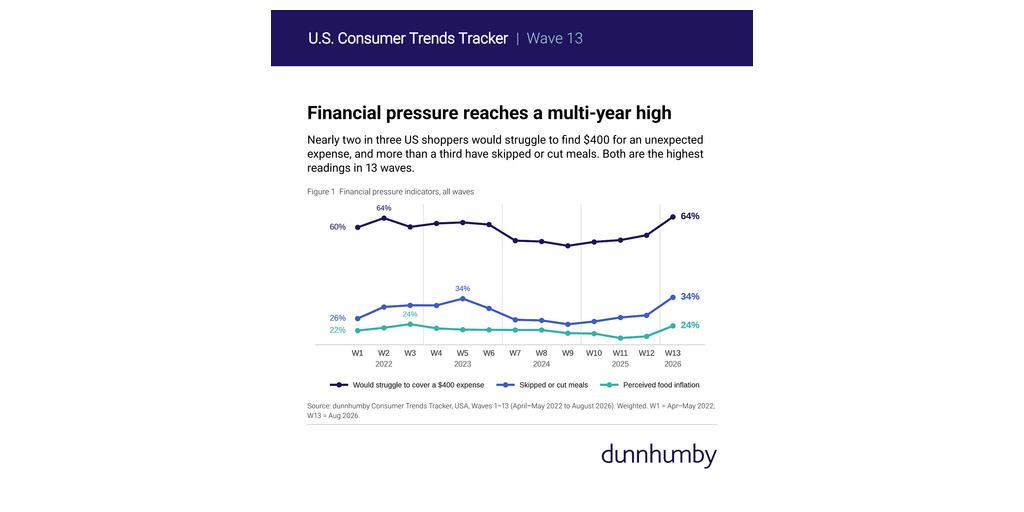 CINCINNATI--( BUSINESS WIRE)--One in three U.S. consumers (34%) reported they had skipped meals or cut meal sizes in the past year for financial reasons, up 7 percentage points since December and the largest increase between surveys in the four-year history of the dunnhumby Consumer Trends Tracker (CTT). Thirty-one percent of middle-income households earning $50,000 - $100,000, reported not having enough to eat compared with 19% in December, the sharpest rise in the 13 th wave of the CTT. Consumers 65 and older saw the second-largest increase, nearly doubling to 17%.
Financial insecurity reached its highest level, with 64% saying they would struggle to cover an unexpected $400 expense, up 7 percentage points since December.
Working-age consumers remain the hardest hit: 39% of those 18–34 and 43% of those 35–54 report not having enough to eat. Food insecurity was also reported by 43% of households earning less than $50,000 and 39% of families with children at home.
This jump in food insecurity comes as SNAP participation has fallen by approximately 5.2 million people since the 2025 federal budget law took effect, according to USDA data compiled by the Food Research & Action Center (FRAC). Meanwhile, food-at-home costs are 12.4% higher than in May 2022, with most of that increase, 10.2%, occurring in 2022 and never reversing. Gas prices have added to the strain with hovering above $4.00 a gallon for most of the year according to AAA. Gas is now 27% higher than August 2025. And consumer sentiment, as measured by the University of Michigan, is more than 20 points lower than the 20-year average.
"American shoppers are under more financial pressure than at any time since we started tracking them in 2022, and it's building fast," said Jamie Samaha, chief executive officer of dunnhumby. "Nearly two in three would struggle to cover a surprise $400 expense, and more than a third have skipped or cut meals for financial reasons. Both are the highest levels we've recorded, and both rose seven points in just eight months. More and more, shoppers want a low price they can trust every day, not just one they have to hunt for. The retailers and brands that deliver it will earn their loyalty."
Key findings from the study:
Methodology
The CTT tracks where people shop and how much they spend, stated behaviors, stated importance of grocery needs, food security, inflation perceptions, and it complements dunnhumby’s Retailer Preference Index which is released every January. For Wave 13, dunnhumby interviewed 8,500 grocery shoppers across Canada, Brazil, Colombia, Mexico, Chile, and the U.S., including 2,000 shoppers in the U.S. The online interviews took place in August 2026, and the previous wave took place in December 2025. The latest CTT study can be accessed here.
About dunnhumby
The science of serving every customer. Together. At scale.
dunnhumby helps businesses grow through faster, better decision making, as the essential intelligence layer connecting the world’s leading retailers and brands.
Sitting at the intersection of loyalty, media, and category management, dunnhumby, helps to navigate complex and competing priorities. Combining AI-enabled science, software, trusted advice, and 35+ years of dedicated retail experience, dunnhumby is recognized as a leader in connecting customer insight and action to build loyalty, drive performance, and deliver results that last.
With offices in locations across Europe, Asia, Africa, and the Americas, dunnhumby works brands including Tesco, Walmart Data Ventures, Coca-Cola, Meijer, Procter & Gamble, and L’Oreal, to make smarter decisions today and tomorrow.