
Level 4 Autonomous Highway Trucking Market to Reach USD 7.8 Billion by 2036 as Fleet Automation Reshapes Long-Haul Economics
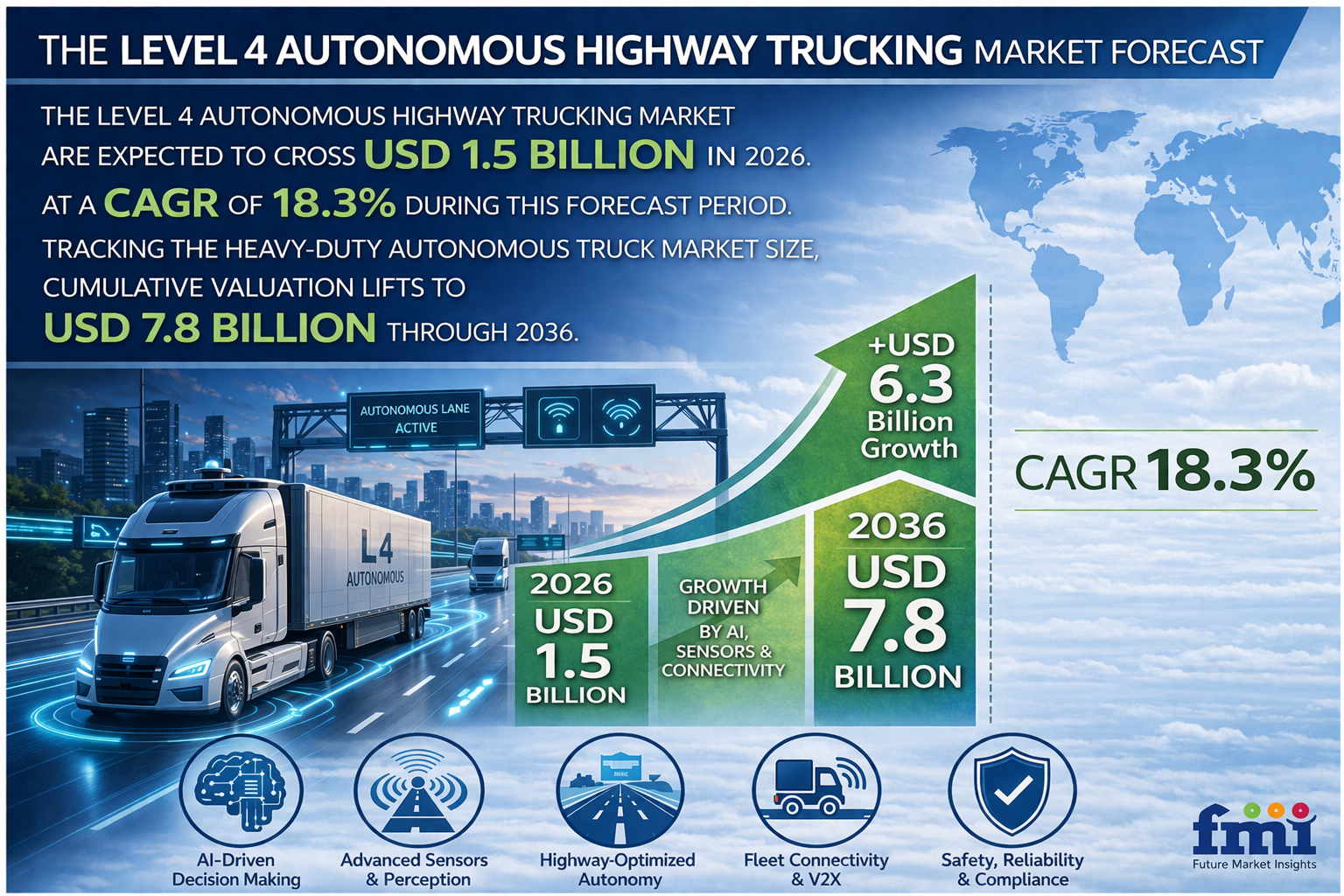 Rising driver shortages, escalating labor costs, and regulatory advancements accelerate adoption of driverless freight systems, enabling predictable per-mile costs and continuous operations across interstate corridors
NEWARK, DE / ACCESS Newswire / April 8, 2026 / The global Level 4 autonomous highway trucking market is entering a rapid expansion phase as logistics carriers transition from human-dependent operations to fully automated, driverless freight systems. Valued at USD 1.2 billion in 2025, the market is projected to reach USD 1.5 billion in 2026 and surge to USD 7.8 billion by 2036, registering a robust CAGR of 18.3% during the forecast period.
This acceleration reflects a fundamental restructuring of long-haul freight economics, where rising driver wages, labor shortages, and regulatory pressures are forcing fleet operators to reconsider traditional operating models. Autonomous trucking is no longer a future concept-it is becoming a strategic necessity. As carriers seek predictable cost structures and higher asset utilization, Level 4 autonomous systems are emerging as the cornerstone of next-generation logistics networks.
Get Access of Report Sample:
https://www.futuremarketinsights.com/reports/sample/rep-gb-32414
Market Value Analysis: Automation Replaces Labor-Driven Cost Structures
Between 2026 and 2030, adoption of Level 4 autonomous trucking is expected to accelerate sharply as fleet operators confront unsustainable driver compensation trends. Long-haul trucking economics are increasingly constrained by wage inflation, compliance costs, and workforce shortages, creating a clear incentive for automation.
Organizations are increasingly prioritizing:
Deployment of driverless trucks for long-haul interstate routes
Investment in high-performance sensor stacks and redundant safety systems
Integration of autonomous driving software with fleet management platforms
Development of dedicated hub-to-hub transfer infrastructure
Transition toward predictable, hardware-based cost models
Failure to adopt autonomous trucking exposes carriers to margin compression, limited fleet scalability, and reduced competitiveness against early adopters operating automated fleets with significantly lower per-mile costs.
From 2030 to 2036, market growth will be driven by regulatory standardization, expansion of autonomous freight corridors, and increased confidence in system safety and reliability.
Technology Evolution: Sensor Fusion and AI Redefine Freight Mobility
The evolution of Level 4 autonomous trucking is being shaped by rapid advancements in artificial intelligence, sensor technologies, and high-performance computing. These systems must operate with complete autonomy under defined conditions, requiring robust and redundant architectures.
Key innovations include:
Multi-sensor fusion combining LiDAR, radar, and camera systems
AI-driven decision-making engines for real-time navigation
High-performance onboard computing for continuous data processing
Vehicle-to-everything (V2X) communication for coordinated movement
Remote teleoperation systems for exception handling
A critical challenge lies in balancing system reliability with cost efficiency. While redundancy ensures safety, it also increases upfront capital investment, requiring fleet operators to carefully evaluate long-term return on investment.
An industry analyst notes:
"Level 4 autonomy transforms trucking from a labor-driven model into a capital-driven system. The ability to operate continuously without human limitations fundamentally changes fleet economics and utilization rates."
Autonomous Trucking Becomes Core to Logistics Efficiency
As long-haul freight operations evolve, Level 4 autonomous systems are becoming essential for maintaining operational efficiency and meeting growing demand. These technologies enable carriers to move beyond human limitations and unlock new levels of productivity.
Core capabilities include:
Continuous 24/7 vehicle operation without hours-of-service constraints
Reduced dependency on driver availability and retention
Improved fuel efficiency through algorithmic driving patterns
Enhanced safety through consistent system behavior
Scalable fleet expansion without proportional labor increases
This shift is redefining competitive dynamics in the logistics industry, where automation directly influences cost structures, delivery speed, and service reliability.
Segment Spotlight
Hardware and Sensor Stack Lead Component (52.0%)
High capital investment in safety-critical hardware drives segment dominance.
OEM-Integrated Trucks Lead Deployment Model (44.0%)
Factory-built autonomous platforms provide reliability and clear liability structures.
Hub-to-Hub Routes Lead Application (61.0%)
Predictable highway environments enable faster commercialization of autonomous systems.
Class 8 Trucks Lead Vehicle Segment (68.0%)
High payload capacity maximizes return on expensive autonomous hardware investments.
Regional Insights: Infrastructure and Regulation Drive Adoption
The Level 4 autonomous highway trucking market is expanding across regions with strong logistics demand, regulatory support, and infrastructure readiness.
Country
CAGR (2026-2036)
Key Growth Drivers
United Arab Emirates
20.1%
Smart logistics corridors and centralized planning
United States
19.4%
Severe driver shortages and large interstate networks
China
18.7%
Government-backed infrastructure and port connectivity
Germany
17.2%
Strong OEM ecosystem and regulatory alignment
Japan
15.9%
Aging workforce and automation necessity
Canada
14.8%
Remote industrial logistics demand
Regional growth is influenced by regulatory frameworks, infrastructure investments, and labor market dynamics, with centralized economies often achieving faster deployment due to unified policy execution.
Opportunities: New Ecosystems Around Autonomous Freight
Key opportunities shaping the market include:
Development of dedicated transfer hubs at urban peripheries
Expansion of tele-assist and remote monitoring services
Growth of sensor calibration and maintenance networks
Integration of autonomous trucks with smart highway infrastructure
Emergence of data-driven logistics optimization platforms
These opportunities are creating entirely new value chains around autonomous freight, extending beyond vehicle manufacturing into services, infrastructure, and digital ecosystems.
Competitive Landscape: Data and Integration Define Leadership
The Level 4 autonomous trucking market is highly competitive, with success driven by data acquisition, system reliability, and integration capabilities.
Leading companies include:
Aurora Innovation
Kodiak Robotics
Daimler Truck / Torc Robotics
PlusAI
Waabi
Volvo Autonomous Solutions
Competitive differentiation is driven by:
Volume and quality of real-world driving data
Integration with OEM vehicle platforms
Reliability of autonomous systems under diverse conditions
Scalability of deployment across multiple routes
Ability to meet regulatory and safety requirements
Future Outlook: Autonomous Trucks Redefine Freight Economics
Looking ahead to 2036, Level 4 autonomous trucking will transition from pilot deployments to large-scale commercial operations, fundamentally reshaping global logistics networks.
Key trends include:
Expansion of fully autonomous freight corridors
Increasing collaboration between regulators, OEMs, and logistics providers
Growth of hybrid logistics models combining automated and human-driven segments
Continuous improvement in AI-driven safety and efficiency
Alignment of fleet performance with long-term cost predictability
As the industry moves toward automation, Level 4 autonomous trucking will become a foundational element of modern supply chains-delivering higher efficiency, lower costs, and unprecedented scalability in long-haul freight operations.
For an in-depth analysis of evolving formulation trends and to access the complete strategic outlook for the Level 4 Autonomous Highway Trucking Market through 2036, visit the official report page at: https://www.futuremarketinsights.com/reports/level-4-autonomous-highway-trucking-market
Browse More Automotive Industry Reports:
Cargo Vans Market - https://www.futuremarketinsights.com/reports/cargo-vans-market
Business Jet Market - https://www.futuremarketinsights.com/reports/business-jet-market
High-Temperature Brake Line Couplings Market - https://www.futuremarketinsights.com/reports/high-temperature-brake-line-couplings-market
Radar Detectors Market - https://www.futuremarketinsights.com/reports/radar-detectors-market
EV Charging Cable Market - https://www.futuremarketinsights.com/reports/ev-charging-cables-market
About Future Market Insights (FMI)
Future Market Insights (FMI) is a leading provider of market intelligence and consulting services, serving clients in over 150 countries. Headquartered in Delaware, USA, with a global delivery center in India and offices in the UK and UAE, FMI delivers actionable insights to businesses across industries including automotive, technology, consumer products, manufacturing, energy, and chemicals.
An ESOMAR-certified research organization, FMI provides custom and syndicated market reports and consulting services, supporting both Fortune 1,000 companies and SMEs. Its team of 300+ experienced analysts ensures credible, data-driven insights to help clients navigate global markets and identify growth opportunities.
For Press & Corporate Inquiries
Rahul Singh
AVP - Marketing and Growth Strategy
Future Market Insights, Inc.
+91 8600020075
For Sales - [email protected]
For Media - [email protected]
For web - https://www.futuremarketinsights.com/
SOURCE: Future Market Insights, Inc.