
AI Radiology Worklist Orchestration Market Forecast 2026-2036: Reach USD 1.8 Billion by 2036 at 23.8% CAGR
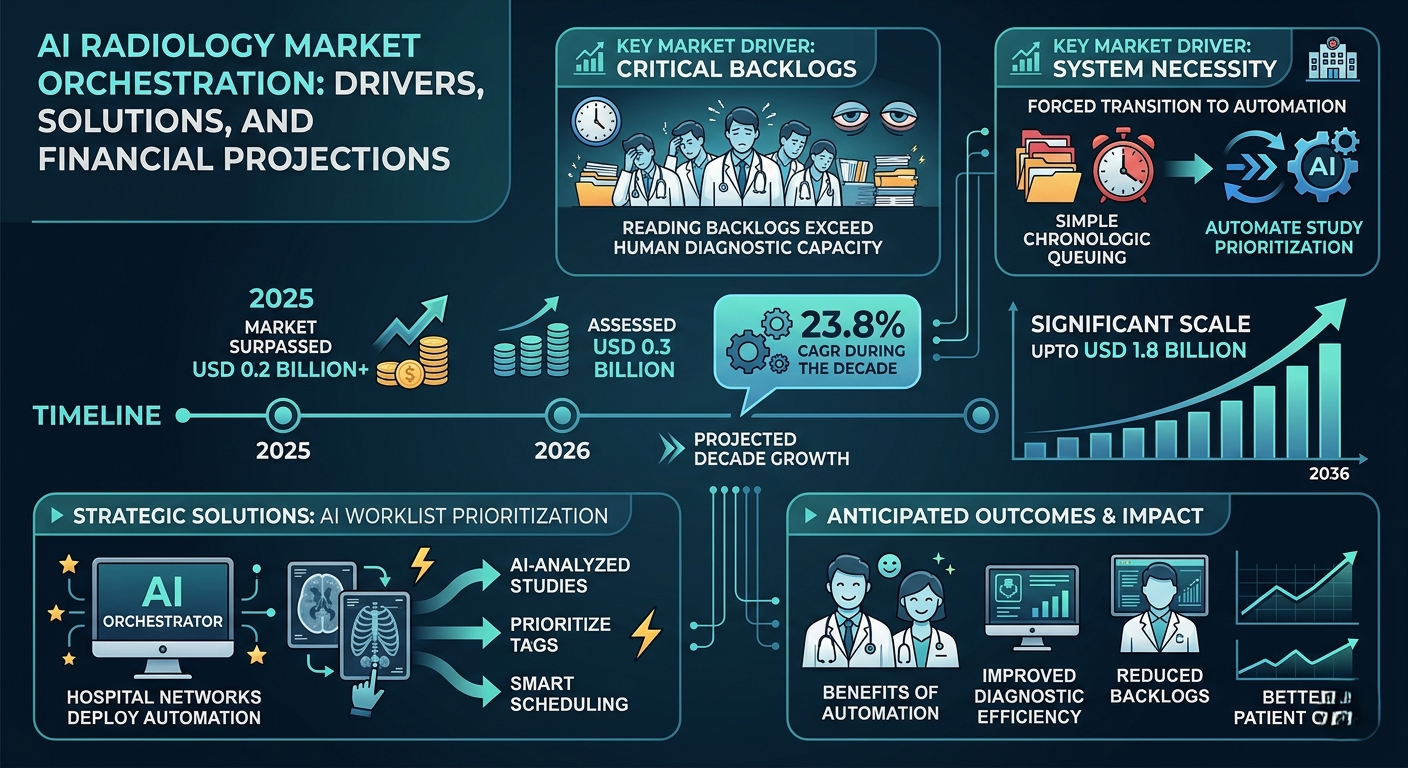 AI-powered radiology worklist orchestration is rapidly becoming the new standard as hospital networks and teleradiology providers shift from chronological queuing to intelligent, pixel-aware study prioritization amid exploding imaging volumes and radiologist shortages.
NEWARK, DE / ACCESS Newswire / March 24, 2026 / According to Future Market Insights (FMI), The global AI Radiology Worklist Orchestration Market is entering a high-growth decade as reading backlogs exceed human diagnostic capacity, forcing healthcare systems to automate study prioritization over simple chronologic queuing. Valued at USD 0.3 billion in 2026, the market is projected to reach USD 1.8 billion by 2036, expanding at a robust CAGR of 23.8%. The surge is driven by emergency department turnaround mandates, shrinking reimbursement rates, and the urgent need to reduce length-of-stay metrics through faster identification of critical findings such as intracranial hemorrhages, stroke, and pulmonary embolisms.
According to a comprehensive strategic outlook from Future Market Insights (FMI), AI radiology worklist orchestration is transitioning from an innovation budget item to a core operational requirement, particularly across hospitals, teleradiology groups, and high-volume imaging centers in North America, Europe, and rapidly digitizing Asia-Pacific healthcare markets.
Get Access of Report Sample: https://www.futuremarketinsights.com/reports/sample/rep-gb-32454
AI Radiology Worklist Orchestration Market Metric Snapshot (2026-2036)
Market Metric
Value
Market Size (2026)
USD 0.3 Billion
Market Value (2036)
USD 1.8 Billion
CAGR (2026-2036)
23.8%
Fastest Growing Market
India
Leading Component
Software Platforms
Dominant Deployment
Cloud
The Workflow Revolution: From Chronological Queues to Algorithmic Triage
Radiology departments worldwide face daily triage failures where life-critical cases wait behind routine scans purely due to arrival order. Teleradiology networks cannot simply hire more readers, as imaging volumes outpace graduating radiologist cohorts globally. AI worklist orchestration sits between scanners and radiologists, reordering reading queues based on automated pixel analysis rather than chronological arrival-pushing suspected critical studies to priority viewing status instantly.
Unlike traditional systems, these platforms require deep integration with existing PACS and RIS environments. Successful deployments demand bidirectional communication with native hanging protocols, avoiding workflow fragmentation and physician resistance. Facilities processing over 50,000 annual scans are particularly vulnerable to bottlenecking without intelligent orchestration.
Operational Economics Are Shifting Across Radiology Networks
While AI orchestration improves turnaround times and reduces missed intervention windows, it introduces new challenges including false-positive fatigue, latency in cloud deployments, and the need for continuous recalibration across heterogeneous scanner fleets. Hospital administrators are now evaluating solutions based on true workflow ROI-measuring not just alert accuracy but actual reductions in emergency department length-of-stay and radiologist burnout.
Greenfield and expanding corporate hospital chains in Asia-Pacific are accelerating adoption by designing AI-compatible workflows from the ground up, bypassing the costly retrofitting faced by legacy systems in North America and Europe.
Segment Spotlight: Software Platforms and Cloud Deployment Lead Demand
Software Platforms Software platforms are expected to dominate with approximately 68.0% market share in 2026. These comprehensive engines intercept DICOM traffic, perform background pixel analysis, and seamlessly integrate triage logic without forcing radiologists to toggle between applications.
Cloud Deployment Cloud configurations hold a 47.0% share in 2026, driven by massive computational demands for deep learning inference and the need for scalable processing during trauma spikes.
CT Modality Focus CT holds the largest modality share at 34.0% as high-slice-count trauma scans generate unsustainable manual review burdens, making algorithmic pre-reading essential for emergency pathways.
Triage Prioritization Triage prioritization accounts for 39.0% share by fundamentally rewriting workflows to ensure critical findings receive immediate expert attention.
Hospitals Hospitals command 52.0% share, possessing the capital budgets and scale required for enterprise-wide algorithmic deployment.
Regional Powerhouses: India Leads Explosive Growth
While North America and Europe adopt due to regulatory pressures and radiologist shortages, the fastest growth is occurring in Asia-Pacific where corporate hospital expansion and government digitalization initiatives are creating new demand.
Key Growth Markets:
India (27.6% CAGR): Rapid corporate hospital chains centralize limited sub-specialist capacity.
South Korea (24.0% CAGR): Government-subsidized digital healthcare transformation.
United States (22.5% CAGR): Private equity consolidation of outpatient imaging centers.
Australia (22.0% CAGR): Geographic distances making intelligent routing mandatory for rural and remote trauma.
United Kingdom (21.1% CAGR): Public trusts managing cancer and emergency backlogs.
Germany (20.8% CAGR): Cross-network balancing of sub-specialist workloads.
Dynamics of the Decade: Interoperability, Edge Computing, and Alert Fatigue Management
Looking toward 2036, several key trends will reshape the competitive landscape:
Middleware and Interoperability Bridges: Enabling legacy PACS/RIS systems to accept algorithmic routing commands without full replacement.
Edge Computing Localization: Reducing latency for rural and bandwidth-constrained facilities.
False-Positive Fatigue Mitigation: Advanced recalibration and confidence-interval displays to maintain physician trust.
Multi-Modality Orchestration: Overcoming structural challenges when applying CT-trained models to variable MRI sequences.
Regulatory Acceleration: FDA 510(k) clearances and equivalent approvals fast-tracking hospital procurement.
Competitive Landscape: Integration Expertise Defines Market Leadership
Competition in the AI radiology worklist orchestration market is driven by seamless interoperability and bidirectional communication with existing viewing platforms rather than raw diagnostic sensitivity alone. Leading vendors embed technical teams within hospital IT environments during qualification to ensure algorithmic flags actually alter native hanging protocols.
Top Players in the AI Radiology Worklist Orchestration Market Key companies operating in the global market include:
Aidoc
Viz.AI
Qure.AI
Harrison.AI
Gleamer
deepc
Blackford
These players compete primarily on workflow integration, vendor-neutral archive compatibility, reduction of alert fatigue, and proven ROI in reducing turnaround times and length-of-stay metrics.
Strategic Outlook: AI Orchestration Will Become Table Stakes for Radiology Operations
Over the next decade, exploding cross-sectional imaging volumes combined with persistent radiologist shortages will make AI worklist orchestration a non-negotiable operational requirement. Facilities that invest early in interoperable platforms, hybrid/edge deployments, and continuous monitoring services will achieve superior efficiency, better patient outcomes, and stronger margins in an era of shrinking reimbursements.
By 2036, industry analysts expect algorithmic study routing to become the global standard across radiology workflows, permanently replacing pure chronological queuing in most major healthcare markets.
For an in-depth analysis of evolving integration trends, modality-specific challenges, and the complete strategic outlook for the AI Radiology Worklist Orchestration Market through 2036, visit the official report page at: https://www.futuremarketinsights.com/reports/ai-radiology-worklist-orchestration-market
Explore More Related Studies Published by FMI Research:
Radiology Drainage Catheters Market: https://www.futuremarketinsights.com/reports/radiology-drainage-catheters-market
Radiology Structured Reporting Automation market: https://www.futuremarketinsights.com/reports/radiology-structured-reporting-automation-market
Radiology Information System RIS Market: https://www.futuremarketinsights.com/reports/radiology-information-system-ris-market
Teleradiology Market: https://www.futuremarketinsights.com/reports/teleradiology-market
Teleradiology Services Market: https://www.futuremarketinsights.com/reports/teleradiology-services-market
About Future Market Insights (FMI)
Future Market Insights (FMI) is a leading provider of market intelligence and consulting services, serving clients in over 150 countries. Headquartered in Delaware, USA, with a global delivery center in India and offices in the UK and UAE, FMI delivers actionable insights to businesses across industries including automotive, technology, consumer products, manufacturing, energy, and chemicals.
An ESOMAR-certified research organization, FMI provides custom and syndicated market reports and consulting services, supporting both Fortune 1,000 companies and SMEs. Its team of 300+ experienced analysts ensures credible, data-driven insights to help clients navigate global markets and identify growth opportunities.
For Press & Corporate Inquiries
Rahul Singh
AVP - Marketing and Growth Strategy
Future Market Insights, Inc.
+91 8600020075
For Sales - [email protected]
For Media - [email protected]
For web - https://www.futuremarketinsights.com/
SOURCE: Future Market Insights, Inc.