
Global Hospital-at-Home Equipment Rental Market to Reach USD 3.8 Billion by 2036, Driven by Expansion of Virtual Care and Acute Home Treatment Models
 The market remains fragmented, with competition centered on fleet availability, logistics efficiency, and the ability to integrate equipment with remote monitoring systems.
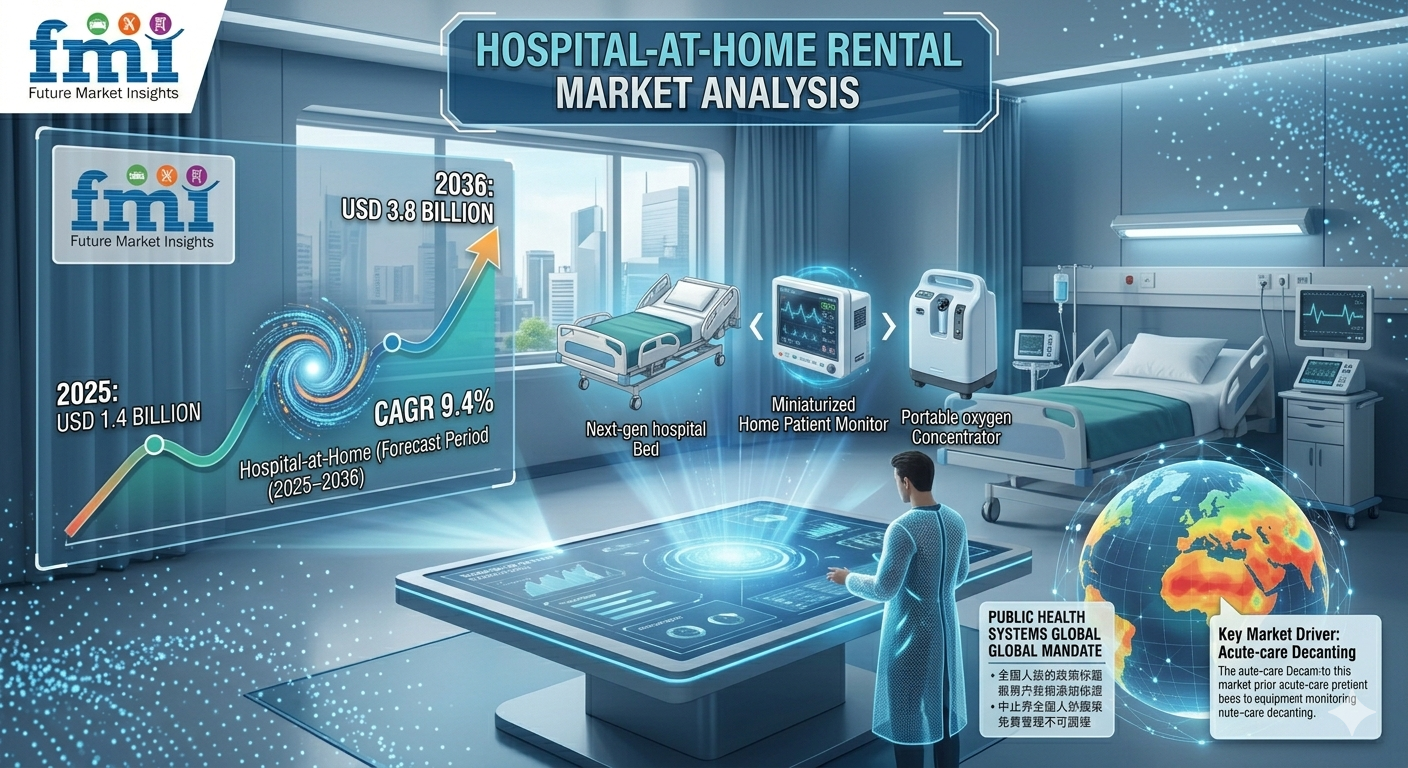
NEWARK, DE / ACCESS Newswire / April 3, 2026 / The global hospital-at-home equipment rental market is witnessing strong momentum, projected to grow from USD 1.6 billion in 2026 to USD 3.8 billion by 2036, registering a CAGR of 9.4% during the forecast period, according to Future Market Insights (FMI). Growth is being driven by the rapid transition of acute and post-acute care from hospitals to residential settings, supported by evolving reimbursement frameworks and increasing healthcare system pressures.
The market represents a critical care-delivery infrastructure segment, centered on renting hospital-grade equipment such as infusion pumps, respiratory devices, patient monitors, and beds to enable high-acuity treatment at home. The shift is fueled by the need to reduce inpatient burden while maintaining clinical quality and monitoring intensity.
Get Access of Report Sample: https://www.futuremarketinsights.com/reports/sample/rep-gb-32543
Hospital-at-Home Equipment Rental Market: Quick Stats Snapshot
2026 Market Value: USD 1.6 Billion
2036 Forecast Value: USD 3.8 Billion
CAGR (2026-2036): 9.4%
Leading Equipment Type: Infusion pumps (29.0% share)
Top Care Model: Admission avoidance (35.0% share)
Leading End User: Health systems (46.0% share)
Market Momentum: Decentralization of acute care and virtual ward expansion
Market Momentum: Decentralized Care Transforming Healthcare Delivery
Healthcare systems worldwide are increasingly shifting acute and step-down care into home environments to reduce costs and improve patient outcomes. Hospital-at-home programs and virtual wards are enabling clinicians to deliver hospital-level treatment outside traditional facilities.
Demand is rising as providers seek to free up expensive inpatient beds while maintaining continuous monitoring and therapy delivery. Government-backed initiatives and reimbursement approvals-particularly for remote monitoring-are accelerating large-scale adoption of home-based acute care models.
Key Market Dynamics
Rising pressure on hospitals to reduce inpatient occupancy
Expansion of virtual ward and hospital-at-home programs globally
Increasing adoption of remote monitoring and telehealth integration
Strong demand for respiratory and infusion equipment in home settings
Market Segment Insights
Equipment Leadership
Infusion pumps dominate with a 29.0% share, driven by their critical role in delivering chemotherapy, antibiotics, and complex therapies in home settings. Respiratory devices and patient monitors also see strong demand due to cardiopulmonary care requirements.
Rental Model Trends
Monthly rental leads with a 41.0% share, supported by predictable reimbursement structures and the need for continuous equipment availability in high-acuity care scenarios.
Care Model Dominance
Admission avoidance accounts for 35.0% share, as hospitals increasingly divert eligible patients directly to home-based care, reducing admissions and improving throughput.
End User Insights
Health systems dominate with 46.0% share, reflecting centralized control over equipment provisioning, clinical oversight, and integration with hospital IT systems.
Regional Insights
Australia (10.4% CAGR): Leading adoption of structured virtual hospital programs
United States (9.8% CAGR): Growth driven by CMS-backed hospital-at-home initiatives
Spain (9.6% CAGR): Strong public healthcare support for early discharge models
United Kingdom (9.1% CAGR): NHS virtual ward expansion fueling demand
France (8.8% CAGR): Growth supported by chronic disease homecare programs
Canada (8.6% CAGR) & Japan (8.2% CAGR): Driven by aging populations and healthcare capacity constraints
Competitive Landscape: Logistics, Scale, and Integration as Key Differentiators
The market remains fragmented, with competition centered on fleet availability, logistics efficiency, and the ability to integrate equipment with remote monitoring systems. Key players include:
AdaptHealth
Accendra Health / Apria
Quipt Home Medical
InfuSystem
Med One Group
US Med-Equip
Agiliti
Companies are focusing on strengthening logistics networks, improving turnaround times, and offering bundled services combining equipment, monitoring, and clinical support.
Market Drivers and Challenges
Growth Drivers:
Increasing shift toward home-based acute care
Favorable reimbursement policies and virtual care programs
Rising demand for cost-effective healthcare delivery models
Expansion of telehealth and remote monitoring technologies
Challenges:
Complex logistics and reverse supply chain management
Reimbursement variability across regions
Equipment sterilization and redeployment delays
Integration challenges with hospital IT systems
Strategic Takeaways for Decision Makers
Invest in scalable logistics and rapid deployment infrastructure
Prioritize interoperable, connected medical devices
Focus on bundled service models combining equipment and care delivery
Strengthen partnerships with hospitals and integrated delivery networks
For an in-depth analysis of evolving formulation trends and to access the complete strategic outlook for the Healthcare Hospital-at-Home Equipment Rental Market through 2036, visit the official report page at: https://www.futuremarketinsights.com/reports/hospital-at-home-equipment-rental-market
Why This Market Matters Now
The hospital-at-home model is redefining acute care delivery by shifting treatment from centralized hospitals to patient homes. With increasing healthcare costs, capacity constraints, and patient preference for home-based care, equipment rental services are becoming essential to enabling this transformation.
As reimbursement frameworks stabilize and technology integration improves, the market is set to play a pivotal role in the future of decentralized healthcare systems.
Explore More Related Studies Published by FMI Research:
Hospital Command Center Operations Market: https://www.futuremarketinsights.com/reports/hospital-command-center-operations-market
Hospital Service Robots Market: https://www.futuremarketinsights.com/reports/hospital-service-robots-market
Hospital Stretchers Market: https://www.futuremarketinsights.com/reports/hospital-stretchers-market
Hospital Surgical Disinfectant Market: https://www.futuremarketinsights.com/reports/hospital-surgical-disinfectant-market
Hospital Supplies Market: https://www.futuremarketinsights.com/reports/hospital-supplies-market
About Future Market Insights (FMI)
Future Market Insights (FMI) is a leading provider of market intelligence and consulting services, serving clients in over 150 countries. Headquartered in Delaware, USA, with a global delivery center in India and offices in the UK and UAE, FMI delivers actionable insights to businesses across industries including automotive, technology, consumer products, manufacturing, energy, and chemicals.
An ESOMAR-certified research organization, FMI provides custom and syndicated market reports and consulting services, supporting both Fortune 1,000 companies and SMEs. Its team of 300+ experienced analysts ensures credible, data-driven insights to help clients navigate global markets and identify growth opportunities.
For Press & Corporate Inquiries
Rahul Singh
AVP - Marketing and Growth Strategy
Future Market Insights, Inc.
+91 8600020075
For Sales - [email protected]
For Media - [email protected]
For web - https://www.futuremarketinsights.com/
SOURCE: Future Market Insights, Inc.