
Global High-Solids Acrylic Polyol Resins for Low-VOC Industrial Coatings Market Set to Reach USD 4.4 Billion by 2036, Led by BASF, Covestro & Asia-Pacific Growth Surge
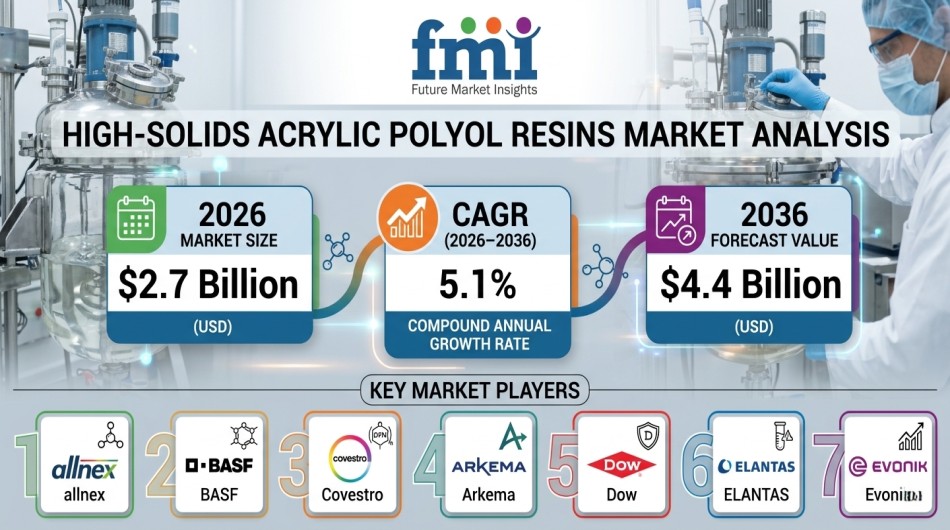 High-solids acrylic polyol resins market grows with low-VOC demand, driven by regulations, industrial coatings performance needs, and rising adoption in emerging markets.
NEWARK, DE / ACCESS Newswire / April 20, 2026 / According to the latest analysis by Future Market Insights, the global high-solids acrylic polyol resins for low-VOC industrial coatings market is witnessing consistent expansion, driven by tightening environmental regulations, performance requirements in industrial coatings, and the ongoing need to balance emissions compliance with application efficiency. The market is valued at approximately USD 2.7 billion in 2026 and is projected to reach USD 4.4 billion by 2036, registering a CAGR of 5.1% over the forecast period.
This growth reflects a broader shift within the coatings industry toward advanced resin systems that enable lower volatile organic compound (VOC) emissions while maintaining durability, gloss retention, and processing efficiency.
Market Snapshot: High-Solids Acrylic Polyol Resins Market
Market Size (2026): USD 2.7 Billion
Forecast Value (2036): USD 4.4 Billion
CAGR (2026-2036): 5.1%
Leading Solids Segment: 65-75% solids (46% share)
Dominant Coating System: 2K Polyurethane (54% share)
Key Application Segment: Metal Coatings (38% share)
Leading Region: Asia Pacific (41% share)
Key Players: allnex, BASF, Covestro, Arkema, Dow, ELANTAS, Evonik
Get detailed market forecasts, competitive benchmarking, and pricing trends: https://www.futuremarketinsights.com/reports/sample/rep-gb-32704
Growth Dynamics and Demand Drivers
The market is experiencing steady demand due to the increasing need for low-emission industrial coating systems that do not compromise on performance. Industrial coating formulators are actively transitioning toward high-solids systems to meet regulatory requirements while maintaining coating durability, adhesion, and aesthetic quality.
One of the primary drivers is stringent VOC regulations across North America and Europe, which are forcing manufacturers to reformulate coatings. High-solids acrylic polyol resins provide an effective solution by reducing solvent content while preserving application properties.
Additionally, the continued dominance of 2K polyurethane systems supports market growth. These systems offer an optimal balance of weatherability, hardness, and gloss retention, making them essential for demanding industrial applications such as metal structures and heavy machinery.
Emerging economies, particularly in Asia Pacific, are further accelerating demand due to expanding industrialization and the adoption of cleaner production technologies.
Segment Insights
By Solids Content
65-75% solids segment leads with 46% share due to:
Balanced viscosity and VOC reduction
Compatibility with existing spray equipment
Lower process risk compared to ultra-high solids
Higher solids segments face limitations such as increased viscosity and application complexity
By Coating System
2K Polyurethane systems dominate (54%) due to:
Superior durability and chemical resistance
Strong performance in harsh industrial environments
Established use in metal and protective coatings
Hybrid and melamine systems occupy niche roles
By Application
Metal coatings lead (38%), driven by:
Demand in machinery, fabricated metals, and structural steel
Need for corrosion resistance and long-term protection
Other segments include protective, wood, and plastic coatings
By End Use
General industrial sector holds 31% share, reflecting:
Broad applicability across manufacturing sectors
Demand for consistent performance and operational efficiency
Automotive refinish, ACE equipment, and packaging also contribute
Supply Chain and Industry Structure
The market operates as a specialty resin segment within the broader coatings value chain. Resin manufacturers supply engineered acrylic polyols to industrial coating formulators, who integrate them into low-VOC systems.
Supply chains are characterized by:
High technical dependency and formulation expertise
Long qualification cycles with OEMs and industrial users
Strong supplier lock-in due to validation requirements
Once a resin system is approved, switching suppliers becomes difficult due to the cost, time, and risk associated with requalification. This creates long-term supply agreements and stable demand visibility for established players.
Customize insights for your business strategy@ https://www.futuremarketinsights.com/customization-available/rep-gb-32704
Pricing and Value Trends
Pricing dynamics in the market are shifting toward performance-based value rather than raw material cost. Buyers increasingly evaluate resins based on:
Application efficiency
Reduced rejection rates
Compliance with environmental standards
Lifecycle cost advantages
Although high-solids systems may carry higher upfront costs, they often deliver better overall value by minimizing emissions penalties, improving throughput, and reducing rework.
Competitive Landscape
The market is moderately consolidated, with competition centered on technical capability, formulation support, and global supply reliability. Key players such as allnex, BASF, Covestro, Arkema, Dow, ELANTAS, and Evonik dominate through:
Advanced resin technologies
Strong R&D capabilities
Extensive industrial validation histories
Competitive differentiation is driven by:
Resin architecture and solids optimization
Viscosity control and curing performance
Technical support at the application level
New entrants face high barriers due to the need for proven long-term performance and extensive qualification cycles.
Regional Analysis
Asia Pacific (High Growth Hub)
Market Share: 41% in 2026
India (6.4% CAGR): Driven by new manufacturing capacity and greenfield installations
China (6.0% CAGR): Strong regulatory push toward low-VOC systems
Regional growth supported by industrial expansion and export-oriented production
North America
United States (4.8% CAGR): Growth driven by air-quality compliance and maintenance coatings demand
Regulatory fragmentation creates complexity but sustains reformulation demand
Europe
Germany (4.2% CAGR): Mature market focused on process consistency and sustainability
Strong emphasis on regulatory compliance and lifecycle impact
Other Key Markets
Mexico (5.2%): Export manufacturing and OEM alignment
South Korea (4.9%): Demand from heavy machinery and marine sectors
Japan (3.7%): Slower growth due to mature industrial base
Future Outlook and Opportunities
The market is expected to evolve steadily as regulatory pressures intensify and industrial users prioritize sustainable yet high-performance coating solutions.
Key opportunities include:
Advanced rheology modifiers for improved application performance
Bio-based polyol integration to meet sustainability goals
Low-temperature curing technologies to reduce energy consumption
Enhanced compatibility with existing equipment to ease adoption
Growth will increasingly depend on the ability to deliver high-performance, low-emission solutions without requiring significant capital investment in new application infrastructure.
Conclusion
The high-solids acrylic polyol resins market for low-VOC industrial coatings represents a critical intersection of environmental compliance and industrial performance. As industries continue to face stricter emission standards, these resin systems provide a practical pathway to achieving both regulatory and operational objectives.
With stable growth projected through 2036, the market is set to remain a key component of the global industrial coatings landscape, driven by innovation, regulatory alignment, and expanding industrial demand.
Unlock 360° insights for strategic decision making and investment planning@ https://www.futuremarketinsights.com/checkout/32704
Explore More Related Studies Published by FMI Research:
Cellulose Ether and Derivatives Market: https://www.futuremarketinsights.com/reports/cellulose-ether-and-derivatives-market
Europe Cement Market: https://www.futuremarketinsights.com/reports/cement-industry-analysis-in-europe
Ethylbenzene Market: https://www.futuremarketinsights.com/reports/ethylbenzene-market
Acrylic Resin Market: https://www.futuremarketinsights.com/reports/acrylic-resin-market
Viscosity Index Improver Market: https://www.futuremarketinsights.com/reports/viscosity-index-improvers-market
About Future Market Insights (FMI)
Future Market Insights (FMI) is a leading provider of market intelligence and consulting services, serving clients in over 150 countries. Headquartered in Delaware, USA, with a global delivery center in India and offices in the UK and UAE, FMI delivers actionable insights to businesses across industries including automotive, technology, consumer products, manufacturing, energy, and chemicals.
An ESOMAR-certified research organization, FMI provides custom and syndicated market reports and consulting services, supporting both Fortune 1,000 companies and SMEs. Its team of 300+ experienced analysts ensures credible, data-driven insights to help clients navigate global markets and identify growth opportunities.
For Press & Corporate Inquiries
Rahul Singh
AVP - Marketing and Growth Strategy
Future Market Insights, Inc.
+91 8600020075
For Sales - [email protected]
For Media - [email protected]
For web - https://www.futuremarketinsights.com/
SOURCE: Future Market Insights, Inc.