
Caledonia Mining Corporation Plc: Blanket Exploration Results
 Surface drilling defines previously unrecognised gold zone containing oxide and sulphide mineralisation
(NYSE AMERICAN: CMCL; AIM: CMCL; VFEX: CMCL)
SAINT HELIER, JE / ACCESS Newswire / July 23, 2026 / Caledonia Mining Corporation Plc ("Caledonia" or "the Company") is pleased to announce results from its surface exploration program at the Blanket mine ("Blanket").
The results demonstrate the presence of significant near surface gold mineralisation in a previously unknown mineralized horizon. This mineralized zone has not been exploited in the underground mine and represents an opportunity for low-cost heap leaching operations of the near surface oxide material, with potential for a sulphide extension below any potential oxide open pit. The exploration results suggest the mineralisation may represent a new orebody that has not previously been exploited by the underground mine. Further drilling is planned to assess the continuity and extent of the mineralised system at depth.
Highlights
Surface drilling confirms continuity of gold mineralisation below surface over the K-Pits target area.
Both oxide and sulphide mineralisation have been identified, supporting potential near-term development opportunities as well as longer-term exploration upside.
Metallurgical test work is underway to evaluate the amenability of the oxide mineralisation to conventional heap leaching, with encouraging preliminary results.
Work is well advanced on an updated Blanket resource statement incorporating the surface exploration programme as well as recent underground drilling. The Company expects to publish the updated resource statement in August 2026.
Follow-up drilling is planned from both surface and underground platforms to test potential extensions of the mineralisation at depth.
Selected drilling highlights for Blanket surface (as extracted from the full results in the Appendix) include :
Hole KPT0EX2553 - 23.00m** at 2.61g/t from 0m downhole, RC, Oxide
Hole KPT0EX2561 - 6.00m** at 1.97g/t from 14m downhole, RC, Oxide
Hole KPT0EX2545 - 15.00m** at 1.69g/t from 0m downhole, RC, Oxide
Hole KPT0EX2545 - 4.00m** at 2.08g/t from 15m downhole, RC, Transitional
Hole KPT0EX2567 - 20.00m** at 1.22g/t from 19m downhole, RC, Transitional
Hole KPT0EX25124 - 12.00m** at 1.20g/t from 23m downhole, RC, Transitional
Hole KPT0EX2510 - 16.00m** at 6.04g/t from 29m downhole, RC, Sulphide
Hole KPT0EX2542 - 7.00m** at 5.96g/t from 13m downhole, RC, Sulphide
Hole KPT0EX2576 - 5.00m** at 3.96g/t from 40m downhole, RC, Sulphide
**all intersections above are down hole intersections; estimated true widths are quoted in the tables later in this press release.
Why this discovery is important
The K-Pits programme was originally designed to evaluate near-surface targets within the Blanket mining lease that had received little exploration attention. Results from trenching and reverse circulation drilling have confirmed the presence of significant gold mineralisation associated with shear structures and lithological contacts.
Importantly, geological interpretation suggests the mineralisation may represent a separate mineralised system located approximately 200 metres east of the nearest projected underground orebody. This raises the possibility that the K-Pits target represents a previously unrecognised mineralised horizon that has not been exploited by historic underground mining activities.
The presence of near-surface oxide mineralisation is particularly significant because it may be amenable to conventional heap leach processing, potentially offering a lower-cost route to extracting gold compared to underground mining. Metallurgical test work is underway to assess this opportunity.
Chief Executive Officer, Mark Learmonth, said:
"This is an exciting development at Blanket and further demonstrates the significant exploration potential that exists within the mining area. We are well advanced in our work to incorporate the results of this surface exploration programme into a revised resource statement expected to be published in August 2026, which will reflect the results of surface and underground exploration at Blanket alongside the exploration programme at Motapa, where we recently announced encouraging initial drilling results.
"We have commenced metallurgical test work on the oxide material at Blanket to evaluate its amenability for conventional heap leaching and the preliminary results are encouraging. If the conclusion of the test work shows an acceptable recovery, we intend to commence a trial heap leach operation on an initial sample of 10,000 tonnes of material during the second half of 2026. The potential to develop a low-cost processing route for this near-surface mineralisation could provide an attractive opportunity to complement Blanket's existing underground operations and unlock additional value."
Enquiries
Caledonia Mining Corporation Plc
Mark Learmonth
Camilla Horsfall
Tel: +44 1534 679 800
Tel: +44 7817 841 793
Cavendish Capital Markets Limited (Nomad and Broker)
Adrian Hadden
Pearl Kellie
Tel: +44 207 397 1965
Camarco, Financial PR (UK)
Elfie Kent
Fergus Young
Tel: +44 20 3757 4980
Curate Public Relations (Zimbabwe)
Debra Tatenda
Tel: +263 77802131
IH Securities (Private) Limited (VFEX Sponsor - Zimbabwe)
Lloyd Mlotshwa
Tel: +263 (242) 745 119/33/39
Overview of the Blanket Surface Exploration Program
The Blanket surface exploration program commenced in 2024 with geological mapping, geophysical surveys, trenching, and historical data collation.
The initial work informed targets for wide spaced surface trenching to understand the geology, both structural and lithological, for the area.
During 2025, a total of 2,304.1m of trenching from 13 trenches and a total of 7,063 of shallow RC drilling was completed at the K-Pit target, focused primarily on examining the area for oxide gold mineralisation that may be amenable to low-cost surface heap leaching operations.
Location of the activities
The exploration area is located within the mining lease boundary of Blanket. Blanket is located in the southwest of Zimbabwe, approximately 15 km northwest of Gwanda, the provincial capital of Matabeleland South. Gwanda is located 147 km southeast of Bulawayo, 197km northwest of the Beitbridge Border post with South Africa, and 560km from Harare.
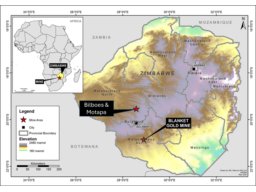
The Blanket locality is shown relative to other material Caledonia properties in Figure 1. Caledonia's Bilboes property, currently in the development stage, and the Motapa exploration property is located further to the north of Blanket.
Blanket is situated on the north-western limb of the Archaean Gwanda Greenstone Belt in south-western Zimbabwe, along strike from several other gold deposits. The Gwanda Greenstone Belt is approximately 7km in length (west to east) and 15 km wide (north to south). The belt is typical of greenstone belts of the Zimbabwe Craton consisting of mafic to felsic volcanics with intercalated sedimentary units. Repeated strong deformation affected all lithologies. Structurally, the Gwanda Greenstone Belt is dominated by a major periclinal synform, plunging 60° NW in the western half of the belt and flanked on both sides by major deformation zones. Gwanda Greenstone Belt metamorphism reaches upper greenschist to amphibolite facies and is higher than in the typical Zimbabwean greenstone belts. The local geology of the Blanket lease area showing the locality of the K-Pits is provided on Figure 2.
Details of the Program
Following a prolonged period of limited exploration activity, Blanket commenced with a surface exploration strategy in 2025. A phased surface exploration programme was launched within the Blanket mining lease, targeting the Banded Iron Formation (BIF) that trends north-northwest and has historically been mined at the nearby Vubachikwe and old Sabiwa mines.
The programme commenced with trenching at the Sabiwa North Extension. Lithological mapping showed discrete, discontinuous BIF lenses with sporadic mineralisation. Subsequently, attention shifted northwards to the K-Pits prospect, located along the same strike of the lithological units in the footwall of Blanket Mine's current production area.
Trenching at K-Pits comprised 13 trenches to a maximum depth of 1.50 meters and totalling 2,304.1 meters in length. All trenches were mapped for lithology and structure and sampled at 1.0-meter intervals along the sidewalls. Samples were sent for fire assay analysis at independent laboratories, and a sub sample was sent for bottle roll analysis at independent laboratories. Figure 3 shows the mapped lithology while Figure 4 shows the related fire assay values of the K-Pit trenches.
On the strength of anomalous assay results, a grid on an approximate spacing of 25 meters x 25 meters was drilled utilising Reverse Circulation ("RC") drilling. A total of 155 drillholes totalling 7,063 meters of drilling was completed. All drillholes were inclined at approximately 60 degrees to the west to an inclined depth of 45 meters resulting in an approximate 40 meters vertical depth. Figure 5 provides the localities of the RC drillholes with fire assay results.
Figure 6 is a cross-section view along section line A - A depicting the oxidation surfaces logged in the drillholes together with the fire assay grades and the interpreted mineralised horizons. All samples were subjected to fire assay and to bottle roll assay at an independent laboratory with the requisite Certified Reference Material ("CRM's") and blank samples inserted into the sample chain.
Analysis and interpretation of the results shows that the mineralisation is related to strong shearing and silicification on the contacts of the talc chlorite schist and the surrounding metabasalts.
Further Potential
The delineation of the mineralized zones at the K-Pits may potentially represent a new orebody that has not been exploited underground at Blanket. When examining the underground workings and the locality of the K-Pits it is evident that the mineralisation is located approximately 200 meters to the east of where the nearest, projected to surface, underground orebody would outcrop. Figure 7 shows an oblique view of the K-Pits in relation to the underground orebodies at Blanket.
A cross section through the K-Pits and Sheet vertical shaft is provided in Figure 8. The orebody dip and dip directions at Blanket are fairly uniform and further drilling is planned, both from underground on 9 level and from surface, to probe the potential extension of the K-Pits mineralized zone at depth.
The drilling and trenching procedures together with an analysis of the Quality Assurance and Quality Control ("QAQC") procedures followed are provided further in the text.
Qualified person
Craig James Harvey, MGSSA, MAIG, Caledonia Vice President, Technical Services, has reviewed and approved the scientific and technical information contained in this news release. Craig James Harvey is a "Qualified Person" as defined by each of (i) the Canadian Securities Administrators' National Instrument 43-101 - Standards of Disclosure for Mineral Projects and (ii) sub-part 1300 of Regulation S-K of the U.S. Securities Act.
Trenching and trench sampling methodology
After the geologist has noted that the trench has successfully been excavated to bedrock, the sample intervals are set out on the side walls. At the start of the sample line, a peg is installed onto the floor with the trench number. A clean, exposed side of the trench is chosen and maintained throughout the sampling process. The sidewall is cleaned with a shovel to ensure an uncontaminated face is exposed for sampling. Thereafter sample localities are marked on the sidewall.
Sampling is done at one-meter intervals respecting lithological contacts, alterations and structures. A minimum sampling width of 0.3m and maximum of 1m are observed throughout the sample interval marking. A clean sample mat is placed on the floor of the trench and samples are chipped from the bedrock sidewall into a sample pan. Samples are ticketed and placed in a sample bag closed with twine. Sample tickets, locality and weights are recorded on the sample sheet record for each trench.
The compositing of samples is guided by lithology as well as alteration domains; no sampling will be done across different domains. Outliers with anomalously high grades are not composited unless they are part of a homogenous lithological and alteration domain. When compositing in wider ore zones, a composite sample is made by combining five samples, whilst in narrow ore zones two samples will make up a composite sample. The homogenized sample is split using a riffle splitter to get two 2kg samples to be delivered to the external laboratory for bottle roll analysis and the other for fire assay.
RC methodology
Checks for rig outlet and splitter cleanliness are conducted prior to the commencement of drilling activities and continuously throughout the drilling activities to avoid sample contamination.
Sample bags are pre-numbered with unique sample numbers (drill hole number and drill hole depth intervals) before the drilling commences. Sample depths recorded are relative to the ground surface at the drillhole collar. If no sample is recovered, such as when voids are intersected, the numbering sequence is continued uninterrupted with empty numbered bags inserted into the sample sequence. This will avoid possible confusion in sampling. Sample bags are immediately sealed to effectively prevent external contamination.
A sample bag is tied to the sample outlet of the rig in preparation for sample collection before sampling commences. Bulk samples are collected at 1m intervals and split using a riffle splitter to three samples. One sub-sample of 2kg will be taken to the lab for assaying, the second remains as a field duplicate for storage at the core shed and the third is prepared as chips for traying. The sampling crew will sample at the designated (one meter) intervals down the hole. The geologist verifies the intervals from the driller's marks on the mast or pull-down chain. For samples sent to the laboratory, the sampling quality is monitored continuously as the geologist ensures the samples for QAQC monitoring purposes are inserted in each sampling stream batch of 20 samples with CRMs being alternated from batch to batch from low, medium and high grade.
QAQC Procedures
A comprehensive QAQC program was implemented for the K-Pits drilling and sampling campaigns to ensure the reliability and integrity of assay data.
The QAQC program includes the systematic insertion and monitoring of:
CRMs
Blank samples (certified and field blanks)
Duplicate samples (field, coarse reject, and pulp duplicates)
QAQC samples were inserted at regular intervals within the sample stream and submitted to the same laboratories as primary samples. Analytical work was conducted primarily by accredited laboratory, Antech Laboratory Services, located in Zimbabwe, following industry-standard fire assay and/or appropriate multi-element analytical techniques.
A comprehensive QAQC programme comprising CRMs, blank samples and other control samples was implemented throughout the drilling programme. The results indicate that the analytical data are generally reliable and suitable for future mineral resource estimation. The majority of CRM populations demonstrated acceptable to excellent accuracy and precision, with the higher-grade standards (AMIS0559, AMIS0872 and G912-2) and several low- to medium-grade standards (AMIS0772 and AMIS0924) consistently reproducing certified values within expected control limits.
Three independent blank datasets (AMIS0865, BLANK0939 and BLANK0991) returned values at or near detection limits, indicating no evidence of significant contamination during sampling, sample preparation or laboratory analysis. This conclusion is supported by the absence of elevated blank failures and by the consistent performance of the blank standards reviewed.
Some of the CRM populations contained isolated catastrophic failures. These failures occurred as discrete events rather than systematic trends and were not associated with elevated blank values or evidence of analytical drift. The observed patterns suggest that the failures are more likely attributable to sample handling, sample identity, CRM insertion, preparation or reporting issues rather than deficiencies in laboratory analytical performance.
Appendix 1: Drillhole collar positions, fire assay and bottle roll assay results.
Drillhole Collar Positions
Hole Identifier
Hole Type
Locality
Azimuth (°)
Dip (°)
Drilled Length(m)
UTM Easting(m)
UTM Northing(m)
UTM Elevation(m)
KPT0EX2501
RC
K-pit
68.4
64.3
45
697 565
7 713 289
1 041
KPT0EX2502
RC
K-pit
65.7
64.1
45
697 570
7 713 243
1 040
KPT0EX2503
RC
K-pit
65.0
64.1
45
697 576
7 713 196
1 039
KPT0EX2504
RC
K-pit
66.0
65.4
45
697 582
7 713 150
1 038
KPT0EX2505
RC
K-pit
68.2
64.5
45
697 588
7 713 103
1 038
KPT0EX2506
RC
K-pit
67.8
64.9
45
697 593
7 713 057
1 037
KPT0EX2507
RC
K-pit
64.3
65.3
45
697 599
7 713 010
1 036
KPT0EX2508
RC
K-pit
66.5
64.2
45
697 605
7 712 964
1 036
KPT0EX2509
RC
K-pit
65.0
65.0
45
697 590
7 713 196
1 039
KPT0EX2510
RC
K-pit
63.0
64.6
45
697 584
7 713 243
1 040
KPT0EX2511
RC
K-pit
67.3
64.5
45
697 579
7 713 289
1 041
KPT0EX2512
RC
K-pit
66.0
63.8
45
697 596
7 713 150
1 039
KPT0EX2513
RC
K-pit
65.1
64.7
45
697 602
7 713 103
1 038
KPT0EX2514
RC
K-pit
66.3
64.6
45
697 607
7 713 057
1 037
KPT0EX2515
RC
K-pit
68.7
62.0
45
697 613
7 713 010
1 036
KPT0EX2516
RC
K-pit
71.0
61.8
45
697 619
7 712 963
1 036
KPT0EX2517
RC
K-pit
65.6
63.0
45
697 593
7 713 290
1 042
KPT0EX2518
RC
K-pit
64.0
61.3
45
697 599
7 713 243
1 041
KPT0EX2519
RC
K-pit
65.4
63.7
45
697 604
7 713 197
1 040
KPT0EX2520
RC
K-pit
65.0
63.4
45
697 610
7 713 150
1 039
KPT0EX2521
RC
K-pit
63.8
65.1
45
697 616
7 713 104
1 038
KPT0EX2522
RC
K-pit
65.0
65.6
45
697 622
7 713 057
1 038
KPT0EX2523
RC
K-pit
64.0
64.3
45
697 627
7 713 010
1 037
KPT0EX2524
RC
K-pit
67.1
64.1
45
697 633
7 712 964
1 037
KPT0EX2525
RC
K-pit
65.0
67.3
45
697 607
7 713 289
1 042
KPT0EX2526
RC
K-pit
65.0
65.0
45
697 613
7 713 243
1 041
KPT0EX2527
RC
K-pit
65.4
66.5
45
697 618
7 713 197
1 040
KPT0EX2528
RC
K-pit
70.0
63.5
45
697 624
7 713 150
1 039
KPT0EX2529
RC
K-pit
65.0
69.0
45
697 630
7 713 103
1 038
KPT0EX2530
RC
K-pit
66.2
64.5
45
697 636
7 713 057
1 038
KPT0EX2531
RC
K-pit
62.0
66.5
45
697 641
7 713 010
1 037
KPT0EX2532
RC
K-pit
66.0
63.8
45
697 647
7 712 964
1 037
KPT0EX2533
RC
K-pit
68.2
65.4
45
697 621
7 713 290
1 042
KPT0EX2534
RC
K-pit
65.0
61.7
45
697 627
7 713 244
1 041
KPT0EX2535
RC
K-pit
69.0
70.4
45
697 632
7 713 197
1 040
KPT0EX2536
RC
K-pit
67.7
69.4
45
697 638
7 713 150
1 039
KPT0EX2537
RC
K-pit
65.0
65.0
45
697 644
7 713 104
1 039
KPT0EX2538
RC
K-pit
69.0
61.8
45
697 650
7 713 057
1 038
KPT0EX2539
RC
K-pit
66.0
63.0
45
697 656
7 713 011
1 038
KPT0EX2540
RC
K-pit
65.0
65.0
45
697 661
7 712 964
1 037
KPT0EX2541
RC
K-pit
66.4
62.9
45
697 635
7 713 290
1 043
KPT0EX2542
RC
K-pit
66.5
68.6
45
697 641
7 713 244
1 042
KPT0EX2543
RC
K-pit
70.1
64.5
45
697 647
7 713 197
1 040
KPT0EX2544
RC
K-pit
65.5
64.6
45
697 652
7 713 151
1 039
KPT0EX2545
RC
K-pit
65.0
63.7
45
697 658
7 713 104
1 039
KPT0EX2546
RC
K-pit
65.6
62.9
45
697 664
7 713 058
1 038
KPT0EX2547
RC
K-pit
67.6
61.9
45
697 670
7 713 011
1 038
KPT0EX2548
RC
K-pit
68.0
64.6
45
697 675
7 712 965
1 037
KPT0EX2549
RC
K-pit
61.0
64.6
45
697 649
7 713 290
1 043
KPT0EX2550
RC
K-pit
50.0
61.1
45
697 655
7 713 244
1 042
KPT0EX2551
RC
K-pit
74.0
66.6
45
697 661
7 713 197
1 040
KPT0EX2552
RC
K-pit
40.0
63.2
45
697 667
7 713 151
1 039
KPT0EX2553
RC
K-pit
60.0
63.0
45
697 672
7 713 104
1 038
KPT0EX2554
RC
K-pit
65.0
65.0
45
697 678
7 713 058
1 038
KPT0EX2555
RC
K-pit
67.0
62.6
45
697 684
7 713 011
1 038
KPT0EX2556
RC
K-pit
64.0
62.5
45
697 690
7 712 964
1 038
KPT0EX2557
RC
K-pit
76.0
62.0
45
697 663
7 713 291
1 043
KPT0EX2558
RC
K-pit
73.0
65.0
45
697 669
7 713 245
1 042
KPT0EX2559
RC
K-pit
90.0
61.7
45
697 675
7 713 198
1 040
KPT0EX2560
RC
K-pit
59.0
64.4
45
697 681
7 713 151
1 039
KPT0EX2561
RC
K-pit
65.0
61.3
45
697 686
7 713 105
1 038
KPT0EX2562
RC
K-pit
77.0
65.9
45
697 692
7 713 058
1 037
KPT0EX2563
RC
K-pit
45.0
67.8
45
697 689
7 713 198
1 040
KPT0EX2564
RC
K-pit
77.0
62.4
45
697 695
7 713 151
1 039
KPT0EX2565
RC
K-pit
69.0
64.8
45
697 701
7 713 104
1 037
KPT0EX2566
RC
K-pit
54.0
66.1
45
697 706
7 713 058
1 036
KPT0EX2567
RC
K-pit
69.0
63.0
45
697 712
7 713 011
1 036
KPT0EX2568
RC
K-pit
76.0
63.0
45
697 718
7 712 965
1 037
KPT0EX2569
RC
K-pit
73.0
64.5
45
697 698
7 713 012
1 038
KPT0EX2570
RC
K-pit
61.0
65.9
45
697 704
7 712 965
1 037
KPT0EX2571
RC
K-pit
89.0
65.4
45
697 677
7 713 291
1 043
KPT0EX2572
RC
K-pit
65.3
63.9
45
697 683
7 713 250
1 041
KPT0EX2573
RC
K-pit
65.1
64.7
45
697 691
7 713 291
1 042
KPT0EX2574
RC
K-pit
65.0
64.8
45
697 697
7 713 245
1 041
KPT0EX2575
RC
K-pit
65.7
64.9
45
697 703
7 713 198
1 040
KPT0EX2576
RC
K-pit
69.0
64.8
45
697 709
7 713 152
1 039
KPT0EX2577
RC
K-pit
65.8
65.9
45
697 715
7 713 105
1 037
KPT0EX2578
RC
K-pit
66.0
65.4
45
697 720
7 713 058
1 036
KPT0EX2579
RC
K-pit
67.4
65.4
45
697 726
7 713 012
1 035
KPT0EX2580
RC
K-pit
65.3
64.3
45
697 732
7 712 965
1 036
KPT0EX2581
RC
K-pit
65.7
63.8
45
697 706
7 713 291
1 042
KPT0EX2582
RC
K-pit
65.9
64.5
45
697 717
7 713 198
1 039
KPT0EX2583
RC
K-pit
64.0
64.6
45
697 723
7 713 151
1 038
KPT0EX2584
RC
K-pit
63.0
64.9
45
697 729
7 713 105
1 036
KPT0EX2585
RC
K-pit
66.2
65.3
45
697 735
7 713 058
1 035
KPT0EX2586
RC
K-pit
66.8
65.2
45
697 746
7 712 965
1 035
KPT0EX2587
RC
K-pit
65.0
62.7
45
697 740
7 713 012
1 035
KPT0EX2588
RC
K-pit
67.0
65.4
45
697 711
7 713 244
1 040
KPT0EX2589
RC
K-pit
64.9
63.3
45
697 720
7 713 291
1 041
KPT0EX2590
RC
K-pit
74.0
65.5
45
697 725
7 713 245
1 040
KPT0EX2591
RC
K-pit
65.0
64.2
45
697 731
7 713 198
1 038
KPT0EX2592
RC
K-pit
63.0
67.1
45
697 737
7 713 152
1 037
KPT0EX2593
RC
K-pit
86.0
66.1
45
697 743
7 713 105
1 036
KPT0EX2594
RC
K-pit
60.0
69.3
45
697 749
7 713 059
1 035
KPT0EX2595
RC
K-pit
66.0
67.4
45
697 754
7 713 012
1 034
KPT0EX2596
RC
K-pit
65.0
63.5
45
697 760
7 712 965
1 035
KPT0EX2597
RC
K-pit
62.0
66.1
45
697 757
7 713 104
1 035
KPT0EX2598
RC
K-pit
59.0
64.9
45
697 763
7 713 058
1 034
KPT0EX2599
RC
K-pit
61.0
66.0
45
697 769
7 713 011
1 033
KPT0EX25100
RC
K-pit
59.0
67.9
45
697 774
7 712 965
1 033
KPT0EX25101
RC
K-pit
65.0
61.0
45
697 771
7 713 105
1 034
KPT0EX25102
RC
K-pit
65.0
65.5
45
697 777
7 713 058
1 033
KPT0EX25103
RC
K-pit
66.9
63.3
45
697 783
7 713 012
1 033
KPT0EX25104
RC
K-pit
67.0
64.5
45
697 788
7 712 966
1 033
KPT0EX25105
RC
K-pit
57.0
65.4
45
697 785
7 713 105
1 034
KPT0EX25106
RC
K-pit
67.3
64.9
45
697 791
7 713 059
1 033
KPT0EX25107
RC
K-pit
64.0
64.4
45
697 797
7 713 012
1 032
KPT0EX25108
RC
K-pit
65.0
65.0
45
697 802
7 712 967
1 032
KPT0EX25109
RC
K-pit
60.0
65.9
45
697 799
7 713 105
1 034
KPT0EX25110
RC
K-pit
63.0
64.0
45
697 805
7 713 058
1 033
KPT0EX25111
RC
K-pit
69.0
63.5
45
697 811
7 713 012
1 032
KPT0EX25112
RC
K-pit
68.8
64.8
45
697 816
7 712 975
1 031
KPT0EX25113
RC
K-pit
65.8
63.7
45
697 813
7 713 106
1 034
KPT0EX25114
RC
K-pit
71.0
68.2
45
697 819
7 713 059
1 033
KPT0EX25115
RC
K-pit
65.0
63.9
45
697 825
7 713 012
1 032
KPT0EX25116
RC
K-pit
65.9
64.7
45
697 831
7 712 966
1 031
KPT0EX25117
RC
K-pit
66.0
63.5
45
697 828
7 713 105
1 033
KPT0EX25118
RC
K-pit
65.0
63.5
45
697 833
7 713 059
1 032
KPT0EX25119
RC
K-pit
70.3
63.5
45
697 839
7 713 012
1 031
KPT0EX25120
RC
K-pit
66.1
64.3
45
697 845
7 712 966
1 030
KPT0EX25121
RC
K-pit
68.7
64.6
45
697 841
7 713 105
1 033
KPT0EX25122
RC
K-pit
66.2
63.7
45
697 847
7 713 059
1 032
KPT0EX25123
RC
K-pit
65.6
66.5
45
697 853
7 713 013
1 031
KPT0EX25124
RC
K-pit
62.5
59.7
45
697 859
7 712 966
1 029
KPT0EX25125
RC
K-pit
62.0
61.3
45
697 850
7 713 152
1 034
KPT0EX25126
RC
K-pit
64.7
66.1
45
697 855
7 713 105
1 032
KPT0EX25127
RC
K-pit
66.9
65.2
45
697 861
7 713 059
1 032
KPT0EX25128
RC
K-pit
65.2
64.6
45
697 867
7 713 012
1 031
KPT0EX25129
RC
K-pit
65.0
68.2
45
697 832
7 713 292
1 038
KPT0EX25130
RC
K-pit
70.0
65.8
45
697 838
7 713 245
1 037
KPT0EX25131
RC
K-pit
67.9
64.3
45
697 844
7 713 199
1 035
KPT0EX25132
RC
K-pit
65.0
64.7
45
697 818
7 713 292
1 039
KPT0EX25133
RC
K-pit
67.2
64.9
45
697 824
7 713 245
1 037
KPT0EX25134
RC
K-pit
68.8
62.5
45
697 830
7 713 199
1 036
KPT0EX25135
RC
K-pit
69.3
65.3
45
697 836
7 713 152
1 034
KPT0EX25136
RC
K-pit
65.5
65.0
45
697 805
7 713 291
1 039
KPT0EX25137
RC
K-pit
65.3
64.1
45
697 810
7 713 245
1 038
KPT0EX25138
RC
K-pit
67.2
65.9
45
697 816
7 713 198
1 036
KPT0EX25139
RC
K-pit
65.1
63.7
45
697 822
7 713 152
1 034
KPT0EX25140
RC
K-pit
65.0
63.9
45
697 791
7 713 292
1 039
KPT0EX25141
RC
K-pit
71.0
67.0
45
697 796
7 713 245
1 038
KPT0EX25142
RC
K-pit
65.0
63.6
45
697 802
7 713 199
1 036
KPT0EX25143
RC
K-pit
60.0
63.3
45
697 808
7 713 152
1 035
KPT0EX25144
RC
K-pit
65.0
63.1
45
697 776
7 713 292
1 040
KPT0EX25145
RC
K-pit
65.0
67.5
45
697 782
7 713 245
1 038
KPT0EX25146
RC
K-pit
67.3
64.4
45
697 788
7 713 198
1 036
KPT0EX25147
RC
K-pit
73.0
69.0
45
697 794
7 713 152
1 035
KPT0EX25148
RC
K-pit
60.0
66.1
45
697 762
7 713 292
1 040
KPT0EX25149
RC
K-pit
62.0
65.6
45
697 768
7 713 245
1 038
KPT0EX25150
RC
K-pit
67.0
64.7
45
697 774
7 713 198
1 037
KPT0EX25151
RC
K-pit
65.8
62.8
45
697 779
7 713 152
1 035
KPT0EX25152
RC
K-pit
67.0
64.6
45
697 748
7 713 291
1 040
KPT0EX25153
RC
K-pit
65.0
65.0
45
697 754
7 713 245
1 039
KPT0EX25154
RC
K-pit
65.0
62.9
45
697 760
7 713 198
1 037
KPT0EX25155
RC
K-pit
64.0
66.0
45
697 765
7 713 152
1 036
Table 1: Reverse Circulation drilling co-ordinates, dip and dip direction of drilling
Appendix 2: Fire assay and bottle roll assay results for weathered (oxide) zone.
Holes Identifier
Hole Type
Orebody Type
Orebody Intersection
Core Length (m)
True width(m)
Fire Assay Grade (g/t)
Bottle Roll Assay Grade (g/t)
E.O.H (m)
From (m)
To (m)
KPT0EX2502
RC
Weathered
0
4
4
3.05
0.66
0.51
45
KPT0EX2503
RC
Weathered
7
13
6
4.58
0.31
0.17
45
KPT0EX2512
RC
Weathered
0
1
1
0.76
0.66
0.03
45
KPT0EX2513
RC
Weathered
0
8
8
6.10
0.62
0.20
45
KPT0EX2514
RC
Weathered
10
31
21
16.02
0.35
0.17
45
KPT0EX2517
RC
Weathered
3
14
11
8.39
0.51
0.41
45
KPT0EX2519
RC
Weathered
2
10
8
6.10
0.66
0.57
45
KPT0EX2522
RC
Weathered
0
11
11
8.39
0.50
0.30
45
16
20
4
3.05
1.54
1.07
45
21
23
2
1.53
0.31
0.25
45
KPT0EX2527
RC
Weathered
2
6
4
3.05
0.82
0.45
45
KPT0EX2529
RC
Weathered
0
9
9
6.86
0.35
0.23
45
KPT0EX2530
RC
Weathered
0
2
2
1.53
0.59
0.44
45
9
12
3
2.29
0.98
0.65
45
20
35
15
11.44
0.99
0.71
45
KPT0EX2531
RC
Weathered
0
14
14
10.68
0.75
0.50
45
KPT0EX2537
RC
Weathered
1
15
14
10.68
0.53
0.49
45
KPT0EX2539
RC
Weathered
0
12
12
9.15
0.64
0.50
45
KPT0EX2542
RC
Weathered
8
13
5
3.81
0.64
0.44
45
KPT0EX2544
RC
Weathered
11
15
4
3.05
0.93
0.46
45
KPT0EX2545
RC
Weathered
0
15
15
11.44
1.69
2.22
45
KPT0EX2546
RC
Weathered
36
39
3
2.29
0.41
0.11
45
KPT0EX2547
RC
Weathered
12
19
7
5.34
0.42
0.13
45
KPT0EX2550
RC
Weathered
0
3
3
2.29
0.55
0.22
45
KPT0EX2553
RC
Weathered
0
23
23
17.54
2.61
1.93
45
KPT0EX2554
RC
Weathered
0
1
1
0.76
1.28
0.17
45
14
24
10
7.63
0.32
0.28
45
32
33
1
0.76
0.54
0.11
45
KPT0EX2555
RC
Weathered
12
23
11
8.39
0.35
0.22
45
KPT0EX2557
RC
Weathered
6
10
4
3.05
1.10
1.37
45
KPT0EX2558
RC
Weathered
0
7
7
5.34
2.49
2.79
45
KPT0EX2561
RC
Weathered
14
20
6
4.58
1.97
1.55
45
KPT0EX2568
RC
Weathered
0
5
5
3.81
0.36
0.31
45
KPT0EX2571
RC
Weathered
39
40
1
0.76
1.44
0.62
45
KPT0EX2578
RC
Weathered
4
8
4
3.05
0.41
0.40
45
KPT0EX2579
RC
Weathered
0
6
6
4.58
0.38
0.35
45
37
38
1
0.76
10.40
2.10
45
KPT0EX2580
RC
Weathered
0
4
4
3.05
0.39
0.32
45
KPT0EX2586
RC
Weathered
3
9
6
4.58
0.36
0.24
45
KPT0EX2590
RC
Weathered
3
5
2
1.53
3.22
2.82
45
KPT0EX2597
RC
Weathered
3
4
1
0.76
0.41
0.02
45
KPT0EX2599
RC
Weathered
0
7
7
5.34
0.48
0.31
45
KPT0EX25100
RC
Weathered
8
9
1
0.76
0.35
0.10
45
KPT0EX25101
RC
Weathered
13
14
1
0.76
0.68
0.62
45
KPT0EX25103
RC
Weathered
0
7
7
5.34
0.85
0.80
45
KPT0EX25104
RC
Weathered
5
7
2
1.53
2.56
0.12
45
KPT0EX25108
RC
Weathered
16
17
1
0.76
0.77
0.15
45
KPT0EX25112
RC
Weathered
0
5
5
3.81
1.05
0.40
45
KPT0EX25114
RC
Weathered
42
43
1
0.76
0.91
0.21
45
KPT0EX25118
RC
Weathered
26
27
1
0.76
0.55
0.58
45
KPT0EX25119
RC
Weathered
5
6
1
0.76
0.49
0.14
45
19
20
1
0.76
0.58
0.25
45
KPT0EX25120
RC
Weathered
0
4
4
3.05
0.53
0.34
45
26
28
2
1.53
1.52
0.61
45
KPT0EX25128
RC
Weathered
24
26
2
1.53
1.64
1.34
45
KPT0EX25149
RC
Weathered
10
14
4
3.05
0.30
0.01
45
16
18
2
1.53
0.81
0.77
45
KPT0EX25152
RC
Weathered
33
35
2
1.53
0.73
0.60
45
KPT0EX25153
RC
Weathered
4
8
4
3.05
1.46
1.31
45
Table 2: RC Fire Assay and Bottle Roll Assay results for the Weathered zone only (oxide).
Notes :
Weathered (oxidized) intersections only.
Drillholes are reported using a 0.30 g/t cut-off grade.
True widths are approximate calculations.
Appendix 3: Fire assay and bottle roll assay results for transitional zone.
Holes Identifier
Hole Type
Orebody Type
Orebody Intersection
Core Length (m)
True width(m)
Fire Assay Grade (g/t)
Bottle Roll Assay Grade (g/t)
E.O.H (m)
From (m)
To (m)
KPT0EX2510
RC
Transitional
0
1
1
0.76
0.61
0.46
45
KPT0EX2511
RC
Transitional
0
27
27
20.59
0.40
0.24
45
39
43
4
3.05
1.12
0.66
45
KPT0EX2514
RC
Transitional
31
35
4
3.05
0.30
0.07
45
KPT0EX2519
RC
Transitional
10
22
12
9.15
0.61
0.46
45
29
37
8
6.10
0.73
0.42
45
KPT0EX2520
RC
Transitional
14
16
2
1.53
0.51
0.50
45
KPT0EX2525
RC
Transitional
16
32
16
12.20
0.50
0.32
45
KPT0EX2526
RC
Transitional
3
18
15
11.44
1.03
0.62
45
25
33
8
6.10
0.36
0.28
45
KPT0EX2529
RC
Transitional
9
20
11
8.39
0.51
0.24
45
KPT0EX2530
RC
Transitional
2
9
7
5.34
0.48
0.31
45
12
20
8
6.10
1.14
0.84
45
KPT0EX2534
RC
Transitional
0
1
1
0.76
0.38
0.20
45
8
17
9
6.86
1.23
1.06
45
KPT0EX2535
RC
Transitional
2
12
10
7.63
0.35
0.23
45
KPT0EX2538
RC
Transitional
1
36
35
26.70
0.56
0.36
45
KPT0EX2543
RC
Transitional
0
4
4
3.05
0.38
0.10
45
KPT0EX2544
RC
Transitional
15
19
4
3.05
0.89
0.52
45
KPT0EX2545
RC
Transitional
15
19
4
3.05
2.08
1.15
45
KPT0EX2546
RC
Transitional
0
14
14
10.68
0.50
0.31
45
32
36
4
3.05
1.53
0.98
45
KPT0EX2547
RC
Transitional
4
12
8
6.10
0.90
0.66
45
KPT0EX2549
RC
Transitional
18
19
1
0.76
0.36
0.24
45
KPT0EX2553
RC
Transitional
23
24
1
0.76
1.27
0.86
45
26
27
1
0.76
0.69
0.32
45
KPT0EX2554
RC
Transitional
10
14
4
3.05
0.52
0.28
45
KPT0EX2555
RC
Transitional
5
12
7
5.34
0.92
0.79
45
KPT0EX2557
RC
Transitional
10
11
1
0.76
6.60
3.74
45
KPT0EX2561
RC
Transitional
20
31
11
8.39
0.59
0.40
45
38
39
1
0.76
0.34
0.19
45
KPT0EX2562
RC
Transitional
3
12
9
6.86
0.31
0.12
45
20
25
5
3.81
0.32
0.18
45
KPT0EX2565
RC
Transitional
20
22
2
1.53
0.57
0.42
45
KPT0EX2566
RC
Transitional
3
4
1
0.76
0.37
0.10
45
11
19
8
6.10
0.51
0.18
45
32
38
6
4.58
0.40
0.14
45
KPT0EX2567
RC
Transitional
9
11
2
1.53
2.37
0.66
45
19
39
20
15.25
1.22
0.59
45
KPT0EX2569
RC
Transitional
0
1
1
0.76
0.33
0.14
45
1
9
8
6.10
0.92
0.69
45
11
15
4
3.05
0.51
0.65
45
KPT0EX2574
RC
Transitional
7
8
1
0.76
0.34
0.26
45
KPT0EX2577
RC
Transitional
20
23
3
2.29
0.60
0.34
45
KPT0EX2578
RC
Transitional
16
31
15
11.44
0.35
0.22
45
KPT0EX2579
RC
Transitional
6
33
27
20.59
0.34
0.26
45
KPT0EX2580
RC
Transitional
4
16
12
9.15
0.60
0.29
45
KPT0EX2584
RC
Transitional
25
26
1
0.76
1.23
0.51
45
KPT0EX2585
RC
Transitional
0
32
32
24.41
0.92
0.49
45
KPT0EX2587
RC
Transitional
2
13
11
8.39
0.62
0.02
45
23
25
2
1.53
0.76
0.12
45
KPT0EX2588
RC
Transitional
4
5
1
0.76
0.54
0.30
45
KPT0EX2593
RC
Transitional
20
32
12
9.15
0.35
0.12
45
27
40
13
9.92
0.30
0.12
45
33
36
3
2.29
0.34
0.17
45
36
39
3
2.29
1.31
0.85
45
KPT0EX2594
RC
Transitional
1
35
34
25.93
0.57
0.40
45
KPT0EX2595
RC
Transitional
0
8
8
6.10
0.52
0.35
45
KPT0EX2598
RC
Transitional
0
35
35
26.70
0.65
0.46
45
KPT0EX2599
RC
Transitional
7
15
8
6.10
1.06
0.75
45
37
38
1
0.76
1.94
0.89
45
KPT0EX25101
RC
Transitional
14
15
1
0.76
0.57
0.43
45
KPT0EX25102
RC
Transitional
0
30
30
22.88
0.74
0.50
45
KPT0EX25103
RC
Transitional
7
13
6
4.58
0.72
0.65
45
KPT0EX25105
RC
Transitional
15
16
1
0.76
0.72
0.72
45
KPT0EX25106
RC
Transitional
0
30
30
22.88
0.97
0.72
45
KPT0EX25107
RC
Transitional
0
22
22
16.78
0.64
0.30
45
KPT0EX25108
RC
Transitional
2
16
14
10.68
0.40
0.30
45
KPT0EX25109
RC
Transitional
16
17
1
0.76
0.59
0.26
45
KPT0EX25110
RC
Transitional
6
25
19
14.49
0.58
0.25
45
KPT0EX25111
RC
Transitional
2
5
3
2.29
1.25
0.32
45
11
18
7
5.34
0.71
0.40
45
33
37
4
3.05
0.38
0.08
45
KPT0EX25112
RC
Transitional
19
24
5
3.81
1.07
0.43
45
KPT0EX25114
RC
Transitional
8
23
15
11.44
0.95
0.17
45
KPT0EX25115
RC
Transitional
5
23
18
13.73
0.43
0.23
45
KPT0EX25116
RC
Transitional
3
4
1
0.76
0.36
0.14
45
20
29
9
6.86
0.36
0.22
45
KPT0EX25119
RC
Transitional
14
19
5
3.81
0.66
0.31
45
35
44
9
6.86
0.61
0.37
45
KPT0EX25120
RC
Transitional
28
29
1
0.76
0.33
0.18
45
KPT0EX25123
RC
Transitional
0
1
1
0.76
0.47
0.45
45
12
27
15
11.44
0.31
0.17
45
37
39
2
1.53
0.41
0.14
45
KPT0EX25124
RC
Transitional
5
13
8
6.10
0.45
0.32
45
23
35
12
9.15
1.20
0.78
45
KPT0EX25128
RC
Transitional
12
14
2
1.53
0.42
0.21
45
20
24
4
3.05
0.34
0.30
45
26
33
7
5.34
0.94
0.52
45
KPT0EX25149
RC
Transitional
7
10
3
2.29
2.23
0.01
45
14
16
2
1.53
0.61
0.01
45
Table 3: RC Fire Assay and Bottle Roll Assay results for the Transitional zone only
Notes :
Moderate to Low Weathering (transitional) intersections only.
Drillholes are reported using a 0.30 g/t cut-off grade.
True widths are approximate calculations.
Appendix 4: Fire assay and bottle roll assay results for sulphide (fresh) zone.
Holes Identifier
Hole Type
Orebody Type
Orebody Intersection
Core Length (m)
True width (m)
Fire Assay Grade (g/t)
Bottle Roll Assay Grade (g/t)
E.O.H (m)
From (m)
To (m)
KPT0EX2501
RC
Sulphide
20
23
3
2.29
1.10
0.52
45
KPT0EX2502
RC
Sulphide
4
11
7
5.34
0.67
0.25
45
KPT0EX2503
RC
Sulphide
13
45
32
24.41
0.30
0.20
45
KPT0EX2505
RC
Sulphide
30
32
2
1.53
5.15
4.25
45
KPT0EX2509
RC
Sulphide
17
43
26
19.83
0.36
0.17
45
KPT0EX2510
RC
Sulphide
29
45
16
12.20
6.04
3.93
45
KPT0EX2511
RC
Sulphide
43
45
2
1.53
1.51
1.42
45
KPT0EX2512
RC
Sulphide
14
45
31
23.64
0.90
0.31
45
KPT0EX2513
RC
Sulphide
32
43
11
8.39
0.31
0.10
45
KPT0EX2517
RC
Sulphide
14
15
1
0.76
1.03
0.99
45
KPT0EX2518
RC
Sulphide
24
45
21
16.02
1.22
0.77
45
KPT0EX2519
RC
Sulphide
37
38
1
0.76
0.44
0.21
45
KPT0EX2520
RC
Sulphide
16
19
3
2.29
0.32
0.14
45
KPT0EX2521
RC
Sulphide
36
45
9
6.86
1.00
0.56
45
KPT0EX2525
RC
Sulphide
32
44
12
9.15
0.98
0.57
45
KPT0EX2526
RC
Sulphide
33
45
12
9.15
0.38
0.24
45
KPT0EX2527
RC
Sulphide
6
16
10
7.63
0.39
0.27
45
KPT0EX2528
RC
Sulphide
11
12
1
0.76
0.75
0.01
45
31
45
14
10.68
0.30
0.12
45
KPT0EX2529
RC
Sulphide
20
45
25
19.07
0.67
0.34
45
KPT0EX2533
RC
Sulphide
21
28
7
5.34
0.53
0.36
45
38
45
7
5.34
1.52
1.37
45
KPT0EX2534
RC
Sulphide
31
45
14
10.68
0.59
0.25
45
KPT0EX2535
RC
Sulphide
12
14
2
1.53
0.43
0.37
45
21
30
9
6.86
0.87
0.55
45
36
40
4
3.05
0.82
0.33
45
KPT0EX2536
RC
Sulphide
6
10
4
3.05
0.45
0.17
45
16
18
2
1.53
0.37
0.28
45
26
44
18
13.73
0.38
0.25
45
KPT0EX2537
RC
Sulphide
15
30
15
11.44
0.34
0.21
45
36
45
9
6.86
0.64
0.50
45
KPT0EX2541
RC
Sulphide
34
44
10
7.63
0.52
0.29
45
KPT0EX2542
RC
Sulphide
13
20
7
5.34
5.96
3.10
45
KPT0EX2542
32
44
12
9.15
1.03
0.77
45
KPT0EX2543
RC
Sulphide
41
45
4
3.05
0.57
0.34
45
KPT0EX2544
RC
Sulphide
19
43
24
18.31
1.12
0.79
45
KPT0EX2545
RC
Sulphide
19
41
22
16.78
0.74
0.35
45
KPT0EX2549
RC
Sulphide
19
37
18
13.73
1.55
0.52
45
KPT0EX2551
RC
Sulphide
41
45
4
3.05
0.76
0.59
45
KPT0EX2552
RC
Sulphide
25
45
20
15.25
1.32
0.79
45
KPT0EX2553
RC
Sulphide
24
26
2
1.53
3.93
2.40
45
27
35
8
6.10
0.46
0.24
45
42
43
1
0.76
0.54
0.16
45
KPT0EX2554
RC
Sulphide
33
42
9
6.86
0.31
0.19
45
KPT0EX2557
RC
Sulphide
11
35
24
18.31
1.93
1.47
45
KPT0EX2560
RC
Sulphide
28
45
17
12.97
1.82
1.52
45
KPT0EX2561
RC
Sulphide
39
44
5
3.81
0.55
0.38
45
KPT0EX2562
RC
Sulphide
25
33
8
6.10
0.83
0.26
45
42
45
3
2.29
0.99
0.85
45
KPT0EX2564
RC
Sulphide
37
44
7
5.34
1.30
1.01
45
KPT0EX2565
RC
Sulphide
43
44
1
0.76
7.64
3.54
45
KPT0EX2569
RC
Sulphide
15
19
4
3.05
2.29
2.11
45
KPT0EX2571
RC
Sulphide
40
41
1
0.76
1.11
0.53
45
KPT0EX2573
RC
Sulphide
37
39
2
1.53
0.72
0.13
45
KPT0EX2576
RC
Sulphide
30
32
2
1.53
0.73
0.45
45
40
45
5
3.81
3.96
2.26
45
KPT0EX2577
RC
Sulphide
23
31
8
6.10
0.46
0.33
45
37
43
6
4.58
0.33
0.22
45
KPT0EX2578
RC
Sulphide
31
37
6
4.58
1.12
0.45
45
KPT0EX2579
RC
Sulphide
33
37
4
3.05
0.70
0.42
45
KPT0EX2581
RC
Sulphide
35
36
1
0.76
0.35
0.30
45
KPT0EX2583
RC
Sulphide
32
35
3
2.29
1.24
0.66
45
KPT0EX2584
RC
Sulphide
26
45
19
14.49
0.57
0.30
45
KPT0EX2589
RC
Sulphide
32
36
4
3.05
1.69
1.46
45
KPT0EX2592
RC
Sulphide
24
25
1
0.76
1.05
0.02
45
KPT0EX2593
RC
Sulphide
35
39
4
3.05
-
-
45
39
51
12
9.15
0.48
0.27
45
KPT0EX2594
RC
Sulphide
35
38
3
2.29
0.77
0.72
45
KPT0EX2597
RC
Sulphide
25
45
20
15.25
0.46
0.21
45
KPT0EX2598
RC
Sulphide
35
36
1
0.76
0.54
0.09
45
KPT0EX25101
RC
Sulphide
25
45
20
15.25
0.54
0.32
45
KPT0EX25102
RC
Sulphide
30
44
14
10.68
0.88
0.51
45
KPT0EX25103
RC
Sulphide
32
33
1
0.76
0.70
0.26
45
KPT0EX25105
RC
Sulphide
27
45
18
13.73
1.07
0.97
45
KPT0EX25106
RC
Sulphide
30
43
13
9.92
0.71
0.48
45
KPT0EX25109
RC
Sulphide
31
45
14
10.68
0.36
0.15
45
KPT0EX25110
RC
Sulphide
25
35
10
7.63
1.93
0.26
45
KPT0EX25113
RC
Sulphide
38
41
3
2.29
0.80
0.38
45
KPT0EX25114
RC
Sulphide
31
42
11
8.39
0.46
0.17
45
KPT0EX25115
RC
Sulphide
33
40
7
5.34
0.75
0.22
45
KPT0EX25117
RC
Sulphide
42
45
3
2.29
1.52
0.28
45
KPT0EX25118
RC
Sulphide
40
42
2
1.53
0.43
0.22
45
KPT0EX25121
RC
Sulphide
42
43
1
0.76
0.39
0.02
45
KPT0EX25122
RC
Sulphide
25
27
2
1.53
0.49
0.39
45
40
43
3
2.29
0.41
0.30
45
KPT0EX25152
RC
Sulphide
30
33
3
2.29
1.98
0.90
45
Table 4: RC Fire Assay and Bottle Roll assay results for the Sulphide (Fresh) zone only
Notes :
Fresh (sulphide) intersections only.
Drillholes are reported using a 0.30 g/t cut-off grade.
True widths are approximate calculations.
Glossary
Term
Definition
Aero-magnetics
A geophysical exploration method in which a magnetometer, often mounted on an aircraft, is used to measure variations in the Earth's magnetic field over a specific area.
Assay
A process of analysing a sample to determine its composition, particularly to measure the concentration of metal (e.g., gold) within it.
Azimuth
The angle between the north direction and the projection of the line to a point, typically used in mapping and surveying.
Blank (Sample)
A type of control sample with a known low concentration of analyte, used in quality assurance to detect contamination.
Bottle Roll Assay
A test method for determining gold content by using a rotating bottle and a leaching solution, often used on-site in laboratories.
Brownfield Exploration
Exploration activities conducted near or around an existing mine, contrasting with greenfield, which targets unexplored areas.
Carbonate
Refers to a group of minerals containing the carbonate ion (CO₃²⁻). In exploration, carbonate alteration can signal the presence of hydrothermal systems, where hot fluids have deposited metals in the surrounding rock.
Certified Reference Material (CRM)
A material or substance with a certified composition used to ensure the accuracy and consistency of analytical results.
Composite Sample
A sample made by combining individual samples from various sections to create a single, representative sample for analysis.
Core Length
The total measured length of the sample core obtained from drilling, often used to analyse mineral composition and structure.
Cut-off Grade
The minimum grade or concentration of mineral that must be met for material to be considered viable for processing.
Diamond Drilling (DD)
A drilling technique using a diamond drill bit to retrieve core samples for geological assessment, commonly used for detailed exploration.
Down-the-Hole Survey
A measurement process to check the angle and path of a borehole as it is drilled, ensuring it follows the planned direction.
Duplicate Sample
A second sample taken from the same source to verify the accuracy and reproducibility of assay results.
End of Hole (E.O.H.)
The final depth reached in a borehole or drilling operation.
Fire Assay
A traditional method to measure precious metal content by heating and melting the sample, allowing separation of metal content for analysis.
Grade (g/t)
The concentration of precious metal, typically measured in grammes per ton (g/t) of ore, used as a quality indicator of mineral deposits.
Greenfield Exploration
Exploration of new, previously untouched areas with no prior mining activity to discover new mineral deposits.
Magnetite
An iron oxide mineral with the chemical formula Fe₃O₄ and is known for its strong magnetic properties.
Mineralised Zone
A section of rock where minerals, especially economically valuable ones, are concentrated.
Quality Assurance and Quality Control (QAQC)
Procedures in place to ensure the reliability and accuracy of testing and analytical methods in sampling and assay results.
Reverse Circulation Drilling (RC)
A method of drilling that uses compressed air to bring rock cuttings to the surface, allowing sampling without retrieving a core.
Riffle Splitter
A device used in sampling to divide material into equal portions, helping obtain a representative sample.
Sericite
A fine-grained, mica-like mineral, typically a variety of muscovite or illite, that forms through the alteration of feldspar and other minerals.
Shear Zone
A region of rock that has been deformed by shear forces, often associated with mineral deposits due to increased permeability and mineralization potential.
Silica
A mineral compound made of silicon and oxygen (SiO₂). In mining exploration, silica alteration is often a good indicator of mineralization, especially in hydrothermal systems.
Sulphide (Fresh) Mineralisation
Fresh, unoxidized gold-bearing rock containing primary sulphide minerals such as pyrite and arsenopyrite, with gold occurring within or associated with these minerals.
Transitional Mineralisation
Partially oxidized gold-bearing material occurring between the weathered and fresh sulphide zones, exhibiting characteristics of both.
Trench Sampling
A method of sampling in exploration where trenches are dug to expose bedrock, allowing geological mapping and sampling.
True Width
The actual thickness of a mineralized zone, as opposed to the core length measured in drilling, adjusted for the angle of drilling.
TSF
Tailings Storage Facility. An engineered structure used to contain and manage tailings generated during mineral processing, together with associated water, in a safe and environmentally responsible manner.
Weathered (Oxide) Mineralisation
Gold-bearing rock that has undergone extensive oxidation and weathering, resulting in the destruction of most primary sulphide minerals and the development of secondary oxide minerals.
Note: The information contained within this announcement is deemed by the Company to constitute inside information under the Market Abuse Regulation (EU) No. 596/2014 ("MAR") as it forms part of UK domestic law by virtue of the European Union (Withdrawal) Act 2018 and is disclosed in accordance with the Company's obligations under Article 17 of MAR.
Cautionary Note Concerning Forward-Looking Information
Information and statements contained in this news release that are not historical facts are "forward-looking information" within the meaning of applicable securities legislation that involve risks and uncertainties relating, but not limited, to Caledonia's current expectations, intentions, plans, and beliefs. Forward-looking information can often be identified by forward-looking words such as "anticipate", "believe", "expect", "goal", "plan", "target", "intend", "estimate", "could", "should", "may" and "will" or the negative of these terms or similar words suggesting future outcomes, or other expectations, beliefs, plans, objectives, assumptions, intentions or statements about future events or performance. Examples of forward-looking information in this news release include: the opportunity for low-cost heap leaching operations of the near surface oxide material, with potential for a sulphide extension below any potential oxide open pit, the presence of a new orebody that has not previously been exploited by the underground mine, the expected publication of a new mineral resource statement in August 2026, the amenability of the oxide mineralisation to conventional heap leach processing, potentially offering a lower-cost route to extracting gold compared to underground mining, test work showing an acceptable recovery, the successful commencement of a trial heap leach operation, and the potential to develop a low-cost processing route for near-surface mineralisation providing an attractive opportunity to complement Blanket's existing underground operations and unlock additional value. This forward-looking information is based, in part, on assumptions and factors that may change or prove to be incorrect, thus causing actual results, performance or achievements to be materially different from those expressed or implied by forward-looking information. Such factors and assumptions include, but are not limited to: failure to establish estimated resources and reserves, the grade and recovery of ore which is mined varying from estimates, success of future exploration and drilling programs, reliability of drilling, sampling and assay data, assumptions regarding the representativeness of mineralization being inaccurate, success of planned metallurgical test-work, capital and operating costs varying significantly from estimates, delays in obtaining or failures to obtain required governmental, environmental or other project approvals, inflation, changes in exchange rates, fluctuations in commodity prices, delays in the development of projects and other factors.
Exploration results that include geophysics, sampling, and drill results on wide spacings may not be indicative of the occurrence of a mineral deposit. Such results do not provide assurance that further work will establish sufficient grade, continuity, metallurgical characteristics and economic potential to be classed as a category of mineral resource. A mineral resource that is classified as "inferred" or "indicated" has a great amount of uncertainty as to its existence and economic and legal feasibility. It cannot be assumed that any or part of an "indicated mineral resource" or "inferred mineral resource" will ever be upgraded to a higher category of mineral resource. Investors are cautioned not to assume that all or any part of mineral deposits in these categories will ever be converted into proven and probable mineral reserves.
Security holders, potential security holders and other prospective investors should be aware that these statements are subject to known and unknown risks, uncertainties and other factors that could cause actual results to differ materially from those suggested by the forward-looking statements. Such factors include, but are not limited to: risks relating to estimates of mineral reserves and mineral resources proving to be inaccurate, fluctuations in gold price, risks and hazards associated with the business of mineral exploration, development and mining, risks relating to the credit worthiness or financial condition of suppliers, refiners and other parties with whom the Company does business; inadequate insurance, or inability to obtain insurance, to cover these risks and hazards, employee relations; relationships with and claims by local communities and indigenous populations; political risk; risks related to natural disasters, terrorism, civil unrest, public health concerns (including health epidemics or outbreaks of communicable diseases such as the coronavirus (COVID-19)); availability and increasing costs associated with mining inputs and labour; the speculative nature of mineral exploration and development, including the risks of obtaining or maintaining necessary licenses and permits, diminishing quantities or grades of mineral reserves as mining occurs; global financial condition, the actual results of current exploration activities, changes to conclusions of economic evaluations, and changes in project parameters to deal with unanticipated economic or other factors, risks of increased capital and operating costs, environmental, safety or regulatory risks, expropriation, the Company's title to properties including ownership thereof, increased competition in the mining industry for properties, equipment, qualified personnel and their costs, risks relating to the uncertainty of timing of events including targeted production rate increase and currency fluctuations. Security holders, potential security holders and other prospective investors are cautioned not to place undue reliance on forward-looking information. By its nature, forward-looking information involves numerous assumptions, inherent risks and uncertainties, both general and specific, that contribute to the possibility that the predictions, forecasts, projections and various future events will not occur. Caledonia undertakes no obligation to update publicly or otherwise revise any forward-looking information whether as a result of new information, future events or other such factors which affect this information, except as required by law.
For a more detailed discussion of such risks and other factors that may affect the Company's ability to achieve the expectations set forth in the forward-looking statements contained in this news release, see the Company's latest 20-F and Management's Discussion and Analysis, each under the heading "Risk Factors", available on the SEDAR website at www.sedar.com or on EDGAR at www.sec.gov. The foregoing should be reviewed in conjunction with the information and risk factors and assumptions found in this news release.
This news release is not an offer of the shares of Caledonia for sale in the United States or elsewhere. This news release shall not constitute an offer to sell or the solicitation of an offer to buy, nor shall there be any sale of the shares of Caledonia, in any province, state or jurisdiction in which such offer, solicitation or sale would be unlawful prior to registration or qualification under the securities laws of such province, state or jurisdiction.
SOURCE: Caledonia Mining Corporation Plc