
Tiny Blue Dot Foundation Awards $9M For 11 New Research Grants Exploring the Science of the Perception Box
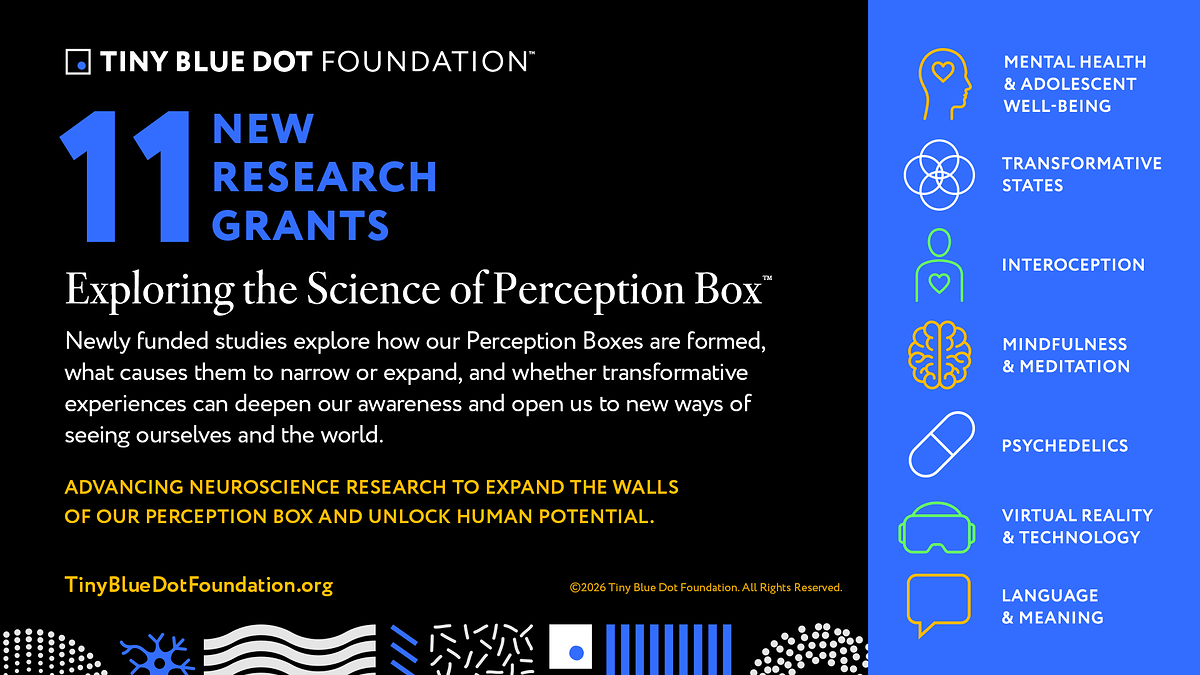 Newly funded studies explore how our Perception Box is formed, what causes it to narrow or expand, and whether experiences, including mindfulness, dreams, psychedelics, play, and virtual reality, can help us become more aware of what shapes our experience and open us to new ways of seeing ourselves and the world
LOS ANGELES, Aug. 27, 2026 /PRNewswire/ -- What if the way we experience reality is more flexible than we think? What if changing our relationship to the sensations in our bodies could change how we experience anxiety? What if the words we use could reveal when our world is narrowing or opening up? And what might dreams, meditation, psychedelics, play, or virtual reality teach us about our ability to see ourselves and the world differently?
What if understanding your Perception Box could open new possibilities for how you experience yourself and the world?
Tiny Blue Dot Foundation today announced $9 million funding for 11 new research projects investigating these questions and others at the intersection of neuroscience, psychology, mental health, and the subjective construction of reality.
The newly funded research spans institutions in the United States, Australia, Great Britain, and the Netherlands and includes studies examining adolescent anxiety and emotion regulation, autism, body perception and chronic pain, transformative dreams, mindfulness, psychedelic-assisted therapy, virtual reality, brain stimulation, and new methods for measuring the Perception Box.
This year's cohort includes research exploring:
These studies are part of Tiny Blue Dot Foundation's broader scientific initiative to investigate the Perception Box framework, developed by Elizabeth R. Koch, which posits that internal beliefs, cognitive schemas, prior experiences, and other factors shape how individuals interpret themselves, other people, and the world around them.
As the scientific research arm of this work, the Foundation supports empirical studies designed to understand the mechanisms underlying these perceptual frameworks and to investigate whether and how they can become more flexible.
This year's awards continue the Foundation's commitment to research that bridges fundamental questions about perception with practical approaches to improving mental health and well-being. Several of the newly funded studies focus specifically on adolescents and young adults, a period when patterns of emotion, identity, and perception are still developing and when anxiety and other mental health challenges frequently emerge.
The 11 projects were selected through Tiny Blue Dot Foundation's competitive request for proposals process.
This fourth round of funding builds upon the Foundation's previous three rounds of research:
With this fourth round, Tiny Blue Dot Foundation will have supported 45 total research projects investigating the science of perception and consciousness across four consecutive funding cycles.
"What excites me most about these extraordinary proposals is that each seeks to better understand, and potentially address, the underlying causes of human suffering," said Elizabeth R. Koch, Co-Founder of Tiny Blue Dot Foundation. "They combine scientific rigor with practical tools that may help certain populations reframe harmful beliefs, recognize buried assumptions, and gain more agency over behaviors that can put them in conflict. Our hope is that the more people understand how their Perception Box functions, the more freedom, possibility, and joy is possible in their lives."
"We continue to be struck by the creativity and scientific ambition researchers bring to the study of perception," said Christof Koch, Chief Scientist at Tiny Blue Dot Foundation. "This cohort approaches the Perception Box from remarkably different directions, from language and visual perception to body awareness, dreams, psychedelics, meditation, and virtual reality. Together, these projects can help us develop a more rigorous understanding of how the bespoke worlds we each experience in our minds are constructed and how they might become more flexible."
Below is a brief summary of each funded project, along with the originating organization and Principal Investigator.
Engineering Transformative Dreams: Pharmacological Augmentation and Gut-Brain Interactions
Institution: Stanford University
Principal Investigator: Boris Heifets
Co-Investigators: Pilleriin Sikka, Neir Eshel, Todd Coleman
Country: USA
Overview: Some experiences can profoundly shift what people believe, value, and perceive about themselves and others. Dreams are one of the most natural ways humans enter such altered states. Researchers at Stanford have found that propofol, a commonly used anesthetic, reliably produces dreams that are typically pleasant, and early work found improvements in trauma-related symptoms among patients who dreamed while under anesthesia.
This project will investigate whether those anesthesia dreams can be made richer and potentially more transformative (in target age 18-70). In two small studies, researchers will combine propofol with either a medication that boosts acetylcholine, a neurotransmitter involved in dreaming, or psilocybin. They will measure how the resulting dreams change while recording electrical signals from both the brain and stomach to investigate how interactions between the brain and body shape subjective experience. The ultimate goal is to explore a safe, controllable, and scalable way to create transformative experiences.
Study Details
Randomized Trial Of A Game-Based Intervention To Enhance Emotion Regulation And Improve Health
Institution: Rhode Island Hospital
Principal Investigator: Christopher Houck
Co-Investigator: David Barker
Country: USA
Overview: The ability to regulate emotions plays an important role in adolescent mental health and decision-making. Yet some young people believe emotions cannot be controlled, a perception that can interfere with their well-being.
Researchers will test iTRAC, a web-based program that uses games, activities, and videos to teach emotion regulation skills to middle school students. Building on promising results from an earlier study, the project will randomly assign 200 adolescents ages 12 to 14 to examine whether the program changes their perception of their ability to manage emotions and whether those changes affect risk behaviors and mental health over an 18-month follow-up period.
Study Details
The PAPAYA Study: Pharmacologically-Assisted Psychotherapy For Social Anxiety In Young People With Autism
Institution: The University of Melbourne
Principal Investigator: Gill Bedi
Co-Investigators: Adam Guastella, David Coghill, Patrick McGorry, Andrew Chanen, Ian Hickie, Hok Pan Yuen, Kelsie Boulton, Alexandre Guerin, Edward Mullen
Country: Australia
Overview: Social anxiety is common among autistic young people and can contribute significantly to distress and disability. Existing approaches, including cognitive behavioral therapy and antidepressant medications, are often ineffective for this population.
The PAPAYA clinical trial will investigate whether MDMA-assisted psychotherapy can reduce social anxiety and improve well-being, including self-compassion and openness to new experiences, in autistic 16-18 years old people. The study builds on promising results from a pilot study involving autistic adults with social anxiety. If successful, the research could help establish a much-needed new treatment option for young people for whom existing therapies have not provided sufficient relief.
Study Details
Characterizing Perception As Intrinsic Meaning: A Quantitative Foundation for the Science of the Perception Box
Institution: University of Wisconsin
Principal Investigator: Giulio Tononi
Country: USA
Overview: People often recognize that their beliefs can be biased, but it can be harder to recognize that perception itself is shaped by learning history and the brain. This project will experimentally investigate one of the central ideas behind the Perception Box: that the same information can mean different things to different people.
Researchers will repeatedly expose two groups of participants (ages 18-35) to different hidden shapes embedded within seemingly meaningless visual patterns, without telling participants what they are seeing. Afterwards, the groups will view the same image and test whether they perceive different objects within it. Researchers will also develop computational models to examine why identical sensory input can acquire different meanings in different brains. The project aims to provide both a quantitative foundation for studying the Perception Box and a direct demonstration of how prior experience shapes perceived reality.
Study Details
Measuring and Expanding the Perception Box: A Lexical Index of Perceptual State and a Game-Based Anxiety Intervention for Adolescents and Young Adults
Institution: Brown University
Principal Investigator: Judson Brewer
Co-Investigator: William Nardi
Country: USA
Overview: Anxiety can narrow attention toward perceived threats and make the range of possibilities available to a person feel smaller. This project seeks to develop a way to measure that contraction and expansion directly through language.
Researchers will analyze tens of thousands of messages from people who have participated in an existing anxiety program and use patterns in their language to create a Perception Box Lexical Index, a measure designed to detect perceptual expansion and contraction from ordinary words. The team will also test Your Life the Game, a game-based program teaching these skills to young adults ages 18 to 22. An initial group of 30 participants will play for one month and provide feedback that will inform a larger clinical trial.
Study Details
From Body Fear to Body Curiosity: Helping Autistic Children with Abdominal Pain
Institution: Duke University
Principal Investigator: Nancy Zucker
Co-Investigators: Gary Maslow, Elena Tenenbaum, Valerie Smith, Kimberly Carpenter, Ilana Pilato, Anna Laakman, Keri Heilman, Sallie Nowell
Country: USA
Overview: Functional abdominal pain is common among children and especially common among autistic children, who may also experience heightened sensitivity to sensations inside their bodies. When these sensations feel unpredictable or threatening, children may begin avoiding them or relying on routines to feel safe, potentially narrowing their Perception Box around what their bodies can experience.
This project will test a playful intervention designed to help autistic children ages 5 to 12 approach bodily sensations with curiosity rather than fear. Through humor, imaginative characters, and guided "body investigations," children will practice noticing and exploring sensations while developing greater trust in their bodies. Researchers will examine whether this approach reduces pain and distress and improves everyday functioning.
Study Details
Using Temporal Interference Non-Invasive Deep Brain Stimulation To Boost Effects Of Mindfulness Meditation In Older Adolescents
Institution: Emory University
Principal Investigator: Negar Fani
Co-Investigators: Deanna Kaplan, Michael Treadway
Country: USA
Overview: Mindfulness meditation may reduce anxiety by improving emotion regulation and present-centered attention, but anxiety itself can make meditation difficult to sustain. This study will investigate whether a new non-invasive brain stimulation technique called temporal interference, or TI, can make mindfulness practice easier and more effective.
Researchers will study 60 young adults ages 18 to 25 with generalized anxiety disorder as they practice mindfulness while TI targets different brain regions involved in fear, reward, and emotion regulation. The study will measure changes in brain activity, mood, and daily emotional well-being. If successful, the approach could provide a safe, affordable, and scalable method for strengthening the benefits of mindfulness practice.
Study Details
Changing How We Feel Ourselves: Floatation-REST for Adolescent Anxiety and Body Image
Institution: University of California, Los Angeles
Principal Investigator: Sahib Khalsa
Co-Investigators: Nicco Reggente, Jamie Feusner
Country: USA
Overview: During adolescence, perceptions of the body can become especially powerful and sometimes rigid. Ordinary bodily sensations may feel threatening, while perceptions of body size and shape can become negative or distorted. This study asks whether changing the sensory environment can help loosen these patterns.
Researchers will study 80 adolescent girls (ages 13-18) with elevated anxiety sensitivity and body image concerns, randomly assigning them to six sessions of either Floatation-REST or mindfulness training. Floatation-REST involves floating in warm salt water while external sensory input is substantially reduced, making internal sensations such as breathing and heartbeat easier to notice. Participants will be followed for six months, with researchers using questionnaires and 3D body-mapping technology to examine changes in anxiety and body perception. The study will also investigate whether learning to experience signals from the heart and lungs as less threatening predicts lasting improvement.
Study Details
The 'One Step Back' Programme: Promoting Mental Health in Adolescents
Institution: University of Cambridge
Principal Investigator: Tim Dalgleish
Co-Investigators: Sarah-Jayne Blakemore, Camilla Nord, Anna Bevan, Marc Bennett, Daniel Mitchell
Country: Great Britain
Overview: With rates of depression and anxiety increasing among young people, accessible interventions that can provide support before symptoms become severe are urgently needed. One Step Back is a five-week digital program designed to help young people develop two skills: monitoring their own distress and broadening their perspective when confronted with upsetting thoughts.
Researchers will study 100 at-risk teenagers (ages 13-18) to understand how these exercises affect the brain and body and identify who benefits most. Through brain imaging and interactive tasks, the team will investigate whether learning to mentally "step back" and see a bigger picture can expand adolescents' Perception Box. Delivered through digital podcasts, the program is designed to provide a low-cost and scalable form of early mental health support.
Study Details
Where You End And The World Begins: Psilocybin, Meditation, and the Brain's Maps Of The Body
Institution: Stichting Vrije Universiteit Amsterdam
Principal Investigator: Tomas Knapen
Country: Netherlands
Overview: The brain continuously maps the body, contributing to the sense of where the self ends and the outside world begins. Researchers have recently identified body maps across the brain that are active both when people experience their own bodies and when they observe someone else's. These maps may represent one of the fundamental boundaries of the Perception Box.
This study will investigate whether psilocybin and body-scan meditation can change those boundaries. Adults (ages 21-50) with previous psilocybin experience will spend six weeks practicing either daily body-scan meditation or an attention game before completing brain scans under both psilocybin and placebo. Researchers will ask whether psilocybin makes body maps more flexible, whether people can learn to influence those maps through meditation, and whether both approaches act on the same neural system. The findings could provide a measurable target for understanding how practices and altered states change the boundary between self and world.
Study Details
A Closed-Loop Virtual Reality-EEG Neurofeedback Mindfulness Intervention for Pediatric Chronic Pain and Distress
Institution: U.C. San Diego
Principal Investigator: Fadel Zeidan
Co-Investigator: Pritha Dalal
Country: USA
Overview: Many children with chronic pain conditions such as Complex Regional Pain Syndrome experience persistent pain and distress even when there is no clear ongoing physical damage. Existing treatments often rely on medications that may provide limited relief or cause unwanted side effects.
NeuroMind offers a novel approach that combines virtual reality with EEG neurofeedback. Children wear a VR headset equipped with sensors that measure electrical activity in the brain as they explore immersive, calming virtual environments. When their brain activity shifts toward a more relaxed, focused state similar to meditation, the virtual environment responds in real time, reinforcing those beneficial patterns.
Rather than relying on meditation instruction or conscious effort, NeuroMind is designed to help children implicitly develop self-regulation skills through interactive exploration. Preliminary studies suggest the approach can reduce pain, anxiety, and depression in children and adults. This study will test whether VR-based brain training can help change how children (ages 13-18) experience and respond to chronic pain, potentially offering a scalable, non-pharmacological approach to reducing pain and distress.
Study Details
About the Tiny Blue Dot Foundation
The Tiny Blue Dot Foundation supports empirical research at the intersection of neuroscience, psychology, and the subjective construction of reality. As the scientific research arm of the Perception Box framework developed by Elizabeth R. Koch, who co-founded Tiny Blue Dot, to examine how internal beliefs, cognitive schemas, and lived experience shape perception and meaning, the Foundation advances studies that investigate the mechanisms underlying consciousness, emotion, and mental health.
The Foundation is led by Chief Scientist Christof Koch (no relation to Elizabeth R. Koch), a pioneering neuroscientist in the field of consciousness research. Together, the Foundation and its research partners aim to produce rigorous, interdisciplinary insights into how individuals interpret and respond to their internal and external worlds and how these perceptual frameworks can be shifted to support greater psychological flexibility, well-being, and interpersonal connection.
Learn more at www.tinybluedotfoundation.org.
SOURCE Tiny Blue Dot Foundation