
Black Book Research Releases 2026 Hospital RCM Evaluation, Naming Top Vendors Across 49 Revenue Cycle Management Categories
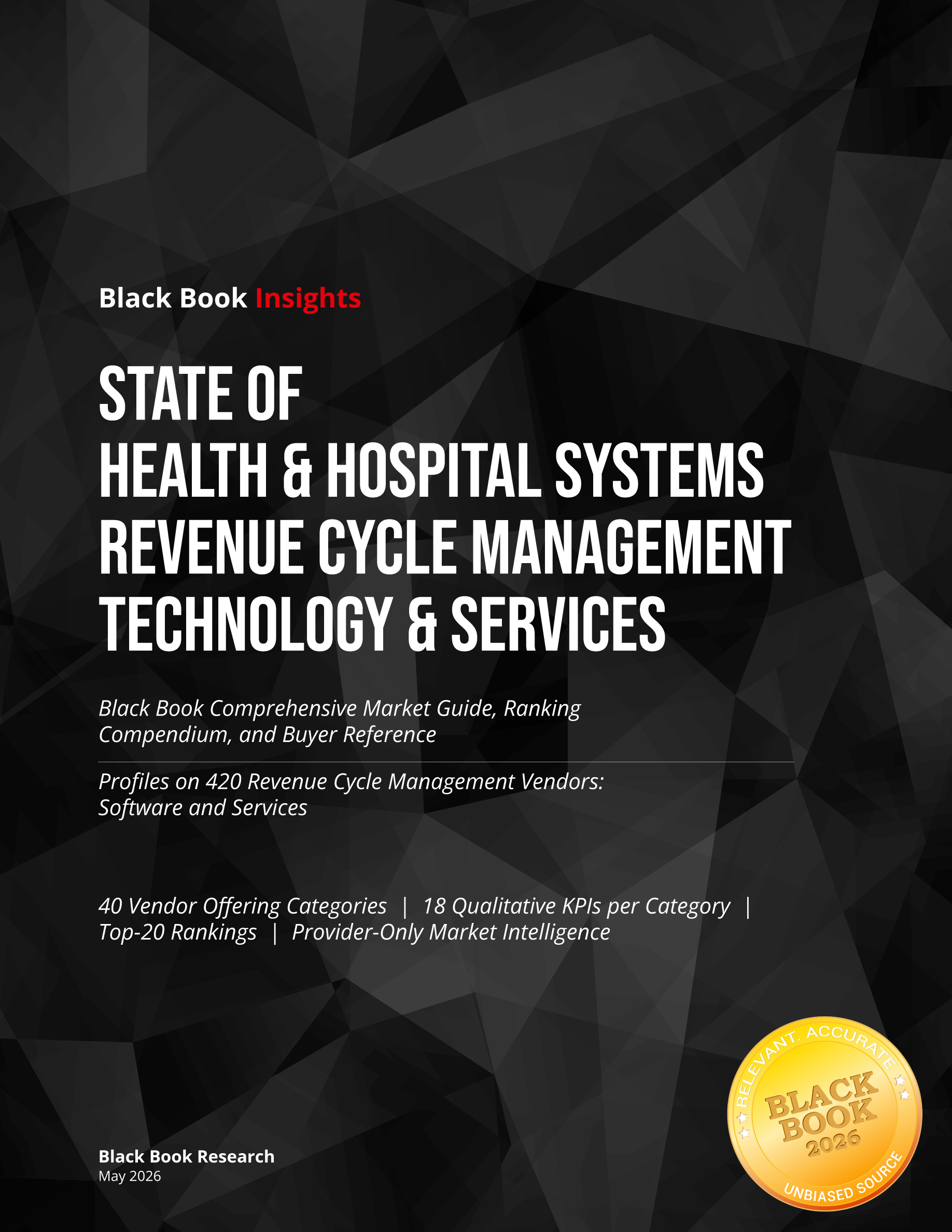 New category-level framework replaces broad vendor scorecards with workflow-specific, provider-validated RCM rankings for hospital finance, revenue cycle, patient access, claims, denials, coding, analytics, automation, AI governance and managed operations.
NATIONAL HARBOR, MD / ACCESS Newswire / June 8, 2026 / Black Book Research today announced the 2026 Hospital Revenue Cycle Management Evaluation, identifying top-rated vendors across 49 revenue cycle management technology and services categories. The new evaluation framework reflects a decisive shift in how hospitals, health systems and inpatient provider organizations assess RCM partners: by workflow, operating risk, buyer use case and measurable financial impact, rather than by broad vendor labels or single-platform scorecards.
The 2026 RCM market is being reshaped by payer friction, preventable denials, prior authorization delays, patient affordability pressure, workforce constraints and fragmented technology. Black Book's report states that hospitals increasingly view the revenue cycle as a connected financial-control system in which front-end data quality, authorization readiness, documentation sufficiency, claim readiness, payer contract interpretation, patient payment capacity and cash forecasting all affect revenue realization.
"Hospital RCM buyers are no longer asking which vendor is best in the abstract," said Doug Brown, Founder of Black Book Research. "They need to know which vendor performs best in the exact workflow causing avoidable write-offs, payment delays, staff burden or executive cash uncertainty. The 49-category model is designed to prevent apples-to-oranges comparisons across platforms, clearinghouses, analytics tools, managed services, automation vendors and AI-enabled RCM solutions."
Black Book's methodology is designed to support apples-to-apples evaluation across provider-facing software, managed services, outsourcing models and hybrid technology-enabled operating models. Category rankings are based on 18 qualitative KPIs per category, with emphasis on workflow impact, implementation experience, integration, support, financial relevance and provider-user satisfaction; vendor marketing claims, sponsor status and non-provider payer performance are excluded from ranking evidence.
Why Black Book Created Expanded RCM Categories
Black Book expanded the 2026 hospital RCM evaluation model because hospital finance and revenue cycle leaders no longer evaluate RCM as a single linear billing process. The category framework recognizes that core patient accounting, clearinghouse connectivity, prior authorization, denial prevention, patient financial engagement, coding, CDI, revenue integrity, contract yield, cash forecasting, workforce optimization, AI governance and outsourced RCM operations each require different evaluator groups, KPIs and buyer evidence.
The 2026 trend signals reinforce the need for category-level scoring. In Black Book's trend index, 78% of qualified respondents ranked payer friction as a top-three RCM technology stressor; 76% linked front-end data quality to denials or cash timing; 74% prioritized denial prevention over post-denial recovery; 73% reported automation in at least one RCM workflow; 71% ranked prior authorization as a top-three operational bottleneck; 70% wanted to reduce or rationalize RCM vendors; 66% said current analytics were insufficient for CFO-level revenue predictability; and 63% said AI auditability and explainability are mandatory.
The result is a buyer-oriented evaluation structure that separates broad platform breadth from category-specific execution. Black Book's report states that vendor comparisons should be built around user-validated outcomes and scored by the ability to prevent defects, accelerate cash, improve payer response, reduce manual work, integrate across systems, preserve auditability and support governed automation and AI in production settings.
Black Book will issue follow-up category releases organized around seven hospital RCM operating domains:
Core inpatient RCM and patient accounting
Claims, payer connectivity, remittance and cash application
Front-end revenue protection and patient affordability
Denials, payer yield, revenue integrity and pricing
Coding, CDI, information governance and identity
CFO, finance operations and enterprise performance
Workforce, automation, AI governance and technology-enabled RCM operations
Each follow-up release will explain the subcategory rationale, primary evaluator groups, category-specific KPIs and leading vendors within that operating domain.
2026 RCM Category Leaders
The following #1-rated vendors are listed in Black Book's 2026 RCM Category Leader Summary.
#
RCM category
#1 rated vendor
1
Full Provider Cloud RCM Suite: Intake-to-Final-Payment Platform Breadth
Inovalon
2
RCM-native agentic AI and autonomous revenue-cycle platforms
Waystar
3
RCM-native workflow orchestration and workqueue automation
Notable
4
Denial prevention and denial analytics software
AKASA
5
Provider-side prior authorization automation and PAIR readiness
Infinx
6
Digital scheduling and referral intake platforms
Luma Health
7
Patient access, registration QA and financial clearance software
RevSpring True Access
8
Eligibility, benefits verification and real-time payer-rule interpretation
Inovalon
9
Coverage discovery, insurance discovery and retroactive eligibility
Experian Health
10
Claims editing and clean-claim validation software
RapidClaims
11
Provider clearinghouse and claims network services
Availity
12
ERA/EFT, remittance, payment posting, reconciliation and cash application automation
InstaMed by J.P. Morgan
13
Patient financial engagement and revenue-cycle communications
ClearGage
14
Patient payment orchestration: digital wallet, POS, portal, IVR and text-to-pay
Flywire
15
Patient financing and payment-plan platforms
CommerceHealthcare
16
Patient financial navigation and assistance coordination
FinThrive / former TransUnion
17
Self-pay, charity care, Medicaid screening and eligibility enrollment services
Elevate Patient Financial Solutions
18
Clinical denial and appeal management services
AGS Health
19
Complex claims and AR recovery services
EnableComp
20
Provider contract management and payer yield optimization software
Experian Health
21
Underpayment, variance and payer contract recovery analytics software
MD Clarity
22
Enterprise health system acute-care patient accounting / hospital billing platforms
Epic
23
Community hospital patient accounting / RCM platforms
TruBridge
24
Small, rural and critical access hospital core RCM platforms
TruBridge
25
Price transparency, patient estimates and NSA compliance software
FinThrive
26
Chargemaster, CDM management and pricing compliance
Craneware
27
Charge capture and revenue leakage prevention software
Iodine Software
28
Revenue integrity and billing compliance audit software
Streamline Health
29
Computer-Assisted Coding, Autonomous Coding and Coding-Automation Software
Dolbey
30
Managed medical coding services
IKS Health
31
CDI and mid-cycle documentation integrity software
IKS Health
32
Ambient Clinical Documentation and AI Coding-Assistant Platforms
Microsoft Nuance / Dragon Copilot
33
Enterprise patient identity, EMPI and patient matching for RCM risk
Verato
34
Release of information, HIM disclosure and revenue-risk information governance
Verisma
35
RCM analytics, CFO command center and operational intelligence
VisiQuate
36
Net revenue, cash forecasting, working-capital and revenue predictability analytics
Kodiak Solutions
37
Cost Accounting, Decision Support and Service-Line Margin Analytics
Vizient / Kaufman Hall / Sg2
38
Budgeting, Planning, Rolling Forecast and Financial Performance Management
Oracle Cloud EPM
39
Healthcare ERP and finance operations systems
Oracle Cloud ERP
40
Healthcare supply chain, MMIS, procure-to-pay and spend management
Premier, Inc.
41
Workforce scheduling, labor productivity and staffing optimization
symplr Workforce
42
Capacity, patient flow and access optimization platforms
TeleTracking
43
AI-driven RCM managed services and outcome-based automation operations
IKS Health
44
End-to-end RCM outsourcing, extended business office and co-managed operations
Ensemble Health Partners
45
EHR-Agnostic Ambulatory RCM Services / Physician Enterprise Revenue Cycle Operations
Omega Healthcare Services / Omega HS
46
Health-System Physician Enterprise / Ambulatory RCM Workflow Optimization and Workforce Automation
MedEvolve
47
Horizontal RPA and enterprise RCM workflow platforms
ServiceNow
48
AI governance, auditability and observability platforms applicable to RCM
Credo AI
49
Laboratory and Radiology RCM
XIFIN
Category-Level Scoring Matters as Vendor Consolidation Accelerates
Black Book findings show that hospitals want fewer disconnected RCM vendors, but the research also cautions that vendor rationalization does not eliminate the need for category-level evidence. The report notes that weak modules in denial prevention, authorization, revenue integrity or patient financial engagement can create measurable financial risk even when buyers prefer fewer vendors.
According to the evaluation framework, peer-group comparisons are intended to avoid misleading cross-type comparisons among platforms, clearinghouses, analytics, services, automation, outsourcing and AI-enabled RCM solutions.
About Black Book Research
Black Book Research is an independent healthcare market research and competitive intelligence firm focused on technology, services, outsourcing, digital health, revenue cycle, payer, public-sector, life sciences, cybersecurity and value-based care markets. Its research emphasizes direct stakeholder feedback, buyer and user experience, structured evaluation frameworks and vendor-agnostic scoring. Industry stakeholders can download the overview research ebook as HFMA AC267 commences at the Black Book website https://www.blackbookmarketresearch.com or requesting via [email protected] Media contact: [email protected]
SOURCE: Black Book Research