
Marimaca Reports Additional High-Grade Silver Assays from Consolidated Drill Results at Pampa Medina
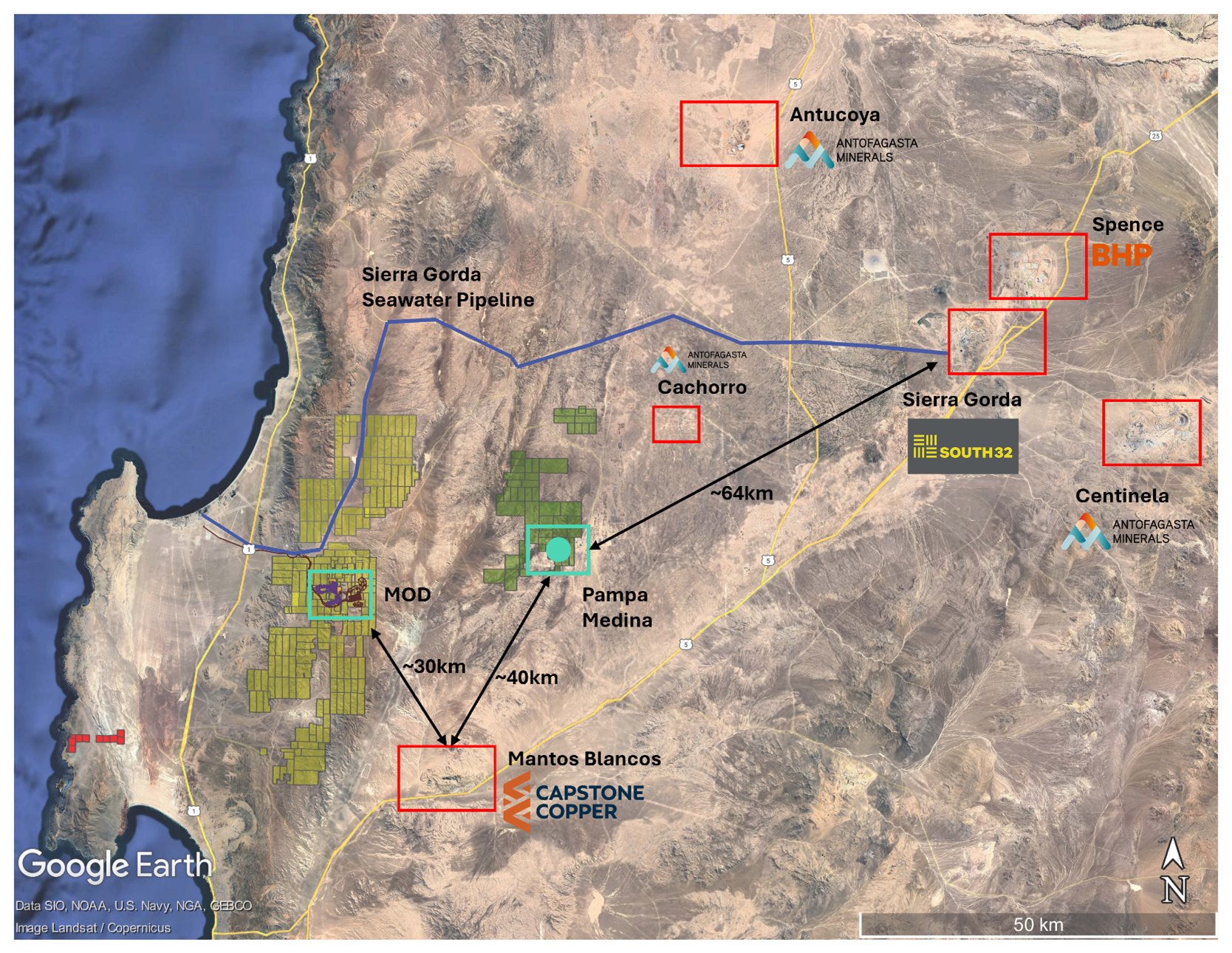 VANCOUVER, BC / ACCESS Newswire / April 2, 2026 / Marimaca Copper Corp. ("Marimaca Copper" or the "Company") (TSX:MARI)(ASX:MC2) is pleased to report the complete silver assay results from its drilling to date at the Pampa Medina deposit, located at low altitude approximately 28km east of the Company's Marimaca Oxide Deposit ("MOD") (Figure 1), in Chile's prolific Antofagasta region. Copper assays and further details for holes reported in this announcement have been previously released.
Silver mineralization is present across the deposit, with elevated silver grades present in both oxide and sulphide copper-mineralized zones and broadly correlated with copper grade. The Company is releasing these silver assays alongside a consolidation of all Pampa Medina drilling results to date, highlighting the significance of the consistent, high-grade copper and silver mineralization across a 3km by 2km area of interest.
The Company has not yet completed its Phase I metallurgical programs at Pampa Medina and is therefore not reporting copper equivalent grades at this time. Silver by-products are common in Chilean manto-type deposits, including the nearby Mantos Blancos (Capstone Copper) and Cachorro (Antofagasta Minerals) deposits.
Highlights
Completion of the ICP assaying on all drilling completed to date at Pampa Medina indicates consistent, high-grade silver mineralization with the potential to be a predictable by-product credit at scale
Highlights from the ICP assaying are below (all copper assays have been previously reported):
Hole SMRD-13:
6m of 11.98% Cu and 82.0 g/t Ag from 594m downhole within 26m of 4.07% Cu and 25.3 g/t Ag from 580m
Both within a broader 100m of 1.28% Cu and 6.9 g/t Ag from 580m
Hole SMR-01:
18m of 5.11% Cu and 53.4 g/t Ag from 320m within 102m of 1.20% Cu and 12.2 g/t Ag from 250m, including
56m of 2.05% Cu and 22.0 g/tAg from 296m
14m of 0.82% Cu and 12.3g/t Ag from 408m
Hole SMRD-16:
10m of 4.24% Cu and 37.8 g/t Ag from 438m within 30m of 2.11% Cu and 17.3 g/t Ag from 434m
Broader 360m of 0.49%Cu and from 434m and 2.5 g/t Ag
8m of 1.80% Cu and 10.8 g/t Ag from 528m
22m of 0.90% Cu and 6.5 g/t Ag from 568m
20m of 1.14% Cu and 3.0 g/t Ag from 612m
10m of 1.09% Cu and 1.2 g/t Ag from 782m
Hole SMRD-22:
74m of 1.62% Cu and 11.9 g/t Ag from 162m within 134m of 1.06% Cu and 8.1 g/t Ag from 102m, including
48m of 2.05% and 13.5 g/t Ag from 186m
16m of 0.70% Cu and 2.1 g/t Ag from 306m
Hole SMD-02:
40m of 2.06% Cu and 13.7 g/t Ag from 282m downhole within 132m of 0.99% Cu and 6.1 g/t Ag from 278m
34m of 1.02% Cu and 6.5 g/t Ag from 378m
Hole SMD-01:
242m of 0.65% Cu and 6.8 g/t Ag, including
20m of 2.25% Cu and 25.9 g/t Ag from 298m downhole, and
32m of 1.03% Cu and 12.0 g/t Ag from 332m downhole
22m of 1.70% Cu and 15.1 g/t Ag from 604m
22m of 0.84% Cu and 4.2 g/t Ag from 472m
Hole SMRD-20:
198m of 0.65% Cu and 5.1 g/t Ag from 460m, including
30m of 1.70% Cu and 20.9 g/t Ag from 548m
90m of 0.96% Cu and 8.5 g/t Ag from 488m
42m of 0.67% Cu and 3.4 g/t Ag from 600m
Hole SMRD-30:
162m of 0.61% Cu and 7.0 g/t Ag from 220m, including
36m of 1.04% Cu and 11.7 g/t Ag from 228m
14m of 1.14% Cu and 10.6 g/t Ag from 316m
6m of 2.09% Cu and 46.0 g/t Ag from 374m
10m of 0.97% Cu and 11.2 g/t Ag from 528m
Hole SWRD-02:
74m of 1.21% Cu and 7.9 g/t Ag from 520m, including
48m of 1.62% Cu and 11.5 g/t Ag from 520m, including
12m of 2.07% Cu and 17.2 g/t Ag from 532m
6m of 1.02% Cu and 7.3 g/t Ag from 814m
Hole SMRD-34:
6m of 3.0% Cu and 37.3 g/t Ag from 166m downhole within 36m of 1.08% Cu and 13.8 g/t Ag from 158m
24m of 1.4% Cu and 12.2 g/t Ag from 600m, including
10m of 2.6% Cu and 25.8 g/t Ag from 606m
8m of 1.07% Cu and 7.3 g/t Ag from 684m
Sergio Rivera, VP Exploration of Marimaca Copper, commented:
"Finalizing our silver assays across the complete Pampa Medina drilling database confirms our working hypothesis that silver grades would be elevated, consistent and strongly correlated with copper grades across the known deposit area to date. Drilling is ongoing on site, now combining 300m to 150m spaced delineation of the interpreted higher-grade zones of the deposit, as well as further step-out drilling focusing on extensions to the west, north-west and north-east. We intend to increase the rig count on site, currently at five, over the course of April and May in order to accelerate the 2026 drilling program. Pampa Medina continues to demonstrate qualities that make us very excited about the future of the deposit. Precious metal by-products in large primary copper deposits can surface exceptional value for builders and operators of these deposits as we have seen in recent and past transactions."
Overview of Pampa Medina
Pampa Medina is a manto-style copper deposit dominantly hosted in Jurassic-Triassic sedimentary units (sandstones, conglomerates, tuffs and black shales) overlain by andesitic volcanics and underlain by an Upper Paleozoic complex of metamorphosed sediments, volcanics and intrusions. Key lithological units are intruded by a dyke swarm and affected by post mineral normal faulting. Copper was originally identified in near-surface oxide mineralization dominated by atacamite, chrysocolla and both secondary chalcocite, and has now been identified in high-grade zones of bornite, chalcopyrite, covellite and chalcocite which extend at depth beyond the oxide-primary transition. Elevated silver grades are present in in both oxide and sulphide copper-mineralized zones and are generally correlated with copper grade.
Following Marimaca's consolidation of the project area and surrounding land packages in 2024, the Company reinterpreted all available geological information and developed an updated geological model for Pampa Medina, which identified the lower sedimentary units of interbedded sandstones, shales, tuffs and conglomerates as the priority target horizons for future drilling. Marimaca's 2026 drilling campaign will focus on three priority goals: definition of the high-grade sulphide-dominant central zone, delineation of the identified oxide extensions, and further step-out drilling to test potential extensions of the broader system identified in geophysical work completed to date.
Hole
Total Depth (m)
From (m)
To (m)
Intersection (m)
% CuT
g/t Ag
SMR-01
650
250
650
400
0.49
4.8
Including
250
466
216
0.70
7.6
Including
250
352
102
1.20
12.2
Including
276
352
76
1.57
16.3
Including
296
352
56
2.05
22.0
Including
320
338
18
5.11
53.4
408
422
14
0.82
12.3
618
650
32
0.62
5.8
Including
648
650
2
3.43
45.0
SMR-04
556
210
218
8
0.70
8.3
258
276
18
0.31
2.7
440
454
14
1.14
12.3
490
494
4
1.04
2.5
538
544
6
0.77
4.7
SMR-05
700
240
290
50
0.42
2.4
470
524
54
0.54
5.4
Including
470
502
32
0.81
9.1
Including
482
492
10
1.17
14.0
SMD-01
952
252
494
242
0.65
6.8
Including
298
366
68
1.20
13.6
Including
298
318
20
2.25
25.9
And
332
364
32
1.03
12.0
And
420
494
74
0.84
8.3
Including
420
460
40
1.07
13.1
Including
420
452
32
1.32
16.1
And
472
494
22
0.84
4.2
604
626
22
1.70
15.1
SMD-02
750
278
410
132
0.99
6.1
Including
282
322
40
2.06
13.7
378
412
34
1.02
6.5
SMD-03
650
226
268
42
0.72
5.7
SMRD-12
750
566
622
56
1.37
10.5
Including
582
590
8
2.00
20.8
SMRD-13
800
580
680
100
1.28
6.9
Including
580
648
68
1.65
9.7
Including
580
606
26
4.07
25.3
Including
594
600
6
11.98
82.0
SMRD-15
580
122
200
78
0.31
0.2
Including
158
200
42
0.51
0.4
Including
188
198
10
0.83
-
SMRD-16
850
236
266
30
0.43
0.3
And
434
794
360
0.49
2.5
Including
434
504
70
1.03
7.6
Including
434
464
30
2.11
17.3
Including
438
448
10
4.24
37.8
Including
516
632
116
0.61
2.6
Including
516
536
20
0.91
4.8
Including
528
536
8
1.80
10.8
Including
568
590
22
0.90
6.5
Including
568
578
10
1.24
8.6
Including
612
632
20
1.14
3.0
Including
744
794
50
0.53
1.5
Including
782
792
10
1.09
1.2
SMD-04
536
214
218
4
0.59
-
SMRD-17
752
200
224
24
0.61
6.7
Including
206
224
18
0.73
8.1
590
600
10
1.34
7.2
SMRD-18
900
42
82
40
0.40
1.5
Including
70
82
12
0.57
2.7
138
164
26
0.51
5.1
Including
152
164
12
0.86
9.5
392
408
16
0.75
10.3
Including
392
398
6
1.56
26.0
866
880
14
0.51
3.0
SMR-19
594
464
492
28
1.44
5.3
Including
464
480
16
2.29
8.8
SMRD-20
850
460
658
198
0.65
5.1
Including
488
578
90
0.96
8.5
Including
548
578
30
1.70
20.9
600
642
42
0.67
3.4
SMRD-21
697.1
342
350
8
0.46
5.8
414
426
12
0.53
5.0
SMRD-22
898
102
236
134
1.06
8.1
Including
162
236
74
1.62
11.9
Including
186
234
48
2.05
13.5
306
322
16
0.70
2.1
746
756
10
0.58
3.0
844
856
12
0.45
3.6
SMRD-23
900
242
264
22
0.53
4.8
Including
256
264
8
1.19
12.3
Including
426
432
6
0.58
2.7
SMRD-24
648
288
356
68
0.44
3.2
Including
288
296
8
1.22
15.3
Including
312
318
6
1.99
16.0
394
410
16
1.24
5.4
554
560
6
1.14
2.7
588
620
32
0.57
2.9
Including
606
616
10
1.20
8.0
SMR-25
610
No significant intercepts
SMRD-26
952
344
350
6
0.46
4.7
586
598
12
0.41
4.2
814
818
4
1.28
16.5
SMR-27
550
No significant intercepts
SMRD-28
820
386
398
12
0.59
1.7
494
504
10
0.47
1.4
SMR-29
618
204
320
116
0.51
3.7
Including
296
320
24
1.62
14.9
Including
296
312
16
2.13
20.3
SMRD-30
863.4
220
382
162
0.61
7.0
Including
228
264
36
1.04
11.7
Including
242
254
12
2.02
24.2
Including
316
330
14
1.14
10.6
And
374
380
6
2.09
46.0
448
454
6
0.80
-
504
538
34
0.44
4.8
Including
528
538
10
0.97
11.2
SMR-31
576
No significant intercepts
SMR-32
570
234
262
28
0.45
-
484
494
10
0.74
4.0
SWRD-01
956
694
732
38
1.43
11.8
Including
694
702
8
2.11
15.5
And
718
732
14
1.86
19.3
848
868
20
0.84
3.0
SWRD-02
944
520
594
74
1.21
7.9
Including
520
568
48
1.62
11.5
Including
532
544
12
2.07
17.2
814
820
6
1.02
7.3
SWRD-03
956
736
754
18
0.55
-
822
880
58
0.49
3.3
Including
840
868
28
0.72
5.9
SWRD-04
898
322
380
58
0.49
-
Including
332
348
16
1.00
5.9
Including
338
342
4
2.51
14.5
And
368
376
8
1.17
5.0
660
670
10
0.71
6.4
706
710
4
1.06
8.5
820
824
4
1.08
17.0
836
842
6
0.85
9.7
SMRD-34
950
140
256
116
0.37
4.4
Including
158
194
36
1.08
13.8
Including
166
172
6
3.01
37.3
600
710
110
0.57
3.9
Including
600
624
24
1.37
12.2
Including
606
616
10
2.58
25.8
And
684
692
8
1.07
7.3
Table 1: Table of Intersections
Hole
Easting
Northing
Elevation
Azimuth
Dip
Depth
Year
Type
SMD-01
407071.4
7441265.9
1270.04
270
-60
950
2025
DDH
SMD-02
407103.1
7440800.9
1268.64
270
-60
750
2025
DDH
SMD-03
407146
7440627.6
1268.32
240
-50
650
2025
DDH
SMD-04
407699
7441101.5
1267.95
270
-60
536
2025
DDH
SMR-01
407062.8
7441273.7
1270.17
270
-60
650
2024
RC
SMR-04
406763.4
7441275.7
1276.67
270
-60
556
2024
RC
SMR-05
407361.6
7441273.8
1268.8
270
-60
700
2025
RC
SMR-19
406946.8
7440199.9
1270.58
270
-60
594
2025
RC
SMRD-12
406787
7440797.2
1274.92
270
-60
750
2025
RCD
SMRD-13
407395.3
7440801.3
1267.63
270
-60
800
2025
RCD
SMRD-15
407698.2
7440799.1
1267.17
270
-60
580
2025
RCD
SMRD-16
406488.2
7440819.3
1282.01
270
-60
850
2025
RCD
SMRD-17
407316
7441099
1268.61
270
-60
752
2025
RCD
SMRD-18
406904
7441100
1272.63
270
-60
900
2025
RCD
SMRD-20
406499.2
7441099.9
1283.59
270
-60
850
2025
RCD
SMRD-21
407099.6
7441404.2
1269.9
270
-60
697
2025
RCD
SMRD-22
406999.4
7440502.1
1270.51
270
-60
898
2025
RCD
SMR-25
407599.1
7440503.1
1267.23
270
-60
610
2025
RC
SMR-27
407598.9
7440199.7
1265.74
270
-60
550
2025
RC
SMR-29
407698.6
7441401
1269.99
270
-60
618
2025
RC
SMR-31
407300.9
7440201.7
1266.54
270
-60
576
2025
RC
SMR-32
406500.4
7440201.9
1277.38
270
-60
570
2025
RC
SMRD-23
406800.9
7441403.3
1276.43
270
-60
900
2025
RCD
SMRD-24
406699.1
7440503.8
1275.95
270
-60
648
2025
RCD
SMRD-26
406497.4
7441404.5
1285.07
270
-55
952
2025
RCD
SMRD-28
407286.4
7440503.5
1266.5
270
-55
820
2025
RCD
SMRD-30
407400.1
7441401.8
1269.05
270
-55
863
2025
RCD
SMRD-34
406399.2
7440496.5
1282.63
270
-55
950
2026
RCD
SWRD-01
406194.3
7440803.7
1288.92
270
-55
956
2026
RCD
SWRD-02
406198.9
7440504.2
1287
270
-55
944
2026
RCD
SWRD-03
405899.9
7440801.4
1296.05
270
-55
956
2026
RCD
SWRD-04
405900.2
7440502.2
1293.18
270
-55
898
2026
RCD
Table 2: Drill Collars
Sampling and Assay Protocols
True widths are estimated as 80-90% of reported intervals, based on down-hole bedding and structural measurements. DDH holes were sampled on a 2m continuous basis, halved by a conventional core splitter on site with one half sent to the Andes Analytical Assay preparation laboratory in Copiapó and the pulps then sent to the same company laboratory in Santiago for assaying. Samples were prepared using the following standard protocol: drying; crushing all sample to -1/4" and passing through a secondary crusher to better than 80% passing -10#; homogenizing; splitting; pulverizing a 400-600g subsample to 95% passing -150#; and a 125g split of this sent for assaying. All samples were assayed for sequential copper %CuT (total copper); %CuS (acid soluble copper), %CuCN (cyanide soluble copper) and CuRes (residual copper), In addition to copper analyses, multi-element analysis including silver (Ag) was undertaken using ICP (multi-element Optical Inductively Coupled Plasma). A full QA/QC program, involving insertion of appropriate blanks, standards and duplicates was employed with acceptable results. Pulps and sample rejects are stored by Marimaca Copper for future reference.
Qualified Person / Competent Person
The technical information in this news release, including the information that relates to geology, drilling and mineralization was prepared under the supervision of, or has been reviewed by Sergio Rivera, Vice President of Exploration, Marimaca Copper Corp, a geologist with more than 40 years of experience and a member of the Colegio de Geólogos de Chile and of the Institute of Mining Engineers of Chile, and who is the Qualified Person for the purposes of NI 43-101 responsible for the design and execution of the drilling program.
The information in this announcement which relates to exploration results for the Pampa Medina Project is based on, and fairly reflects, information and supporting documentation prepared by Sergio Rivera, VP Exploration of Marimaca, a Competent Person who is a member of the Comision Minera (Chilean Mining Commission), Colegio de Geólogos de Chile and of the Institute of Mining Engineers of Chile. Mr. Rivera has sufficient experience that is relevant to the style of mineralisation and types of deposit under consideration and to the activity being undertaken to qualify as a Competent Person as defined in the 2012 Edition of the Joint Ore Reserves Committee Australasian Code for Reporting of Exploration Results, Mineral Resources and Ore Reserves. Mr. Rivera consents to the inclusion in this announcement of the matters based on his information in the form and context in which it appears.
Contact Information
For further information please visit www.marimaca.com or contact:
Tavistock
+44 (0) 207 920 3150
Emily Moss
[email protected]
About Marimaca Copper:
Marimaca is a TSX ("MARI") and ASX ("MC2")-listed copper company focused on the development of high-quality copper assets in northern Chile. The Company's flagship asset is the Marimaca Oxide Deposit Project ("MOD"), located in Chile's prolific Antofagasta region. It has the potential to produce 50kt per year starting within the next three years. It is one of the few globally significant greenfield copper discoveries made in the last decade and represents a low-risk development opportunity, given the proximity to the city of Antofagasta and port of Mejillones, with substantial exploration upside. The Company also controls additional exploration properties at Pampa Medina and Madrugador within the Sierra de Medina region, located 25 kilometers from the MOD, where recent drilling has identified both oxide extensions and high-grade sulphide mineralization at depth.
Forward Looking Statements
This news release includes certain "forward-looking statements" under (without limitation) applicable Canadian securities legislation, including, without limitation, statements regarding the development of activities at Pampa Medina, the potential growth of Pampa Medina, and the discovery's potential to complement the MOD. There can be no assurance that such statements will prove to be accurate, and actual results and future events could differ materially from those anticipated in such statements. Forward-looking statements reflect the beliefs, opinions and projections on the date the statements are made and are based upon a number of assumptions and estimates that, while considered reasonable by Marimaca Copper, are inherently subject to significant business, economic, competitive, political and social uncertainties and contingencies. Many factors, both known and unknown, could cause actual results, performance or achievements to be materially different from the results, performance or achievements that are or may be expressed or implied by such forward-looking statements and the parties have made assumptions and estimates based on or related to many of these factors. Such factors include, without limitation: risks that the development activities at Pampa Medina will not progress as anticipated, or at all, risks related to share price and market conditions, the inherent risks involved in the mining, exploration and development of mineral properties, the uncertainties involved in interpreting drilling results and other geological data, fluctuating metal prices, the possibility of project delays or cost overruns or unanticipated excessive operating costs and expenses, uncertainties related to the necessity of financing, uncertainties relating to regulatory procedure and timing for permitting submissions and reviews, the availability of and costs of financing needed in the future as well as those factors disclosed in the annual information form of the Company dated March 27, 2025 and other filings made by the Company with the Canadian securities regulatory authorities (which may be viewed at www.sedar.com). Readers should not place undue reliance on forward-looking statements. Marimaca Copper undertakes no obligation to update publicly or otherwise revise any forward-looking statements contained herein whether as a result of new information or future events or otherwise, except as may be required by law.
None of the TSX, ASX or the Canadian Investment Regulatory Organization accepts responsibility for the adequacy or accuracy of this release.
This announcement was authorised for release to the ASX by the Board of Directors of the Company.
Appendix 1 - JORC Code 2012 Table 1 (ASX Listing Rule 5.7.1)
Section 1 Sampling Techniques and Data
Criteria
JORC Code explanation
Commentary
Sampling techniques
Nature and quality of sampling (eg cut channels, random chips, or specific specialised industry standard measurement tools appropriate to the minerals under investigation, such as down hole gamma sondes, or handheld XRF instruments, etc). These examples should not be taken as limiting the broad meaning of sampling.
Include reference to measures taken to ensure sample representivity and the appropriate calibration of any measurement tools or systems used.
Aspects of the determination of mineralisation that are Material to the Public Report.
In cases where ‘industry standard' work has been done this would be relatively simple (eg ‘reverse circulation drilling was used to obtain 1 m samples from which 3 kg was pulverised to produce a 30 g charge for fire assay'). In other cases more explanation may be required, such as where there is coarse gold that has inherent sampling problems. Unusual commodities or mineralisation types (eg submarine nodules) may warrant disclosure of detailed information.
All current drilling conducted at Sierra Medina, which includes the Pampa Medina deposit, was completed under the supervision of a registered professional geologist as a Competent Person/Qualified Person (QP) who is responsible and accountable for the planning, execution, and supervision of all exploration activity as well as the implementation of quality assurance programs and reporting.
Drilling reported is Reverse Circulation "RC" collared and Diamond ("DDH") tailed drilling
Assay samples were prepared at a laboratory site in Copiapó and assayed by Andes Analytical Assay Ltd. (AAA) in Santiago.
Sierra Medina´s DDH holes are drilled and sampled on a continuous 2-meter basis, halved by a conventional core splitter on site, with one half sent to the Andes Analytical Assay preparation laboratory in Copiapó and the pulps then sent to the same company laboratory in Santiago for assaying.
Sierra Medina RC holes are drilled and sampled on a continuous 2-meter basis and riffle split on site up to one-eighth (12.5%) of its volume, after which samples are sent for preparation and assaying.
Marimaca staff supervised all the drilling and sampling.
DD recoveries were controlled by accurate core recovery measurement control was extended toward the division process realized in the drill location.
DD recoveries were measured by core length measurement and compared with the effective core run. Marimaca technical staff checked all data.
Measured recoveries are over 95% for DDH drilling, without significant variations and unrelated to copper grades.
RC recoveries were controlled by weighing samples and accurate control was extended toward the division process realized in the drill location.
RC recoveries were measured in weight percent as compared with a theoretical sample weight. Marimaca technical staff checked all data.
Measured recoveries are over 95% for RC drilling, without significant variations and unrelated to copper grades.
Drilling techniques
Drill type (eg core, reverse circulation, open-hole hammer, rotary air blast, auger, Bangka, sonic, etc) and details (eg core diameter, triple or standard tube, depth of diamond tails, face-sampling bit or other type, whether core is oriented and if so, by what method, etc).
Drilling reported RC collared and DDH-tailed drilling, DDH drilling commenced when the contact between the upper volcanics and upper sediments is encountered, which is variable in depth
DDH drilling is drilled in HQ and NQ standard core diameters
Drill sample recovery
Method of recording and assessing core and chip sample recoveries and results assessed.
Measures taken to maximise sample recovery and ensure representative nature of the samples.
Whether a relationship exists between sample recovery and grade and whether sample bias may have occurred due to preferential loss/gain of fine/coarse material.
Sierra Medina´s DDH holes are drilled and sampled on a continuous 2-meter basis, halved by a conventional core splitter on site, with one half sent to the Andes Analytical Assay preparation laboratory in Copiapó and the pulps then sent to the same company laboratory in Santiago for assaying.
Sierra Medina RC holes are drilled and sampled on a continuous 2-meter basis and riffle split on site up to one-eighth (12.5%) of its volume, after which samples are sent for preparation and assaying.
Marimaca staff supervised all the drilling and sampling.
DD recoveries were controlled by accurate core recovery measurement control was extended toward the division process realized in the drill location.
DD recoveries were measured by core length measurement and compared with the effective core run. Marimaca technical staff checked all data.
RC recoveries were controlled by weighing samples and accurate control was extended toward the division process realized in the drill location.
RC recoveries were measured in weight percent as compared with a theoretical sample weight. Marimaca technical staff checked all data.
Measured recoveries are over 95% for RC drilling, without significant variations and unrelated to copper grades.
Logging
Whether core and chip samples have been geologically and geotechnically logged to a level of detail to support appropriate Mineral Resource estimation, mining studies and metallurgical studies.
Whether logging is qualitative or quantitative in nature. Core (or costean, channel, etc) photography.
The total length and percentage of the relevant intersections logged.
All holes were geologically logged on digital data capture.
The data collected are rock, structure, alteration and mineralization based on drilling intervals, recoveries and analytical results.
After validation, the mineral and alteration zones were defined.
The results were entered in the database as a table with all mapped data and a consolidated log of the drill was prepared.
Most of this work was done by experienced senior consultant geologist supported by consultant junior geologist.
In addition to measuring deviations, most of the holes were surveyed using an optical tele viewer (OPTV or BHTV), with structures and orientation measurements, which continuously and thoroughly recorded the holes' walls and measured structures.
The structures were measured in ranks according to their width and the results were reported and plotted on stereographic networks and rosette diagrams.
Sub-sampling techniques and sample preparation
If core, whether cut or sawn and whether quarter, half or all core taken.
If non-core, whether riffled, tube sampled, rotary split, etc and whether sampled wet or dry.
For all sample types, the nature, quality and appropriateness of the sample preparation technique.
Quality control procedures adopted for all sub-sampling stages to maximise representivity of samples.
Measures taken to ensure that the sampling is representative of the in situ material collected, including for instance results for field duplicate/second-half sampling.
Whether sample sizes are appropriate to the grain size of the material being sampled.
Sierra Medina´s DDH holes are drilled and sampled on a continuous 2-meter basis, halved by a conventional core splitter on site, with one half sent to the Andes Analytical Assay preparation laboratory in Copiapó and the pulps then sent to the same company laboratory in Santiago for assaying
The last split yields "sample A", which is sent for preparation and assaying, and "sample B", which is used to obtain drill cuttings (1 kg) and coarse/preparation duplicates and then stored in special facilities on site.
DDH samples are obtained every 2 meters from a half-core, with the other half stored on site.
RC holes are drilled and sampled on a continuous 2-meter basis and its samples riffle split on site three times, up to one eighth (12.5%) of its volume.
The last split yields "sample A", which is sent for preparation and assaying, and "sample B", which is used to obtain drill cuttings (1 kg) and coarse/preparation duplicates, and then stored in special facilities on site.
Samples are transferred by laboratory personnel from the project to Copiapó, and then the preparation pulps are returned to generate the analysis batches. Upon receipt, sample details are logged and insertion points for quality control samples in the sample flow are determined.
Samples were prepared using the following standard protocol: drying; crushing all sample to -1/4" and passing through a secondary crusher to better than 80% passing -10#; homogenizing; splitting; pulverizing a 400-600g subsample to 95% passing -150#; and a 125g split of this sent for assaying. All samples were assayed for sequential copper %CuT (total copper); %CuS (acid soluble copper), %CuCN (cyanide soluble copper) and CuRes (residual copper), and multi-element Optical Inductively Coupled Plasma (ICP).. A full QA/QC program, involving insertion of appropriate blanks, standards and duplicates was employed with acceptable results. Pulps and sample rejects are stored by Marimaca Copper for future
Laboratory results are loaded directly from digital assay certificates into the database, in order to minimize error sources.
Quality of assay data and laboratory tests
The nature, quality and appropriateness of the assaying and laboratory procedures used and whether the technique is considered partial or total.
For geophysical tools, spectrometers, handheld XRF instruments, etc, the parameters used in determining the analysis including instrument make and model, reading times, calibrations factors applied and their derivation, etc.
Nature of quality control procedures adopted (eg standards, blanks, duplicates, external laboratory checks) and whether acceptable levels of accuracy (ie lack of bias) and precision have been established.
Samples are prepared at a laboratory site in Copiapó and assayed by Andes Analytical Assay Ltd. (AAA) in Santiago.
Samples were prepared using the following standard protocol: drying; crushing all sample to -1/4" and passing through a secondary crusher to better than 80% passing -10#; homogenizing; splitting; pulverizing a 400-600g subsample to 95% passing -150#; and a 125g split of this sent for assaying. All samples were assayed for %CuT (total copper); %CuS (acid soluble copper). A full QA/QC program, involving insertion of appropriate blanks, standards and duplicates was employed with acceptable results. Pulps and sample rejects are stored by Marimaca Copper for future. In addition to copper analyses, multi-element analysis including silver (Ag) was undertaken using ICP.
All samples were assayed for sequential copper %CuT (total copper); %CuS (acid soluble copper), %CuCN (cyanide soluble copper) and CuRes (residual copper). Silver and an additional 33 elements were analysed using a 0.5g pulp sample and measured by optical ICP.
Laboratory results are loaded directly from digital assay certificates into the database, in order to minimize error sources.
The analytical quality control programs implemented at Marimaca involve the use of coarse/preparation and pulp duplicates for precision analyses and standard reference materials (SRM). QA/QC procedures apply equally to silver and the multi-element suite.
Marimaca has protocols in place for handling analytical results that exceed acceptable limits, which can ultimately trigger re-assays of entire or portions of sample batches.
Verification of sampling and assaying
The verification of significant intersections by either independent or alternative company personnel.
The use of twinned holes.
Documentation of primary data, data entry procedures, data verification, data storage (physical and electronic) protocols.
Discuss any adjustment to assay data.
There are no twinned holes in the dataset
All logging data was completed, and logging data was entered directly into the deposit database.
Laboratory results are loaded directly from digital assay certificates into the database to minimize error sources.
Location of data points
Accuracy and quality of surveys used to locate drill holes (collar and down-hole surveys), trenches, mine workings and other locations used in Mineral Resource estimation.
Specification of the grid system used.
Quality and adequacy of topographic control.
Local contractors carried out the supervision of the drilling operation.
An experienced topographer surveyed the collars.
WGS84 UTM coordinates are used.
Data Well Services carried out the downhole surveys for drill holes.
Data collected is considered adequate for eventual use in mineral resource estimation.
Data spacing and distribution
Data spacing for reporting of Exploration Results.
Whether the data spacing and distribution is sufficient to establish the degree of geological and grade continuity appropriate for the Mineral Resource and Ore Reserve estimation procedure(s) and classifications applied.
Whether sample compositing has been applied.
Due to the nature of mineralisation and the type of exploration discovery drilling program the hole spacing is highly variable.
Data spacing is not considered sufficient to establish geological and grade continuities for Mineral Resource Estimation at the Inferred and Indicated category.
No sample compositing was applied.
Orientation of data in relation to geological structure
Whether the orientation of sampling achieves unbiased sampling of possible structures and the extent to which this is known, considering the deposit type.
If the relationship between the drilling orientation and the orientation of key mineralised structures is considered to have introduced a sampling bias, this should be assessed and reported if material.
Drill hole orientation was generally oriented to be sub perpendicular to the mineralisation but variable in places given the nature of the exploration program being conducted
Assays are reported on a downhole basis
True widths are estimated as 80-90% of reported downhole intersection widths
Sample security
The measures taken to ensure sample security.
All drilling assay samples are collected by company personnel or under the direct supervision of company personnel.
Samples from Marimaca were initially processed at the project site and shipped directly from the property to a laboratory facility for final preparation, and later, upon their return, to the laboratory for analysis.
Appropriately qualified staff at the laboratories collect assay samples.
Security protocols implemented maintain the chain of custody of samples to prevent unnoticed contamination or mixing of samples and to make active tampering as difficult as possible.
Audits or reviews
The results of any audits or reviews of sampling techniques and data.
It is the Competent Persons opinion that these processes met acceptable industry standards, and that the information can be reported under both JORC and NI43-101 standards and, in the future, be used for geological and resource modelling.
Section 2: Reporting of Exploration Results
Criteria
JORC Code explanation
Commentary
Mineral tenement and land tenure status
Type, reference name/number, location and ownership including agreements or material issues with third parties such as joint ventures, partnerships, overriding royalties, native title interests, historical sites, wilderness or national park and environmental settings.
The security of the tenure held at the time of reporting along with any known impediments to obtaining a licence to operate in the area.
Marimaca Copper Corp. owns a tenement package consisting of approximately 14,500 hectares at the broader Sierra de Medina project area and are a mix of mining concessions and exploration concessions.
The Sierra de Medina Project are comprising 55 concessions owned by ICAL, a subsidiary of Marimaca Copper Corp.
The Pampa Medina Project comprises 12 concessions owned by SCM Elenita over which the Company entered into an option agreement to acquire.
The Madrugador Project comprises 10 concessions owned by SLM Juanita and SLM Madrugador over which the Company entered into an option agreement to acquire.
There are no known impediments to operating exploration drilling campaigns on the project areas.
Exploration done by other parties
Acknowledgment and appraisal of exploration by other parties.
1. Pampa Medina Concessions
Between 1993 and 1996, Compañía Minera Doña Isabel and Rayrock Ltda carried out an extensive exploration program. The program included a geochemistry program with short Track Drill wells spaced every 50 m along several E-W lines between 2 km and 5 km in length, which extend throughout the district, covering the southeastern part of the Pampa concessions in an area of approximately 460 ha. The aim was to evaluate the rock below the caliche layer. In this area, approximately 600 samples were obtained, representing 40% of the total samples extracted throughout the district, of which 2% of the total have copper anomalies.
For 2003 and 2004, the right to exploit the Pampa 81 (1/20 and 21/40) and Pampa 47 (1/20 and 21/40) concessions by Minera Rayrock Ltda was established.
In 2008, Rayrock Ltda carried out two RC drilling campaigns. The first involved 15,729 m distributed in 38 holes with an approximate mesh of 500 m × 500 m and the second campaign involved 14,913 m in 35 holes with a mesh of 125 m ×125 m in an area of 1,000 × 350 m, recognising mainly copper oxides, with some mixed intervals and small amounts of primary mineralisation.
An exploration campaign was subsequently carried out in 2013, consisting of 45 diamond holes for a total of 18,707 m drilled.
During 2014, Rayrock Ltda continued with the latest exploration campaign, with the completion of 17 diamond drill holes for a total of 5,264 m drilled.
2. Madrugador Concessions
The Madrugador concessions were previously the subject of limited exploration efforts since the 1980s. Most of the exploration on the Madrugador concessions was conducted by Rayrock from 1993 to 1996 and consisted of diamond and reverse circulation drilling. A total of 23,502 m of diamond and RC drilling in 223 holes had been completed on the property prior to 2005. Proyecta, a Chilean engineering company, conducted a short track RC drilling program on the Madrugador claim in 2005.
During the period 1994 to 1999, Rayrock conducted geological mapping of the property, a stream sediment and soil/road‐cut sampling survey, as well as limited diamond drilling.
In 2007 and 2008, Apoquindo Minerals Inc. (Apoquindo) completed 21,177 m of RC drilling in 132 holes and 1,206 m of diamond drilling in eight holes.
In April 2009, Apoquindo entered into a JV agreement with Minera S.A.
Geology
Deposit type, geological setting and style of mineralisation.
The Pampa Medina mining district is characterised by Jurassic_Triassic volcanic and sediment hosted manto type copper mineralization. Characteristics volcanic hosted, such as shallow Madrugador mineralization, resembles the typical Coastal Belt copper style mineralization and the sediment hosted style is exposed at old mine workings along the Sierra de Valenzuela District and at deep drilling below covered areas extending around where the host sediments are covered by volcanics.
Main structural system are a block faulting and a complex of dyke swarm.
The copper mineralisation observed in the drill holes comprises both oxides and sulphides. The predominant oxides correspond to atacamite, azurite and chrysocolla. The oxide zone thickness varies between few metres up to more than 200 m, and irregular mixed zone characterised by a mixture of green copper oxides (mainly atacamite) and copper sulphides (mostly chalcocite, and less chalcopyrite and pyrite). At depths of more than 300m primary mineralization was observed and consist of chalcopyrite, bornite and variable covellite and pyrite.
Rock alteration is mostly albitization of sediments and little clay is observed in the upper oxidized zones.
Drill hole Information
A summary of all information material to the understanding of the exploration results including a tabulation of the following information for all Material drill holes:
easting and northing of the drill hole collar
elevation or RL (Reduced Level - elevation above sea level in metres) of the drill hole collar
dip and azimuth of the hole
down hole length and interception depth
hole length.
If the exclusion of this information is justified on the basis that the information is not Material and this exclusion does not detract from the understanding of the report, the Competent Person should clearly explain why this is the case.
Drill hole attribute information is included in a table herein.
Data aggregation methods
In reporting Exploration Results, weighting averaging techniques, maximum and/or minimum grade truncations (eg cutting of high grades) and cut-off grades are usually Material and should be stated.
Where aggregate intercepts incorporate short lengths of high grade results and longer lengths of low grade results, the procedure used for such aggregation should be stated and some typical examples of such aggregations should be shown in detail.
The assumptions used for any reporting of metal equivalent values should be clearly stated.
Length weighted averages were used to calculate grade over width.
No specific grade cap or cut-off was used during grade width calculations. The total copper (CuT) weighted average grade of the entire interval is calculated for all intervals over 2m samples lengths. Manto-type deposits can be variable in nature resulting in some intervals having a small number of poorly mineralized samples (<0.1% CuT) included in the calculation.
Silver assays reporting less than 3 g/t Ag detection limit in the ICP analysis were assigned a value of zero.
No metal equivalents have been reported.
Relationship between mineralisation widths and intercept lengths
These relationships are particularly important in the reporting of Exploration Results.
If the geometry of the mineralisation with respect to the drill hole angle is known, its nature should be reported.
If it is not known and only the down hole lengths are reported, there should be a clear statement to this effect (eg ‘down hole length, true width not known').
True widths are estimated at 80-90% of the reported downhole intersection, however drilling generally targets subparallel intersections of the mineralized manto units as understood/interpreted at the time of drilling
All intersections are reported on a downhole basis.
Diagrams
Appropriate maps and sections (with scales) and tabulations of intercepts should be included for any significant discovery being reported These should include but not be limited to a plan view of drill hole collar locations and appropriate sectional views.
Please refer to the figures contained herein
Balanced reporting
Where comprehensive reporting of all Exploration Results is not practicable, representative reporting of both low and high grades and/or widths should be practiced to avoid misleading reporting of Exploration Results.
All significant results have been reported
Please refer to the tables herein
Other substantive exploration data
Other exploration data, if meaningful and material, should be reported including (but not limited to): geological observations; geophysical survey results; geochemical survey results; bulk samples - size and method of treatment; metallurgical test results; bulk density, groundwater, geotechnical and rock characteristics; potential deleterious or contaminating substances.
Not applicable
Further work
The nature and scale of planned further work (eg tests for lateral extensions or depth extensions or large-scale step-out drilling).
Diagrams clearly highlighting the areas of possible extensions, including the main geological interpretations and future drilling areas, provided this information is not commercially sensitive.
Over the course of 2025, the Company intends to complete further exploration work at the project area including:
Geophysical surveys
Reverse circulation and diamond core drilling
Of particular focus will be the potential for extensions from the Pampa Medina Deposit north and west
SOURCE: Marimaca Copper Corp.