
Vadzo Imaging Explains BSI Sensor vs FSI Sensor: When Backside Illumination Matters in Camera System Design
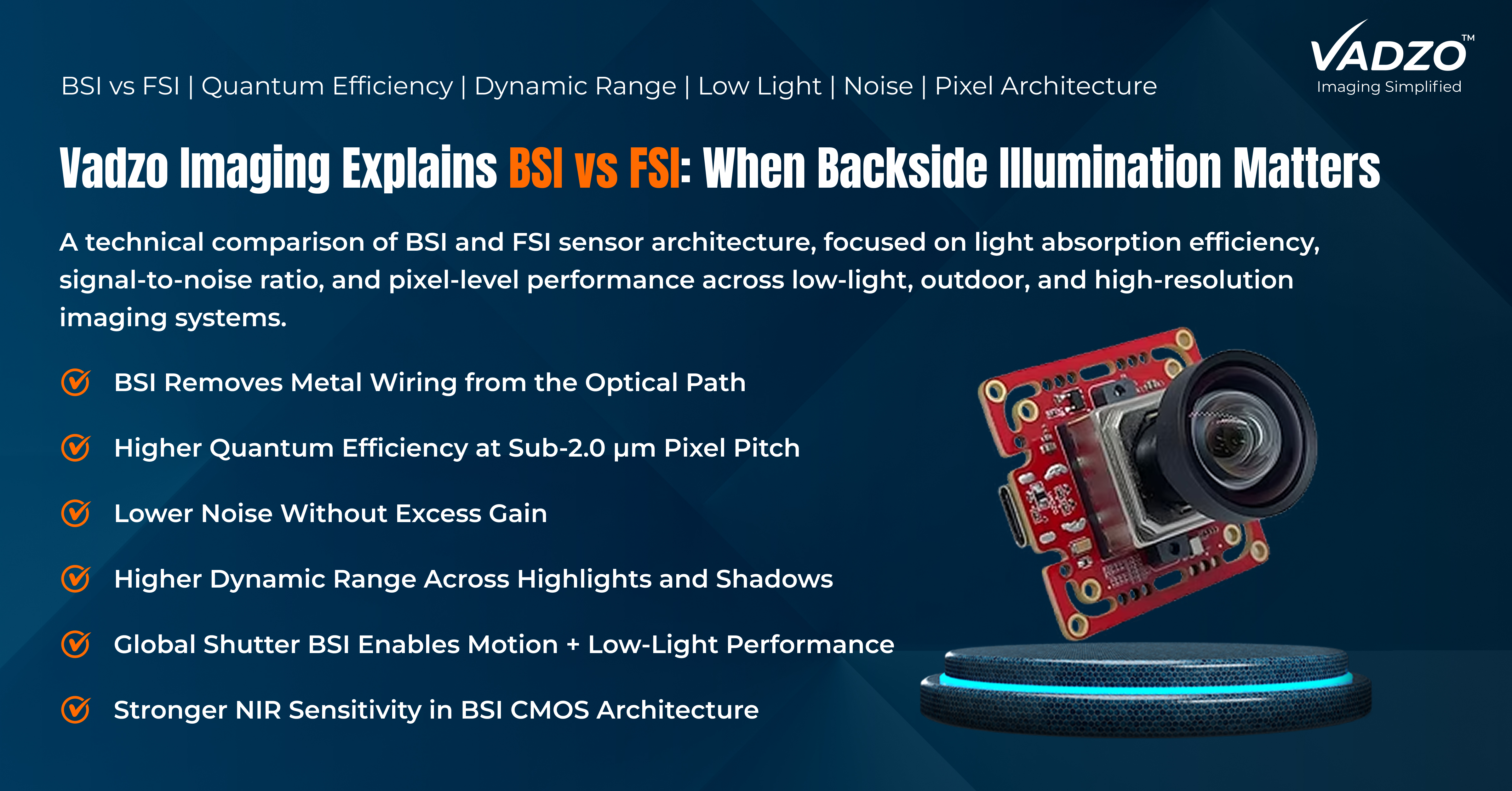 From autonomous machines to medical imaging and outdoor surveillance, Vadzo Imaging breaks down the sensor-level differences between BSI and FSI architecture and introduces the embedded camera portfolio built around each.
FORT WORTH, TX / ACCESS Newswire / May 12, 2026 / Vadzo Imaging, a globally trusted provider of high-performance embedded vision systems, today publishes a definitive technical breakdown of BSI sensor versus FSI sensor architecture. For system integrators, OEMs, and vision engineers, the difference between a backside illuminated sensor and a frontside illuminated sensor determines low-light performance, quantum efficiency, noise reduction, and higher dynamic range before the ISP processes a single frame. Vadzo Imaging builds its embedded camera portfolio on both architectures where the application demands it and explains precisely where each belongs.
What Separates a BSI Sensor from a Frontside Illuminated Sensor
An imaging sensor converts photons into charge at the photodiode layer. In a frontside illuminated sensor, the metal wiring layer sits above the photodiode. Light must travel through that wiring stack before it reaches the silicon. Metal scatters. Metal absorbs. Quantum efficiency drops. The signal captured from any given scene is fundamentally limited by the architecture, not the scene itself.
A backside illuminated sensor solves this structurally. BSI design flips the pixel architecture so that light enters from the back of the silicon, with no wiring obstructing the path to the photodiode. More photons reach the photodiode layer. Quantum efficiency rises. The AR0821 USB Camera from Vadzo Imaging demonstrates exactly this, delivering 8.3MP BSI CMOS performance that captures more signal from the same scene than an equivalent frontside illuminated design. That is not firmware optimization. That is geometry.
Quantum Efficiency and Low-Light Sensitivity: The Structural Difference
Quantum efficiency is the fraction of incident photons that are converted into measurable electrical signals. A BSI sensor removes the structural obstacles that a frontside illuminated sensor accepts as fixed constraints. At identical scene brightness, a BSI CMOS sensor produces more signal per unit area. That structural advantage is the foundation of all low-light camera performance. No ISP algorithm creates signal the photodiode did not capture.
When illumination is scarce, signal-to-noise ratio is governed by capture efficiency at the sensor level. A backside illuminated sensor captures more light per pixel area, which means the IMX678 GigE Camera portfolio produces usable signals before noise overwhelms the output. The 8MP 4K GigE camera built on the Sony IMX678 BSI CMOS preserves fine image detail in low-light conditions where a frontside illuminated sensor of equivalent resolution produces only digital noise. This performance advantage is fixed into silicon, not tuned into firmware.
Higher Dynamic Range and Noise Reduction: Where BSI and FSI Diverge Most
A higher dynamic range requires the sensor to hold the brightest highlight and the darkest shadow in a single captured frame without clipping either end. A factory inspection line with both LED banks and deep shadow. A building entrance with direct sun at the threshold and an unlit interior behind. Most sensors fail at one extreme or the other. The AR0830 Rolling Shutter Camera from Vadzo Imaging, built on the onsemi AR0830 Hyperlux BSI CMOS, addresses both extremes without compromise.
A BSI sensor achieves a higher dynamic range through two compounding mechanisms. Higher quantum efficiency extends the usable range at the bright end, delaying saturation. Improved low-light sensitivity extends the usable range at the dark end, maintaining signal integrity before noise reduction is required. The 8MP USB 3.2 camera built on the AR0830 delivers clean signal paths that reduce fixed pattern noise at the sensor level, before the ISP processes the frame. This is the structural promise of backside illuminated design in demanding imaging conditions.
"Backside illumination is not a feature. It is a sensor-level architectural decision made before the lens is selected, before the ISP is tuned, and before the camera system is deployed. The AR0821 and AR0830-based portfolio exists because maximizing photon efficiency is not something firmware can replicate." - Alwin Vincent, Product Manager, Vadzo Imaging.
High-Performance BSI Imaging: Vadzo Camera Portfolio for Demanding Environments
AR0821 USB Camera: 8.3MP 4K HDR for Smart Cities and Outdoor Surveillance
The AR0821 USB Camera targets smart city deployments and outdoor surveillance environments where illuminance shifts from direct midday sun to deep shadow within the same frame. Delivering 4K HDR output with high quantum efficiency on the onsemi AR0821 BSI CMOS, it maintains clean signal integrity across the full dynamic range without ISP compensation. This 8.3MP 4K HDR Rolling Shutter USB Camera supports UVC compatibility over USB 3.2 Gen 1, making it a validated drop-in solution for vision systems requiring plug-and-play integration without custom drivers.
Key specs: 8.3MP (3840x2160) | onsemi AR0821 BSI CMOS | Rolling Shutter | 1/2.5" BSI | USB 3.2 Gen 1 | 4K HDR + High Quantum Efficiency | UVC Compatible
AR0830 Rolling Shutter Camera: 8MP USB 3.2 for Autonomous Inspection
The AR0830 Rolling Shutter Camera targets autonomous machines, drone platforms, and high-speed industrial inspection lines where motion integrity and low-light sensitivity must both be satisfied simultaneously. Delivering 8MP 4K HDR output on the onsemi AR0830 Hyperlux BSI CMOS with rolling shutter readout, it eliminates motion artefact on fast-moving subjects while maintaining signal quality in low-illuminance operating conditions. This 8MP 4K HDR USB 3.2 camera operates over USB 3.2 Gen 1 with hardware trigger support, making it a ready deployment solution for robotics and inspection platforms requiring deterministic frame capture.
Key specs: 8MP (3840x2160) | onsemi AR0830 Hyperlux BSI CMOS | Global Shutter | USB 3.2 Gen 1 | 4K HDR + BSI CMOS | Hardware Trigger Support
IMX678 GigE Camera: 8MP GigE for Traffic and Port Surveillance
The IMX678 GigE Camera targets traffic monitoring, port surveillance, and outdoor perimeter deployments where cable runs exceed 100 meters and low-light performance is operationally critical. Delivering 8MP output at up to 110 dB HDR on the Sony IMX678 BSI CMOS with enhanced NIR sensitivity at 850nm and 940nm, it maintains usable image quality at illuminance levels that would push a frontside illuminated sensor beyond its operating range. This Sony IMX678 Rolling Shutter GigE Camera supports GigE Vision with PoE over standard RJ45 Ethernet, making it a single-cable deployment solution for city-scale surveillance infrastructure.
Key specs: 8MP (3840x2160) | Sony IMX678 BSI CMOS | Rolling Shutter | GigE Vision PoE | 110dB HDR + NIR Sensitivity | ONVIF Compliant
IMX900 Global Shutter USB Camera: 3.2MP Monochrome for Autonomous Navigation
The IMX900 Global Shutter USB Camera targets autonomous navigation platforms, covert imaging systems, and precision inspection deployments where the operating environment spans direct sunlight and complete darkness within a single mission. Delivering Quad HDR up to 120 dB with NIR sensitivity at 850nm and 940nm on the Sony IMX900 Pregius S BSI CMOS at 2.25 micrometer pixel pitch, it maintains structural edge definition and signal integrity across the full illuminance range without gain compensation. This 3.2MP Monochrome Global Shutter Camera operates over USB 3.2 Gen 2x2 with hardware trigger and GPIO support, making it a production-ready solution for multi-camera synchronization in autonomous and inspection platforms.
Key specs: 3.2MP | Sony IMX900 Pregius S BSI CMOS | Global Shutter | USB 3.2 Gen 2x2 | Quad HDR 120dB + NIR Sensitivity | Hardware Trigger + GPIO
Applications for Vadzo BSI and FSI Camera Portfolio Across Industries
Traffic Monitoring & Perimeter Security: Roadway intersections, tollbooths, and expressway monitoring systems operate under continuous illuminance variation, from full midday sun to complete darkness. Models like the AR0821 USB Camera and IMX678 GigE Camera portfolio handle this range without manual intervention. PoE deployment over standard Ethernet allows city-scale rollouts without proprietary network infrastructure.
Outdoor & Smart City Surveillance: Direct sunlight at midday, deep shadow under overpass structures, and IR-illuminated darkness at 3AM represent the full illuminance span a smart city deployment must cover. BSI sensors provide the higher dynamic range and low-light sensitivity required for this application. Models like the AR0830 Rolling Shutter Camera and IMX678 GigE Camera portfolio deliver this performance across USB and GigE Vision platforms with PoE and ONVIF compliance.
Autonomous Machines & Robotics: Autonomous inspection platforms, drones, and robotic systems move between direct sunlight and unlit interiors. No auto-exposure profile handles this illuminance span without sensor-level HDR capability. The IMX900 Global Shutter USB Camera addresses this use case with Quad HDR up to 120 dB, NIR sensitivity at 850nm and 940nm, and a global shutter readout that eliminates motion artifact on moving platforms. Hardware trigger and GPIO support deterministic multi-camera synchronization.
Medical Imaging & Industrial Inspection: Controlled lighting is not guaranteed in pathology environments, PCB inspection lines, or surgical imaging systems. BSI sensor design ensures that higher resolution does not introduce higher noise. Models like the AR0821 USB Camera and AR0830 Rolling Shutter Camera portfolio deliver clean signal output in controlled and uncontrolled lighting without ISP over-compensation. UVC compatibility on the AR0821 eliminates driver complexity in medical device integration.
Frequently Asked Questions
1. Can the IMX678 GigE Camera be powered without a separate power supply at each installation point?
Yes. The IMX678 GigE Camera supports Power over Ethernet (PoE), delivering both power and data over a single standard Cat5e or Cat6 cable from a PoE-capable network switch. For city-scale traffic monitoring or port surveillance deployments where running separate power lines to each camera position adds significant installation cost and complexity, PoE over RJ45 reduces each installation point to a single cable termination. No additional power infrastructure is required at the camera end.
2. What interface should be selected for a medical imaging integration that requires the lowest possible host-side integration complexity?
USB with UVC compliance. The AR0821 USB Camera streams over USB 3.2 Gen 1 as a UVC device, which means it integrates with medical imaging software stacks, patient monitoring platforms, and embedded Linux hosts without custom driver development or kernel module signing. For medical device programs where regulatory timelines make driver certification a schedule risk, UVC compliance removes that dependency. The BSI CMOS architecture of the AR0821 maintains 8.3MP 4K HDR image quality under the variable and often low-level lighting present in clinical environments, without requiring ISP compensation that would add processing latency to the imaging pipeline.
3. What is the practical difference between a BSI and FSI sensor in an embedded camera deployment?
In an FSI sensor, the metal wiring layer sits between the incoming light and the photodiode. That wiring absorbs and scatters photons before they reach the active pixel area. A BSI sensor flips the pixel stack so light hits the photodiode directly, with no wiring in the optical path. For a deployment context, this means the AR0821 and AR0830 BSI CMOS cameras capture more signal per pixel at the same scene brightness compared to an FSI alternative at equivalent resolution. That additional signal is what sustains image quality in low-light, high-contrast, and HDR operating conditions.
4. When should a system integrator choose the IMX678 GigE Camera over the AR0821 USB Camera?
The decision is primarily driven by cable distance and network integration requirements. The IMX678 GigE Camera supports GigE Vision with PoE over standard RJ45 Ethernet, covering cable runs that exceed 100 meters and enabling single-cable power and data delivery at scale. It also carries ONVIF compliance for direct integration into IP video management systems. The AR0821 USB Camera is the correct choice for deployments where USB 3.2 Gen 1 connectivity is sufficient, UVC plug-and-play integration is a requirement, and cable runs are within USB distance. Both sensors are BSI CMOS and deliver comparable image quality at the photodiode level.
5. Does the IMX678 GigE Camera support integration with existing Video Management Systems (VMS)?
Yes. The IMX678 GigE Camera is ONVIF compliant, which means it integrates directly with any VMS platform that supports the ONVIF Profile S, T, or G standard including Milestone, Genetec, Axis Camera Station, and other widely deployed surveillance management systems. For city-scale or port surveillance programs where cameras from multiple vendors feed into a unified management layer, ONVIF compliance eliminates the custom integration work that proprietary protocols require. GigE Vision over standard RJ45 with PoE means the camera appears on the network like any managed IP device, with no proprietary capture hardware required at the server end.
Availability
The AR0821 USB Camera, AR0830 Global Shutter Camera, 8MP 4K HDR USB 3.2 Camera, Sony IMX678 Rolling Shutter GigE Camera, IMX900 Global Shutter USB Camera are available now for OEM evaluation and production deployment. Technical documentation, evaluation kits, datasheets, and SDK downloads are available through the Vadzo Imaging sales team. For volume pricing, OEM customization, and firmware modifications, contact [email protected] or call +1 817-678-2139.
About Vadzo Imaging
Vadzo Imaging is one of the few companies worldwide that designs and manufactures embedded vision systems and camera modules from India, delivering premium imaging products at accessible prices for OEMs and system integrators worldwide. The company builds imaging platforms across USB, MIPI, GigE, Wi-Fi, and SerDes interfaces, supporting applications in industrial automation, robotics, smart surveillance, smart city infrastructure, and edge AI. Beyond hardware, Vadzo provides end-to-end imaging expertise including sensor integration, ISP tuning, firmware development, and OEM customization services that accelerate development and deployment at scale. Every product is built on the principle that world-class imaging performance, designed and manufactured in India, should be accessible, reliable, and instantly deployable anywhere in the world. Visit vadzoimaging.com to explore the full camera portfolio.
Media Contact
Alwin Vincent
Vadzo Imaging
Phone: +1 817-678-2139
Email: [email protected]
LinkedIn: Vadzo Imaging
YouTube: Vadzo Imaging
X: Vadzo Imaging
SOURCE: Vadzo Imaging