
Global Oxidizing Agents Market Outlook: Price Trends, Production Capacity and Demand Forecast (2026-2036) | FMI Analysis
 Rising environmental compliance mandates and expansion in industrial and municipal effluent treatment accelerate market growth.
NEWARK, DE / ACCESS Newswire / March 18, 2026 / The global oxidizing agents market is set to witness steady expansion over the next decade, growing from USD 52.4 billion in 2025 to USD 92.1 billion by 2036, registering a CAGR of 5.2% during the forecast period. According to the latest analysis by Future Market Insights (FMI), increasing regulatory pressure on wastewater discharge, combined with growing demand for residue-free chemical oxidation processes, is driving adoption across industries such as water treatment, pulp & paper, and chemical synthesis.
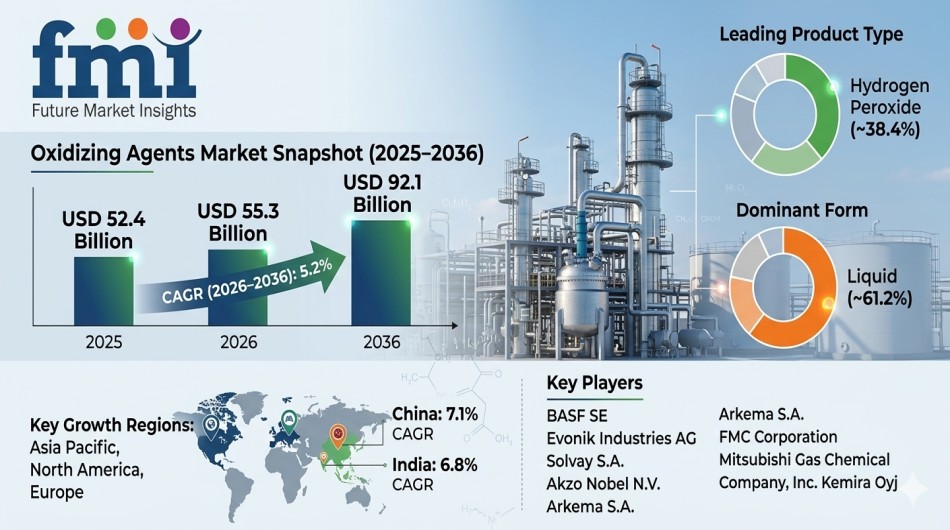
Oxidizing Agents Market Snapshot (2025-2036)
Market size in 2025: USD 52.4 billion
Market size in 2026: USD 55.3 billion
Market size in 2036: USD 92.1 billion
CAGR (2026-2036): 5.2%
Leading product type: Hydrogen Peroxide (~38.4% share)
Dominant form: Liquid (~61.2% share)
Key growth regions: Asia Pacific, North America, Europe
Fastest-growing countries: China (7.1% CAGR), India (6.8% CAGR)
Get Access of Report Sample: https://www.futuremarketinsights.com/reports/sample/rep-gb-32280
Market Momentum
The oxidizing agents market is entering a structurally transformative phase driven by tightening environmental regulations. From USD 55.3 billion in 2026, the market advances steadily as industries transition away from halogen-based chemistries toward oxygen-based oxidizers.
By 2030, widespread adoption of advanced oxidation processes in wastewater treatment and pulp bleaching pushes demand significantly higher. Between 2030 and 2036, growth accelerates further as zero-discharge mandates and total-chlorine-free (TCF) standards become standard practice globally. By the end of the forecast period, the market reaches USD 92.1 billion, maintaining a stable 5.2% CAGR.
Why the Market Is Growing
The oxidizing agents market is expanding due to its essential role in enabling clean, residue-free oxidation processes across industrial applications. These chemicals are critical for breaking down complex organic pollutants, disinfecting water, and supporting high-purity chemical synthesis.
Stringent environmental regulations are forcing municipal and industrial operators to eliminate halogenated residues from effluent streams. This is accelerating the shift toward hydrogen peroxide, ozone, and other advanced oxidizing systems that decompose cleanly without generating secondary sludge.
At the same time, pulp and paper manufacturers are transitioning to total-chlorine-free bleaching processes to meet global export standards. In pharmaceuticals, the demand for ultra-pure oxidation processes is driving the adoption of electronic-grade oxidizers.
Technological advancements in dosing automation, sensor calibration, and on-site chemical generation are further enhancing operational efficiency and enabling broader adoption across legacy facilities.
Segment Spotlight
Product Type: Hydrogen Peroxide Leads with ~38.4% Share
Hydrogen peroxide dominates the market due to its clean decomposition into water and oxygen, eliminating downstream remediation costs and simplifying regulatory compliance.
End-use Industry: Paper & Pulp Holds ~29.6% Share
The pulp and paper industry remains the largest consumer, driven by continuous demand for chlorine-free bleaching processes and large-scale chemical consumption.
Form: Liquid Segment Commands ~61.2% Share
Liquid oxidizers lead due to their seamless integration with automated dosing systems, enabling precise control in continuous industrial processes.
Regional Growth: Asia Pacific Leads Global Expansion
Asia Pacific remains the fastest-growing region, driven by strict environmental mandates and rapid industrial upgrades in China and India. Large-scale investments in wastewater treatment and pulp processing infrastructure are accelerating adoption.
North America shows steady growth supported by gradual modernization of municipal water systems, while Europe advances through sustainability-driven regulations and energy-efficient chemical processes.
Drivers, Opportunities, Trends, Challenges
Drivers:
Stringent wastewater discharge regulations
Rising demand for chlorine-free bleaching
Growth in pharmaceutical-grade oxidation processes
Opportunities:
On-site oxidizer generation systems
Sensor-integrated chemical dosing solutions
High-purity specialty oxidizers
Trends:
Shift toward oxygen-based chemistries
Integration of automation and real-time monitoring
Decentralized chemical production models
Challenges:
High capital investment for infrastructure upgrades
Storage and transport complexities for reactive chemicals
Compatibility issues with legacy plant systems
Country Growth Outlook (CAGR 2026-2036)
Country
CAGR
China
7.1%
India
6.8%
Brazil
5.4%
United States
4.2%
Germany
3.9%
Japan
3.5%
United Kingdom
3.2%
Competitive Landscape
The oxidizing agents market is moderately consolidated, with competition centered on production scale, distribution infrastructure, and technological integration. Leading players maintain dominance through established manufacturing networks and specialized logistics systems for handling reactive chemicals.
Companies are increasingly focusing on integrating chemical supply with equipment solutions such as on-site generation units and automated dosing systems. Strategic partnerships and regional distribution networks are critical to maintaining supply continuity and cost efficiency.
Key Players in the Oxidizing Agents Market
BASF SE
Evonik Industries AG
Solvay S.A.
Akzo Nobel N.V.
Arkema S.A.
FMC Corporation
Mitsubishi Gas Chemical Company, Inc.
Kemira Oyj
For an in-depth analysis of evolving formulation trends and to access the complete strategic outlook for the Oxidizing Agents Market through 2036, visit the official report page at: https://www.futuremarketinsights.com/reports/oxidizing-agents-market
Explore More Related Studies Published by FMI Research:
Low-Creep High-Modulus Yarns Market: https://www.futuremarketinsights.com/reports/low-creep-high-modulus-yarns-market
Hydrophobic-Oleophilic Sorbent Fibers Market: https://www.futuremarketinsights.com/reports/hydrophobic-oleophilic-sorbent-fibers-market
Odor-Control Silver & Zinc Ion Fiber Market: https://www.futuremarketinsights.com/reports/odor-control-silver-and-zinc-ion-fiber-market
Recycled Ocean Plastic Performance Textile Fiber Market: https://www.futuremarketinsights.com/reports/recycled-ocean-plastic-performance-textile-fiber-market
Low Yellowing White Technical Yarns Market: https://www.futuremarketinsights.com/reports/low-yellowing-white-technical-yarns-market
About Future Market Insights (FMI)
Future Market Insights (FMI) is a leading provider of market intelligence and consulting services, serving clients in over 150 countries. Headquartered in Delaware, USA, with a global delivery center in India and offices in the UK and UAE, FMI delivers actionable insights to businesses across industries including automotive, technology, consumer products, manufacturing, energy, and chemicals.
An ESOMAR-certified research organization, FMI provides custom and syndicated market reports and consulting services, supporting both Fortune 1,000 companies and SMEs. Its team of 300+ experienced analysts ensures credible, data-driven insights to help clients navigate global markets and identify growth opportunities.
For Press & Corporate Inquiries
Rahul Singh
AVP - Marketing and Growth Strategy
Future Market Insights, Inc.
+91 8600020075
For Sales - [email protected]
For Media - [email protected]
For web - https://www.futuremarketinsights.com/
SOURCE: Future Market Insights, Inc.